
Another Night, Another Dog by Itto and Mekiya Outini
Another Night, Another Dog by Itto and Mekiya Outini
On the steps of the police station, a man in black struggles in silence against his umbrella. Sepia falls from a sodium bulb, but the man’s mind is elsewhere, his fingers dulled to nonexistence by the cold, and the little metal clasp he’s looking for eludes him. He fumbles and fumbles. Eventually, he gets it folded. He winds the strap around the canvas. Then, briefly and imperfectly satisfied, he stands on the steps as clouds puff from his mouth in a ghostly procession, condensing in his salt and pepper beard. Snowfall turns the tableau grainy, giving it all the character of a poor connection, as if what’s needed is one good, hard thump, and all will be made clear.
Suddenly, as if recalling something, he lopes up the steps and throws his weight against the revolving door. The lobby is empty except for a blank-faced guard, who runs a scanner over him and impounds his umbrella, and one woman, black, sturdy, encased in a box of presumably bullet-proof glass, ashy-miened in the glow of an unseen screen. He does not respect or even know her, but he gropes about until he finds a morsel of regard, inspired in him by a certain detective, now retired, who almost caught him once. This, he brings over and applies to the woman as if transferring cash between bank accounts.
Her eyes say, Can I help you?
“Joel Breytenbach,” he says.
What about him?
“I’d like to see him.”
He shows his ID, inscribed with the same name: Breytenbach. She scans it with her eyes and then with a machine, hammers out a tune on her keyboard, and returns the ID. Unburdened, her chair releases a pneumatic moan.
The visiting room is not even as wide as the hall. On a stool, facing the portal that used to be glass and is now a screen, Breytenbach rests without ease. Soon enough, Joel materializes in digital purgatory. It appears to be snowing there, too. He is asymmetry incarnate, head shaggy on one side, shaven on the other. Metal rings loop through his lips and his nose. When he speaks, he sounds congested, as if his conscience crawled up into his nasal cavity and died there.
“What do you want, Dad?”
“There’s something wrong with you,” Breytenbach says. How much is he going to say? he wonders. Here? Where they can hear him? And how much has he said already? And even if he doesn’t talk, is there not more than one kind of talking?
“I told you what I want,” says Joel. “It’s your turn.”
Breytenbach’s eyes, and his brows, and the cut of his shoulders—all say, I believe I have made myself clear.
“You only ever tell me what you don’t want,” Joel says. “What am I supposed to do with don’t and can’t? You can’t make nothing out of pure negation.”
Now Breytenbach does speak, his voice like gravel mixed with black mud: “Only six of the ten commandments.”
“Honor thy father and mother,” Joel says, his voice metallic, strained. “Honor thy father and mother. Honor thy father and mother.” He repeats it several more times. Then falls silent.
Jesus, thinks Breytenbach. The kid’s out of his mind. He transfers the receiver to his left ear. The stool is too small for his buttocks, too unforgiving. He’s feeling his age in his back and his brain. He asks, “Is this what your mother deserves?”
“There’s a tribe,” says Joel, “down in the Amazon. I read about them. Somewhere in the Amazon. They kill their women. When they get too old, when they can’t keep up with life anymore, they sneak up behind them with a rock, a machete, and they bash their heads in. And then the kids, the hunters, when they come of age—my age—they brag about it. Yeah. About killing old women.”
“Don’t believe everything you read.”
“There it is again,” Joel says. “There’s that don’t. Don’t this. Don’t that. Why don’t you tell me, Dad—since you know—what should I believe?”
“Do you think I’m here to bail you out?” asks Breytenbach. “Do you think you’re coming home tonight?”
“I think Mom would want to see me,” Joel says slyly.
“Your mother does not want to see you,” says Breytenbach. “Your mother wants what’s best for you—which, tonight, is to stay there, in that cell, reflecting on how actions have consequences. You could’ve killed someone. Could’ve been killed. You’re lucky it was just a dog. You never know who keeps a gun.”
Joel’s discontent churns in the depths of his sinuses.
“You think you’re clever?” Breytenbach goes on. “You think you’re the only one who reads? How about Sparta. Do you know about Sparta? Do you know how they handled their thieves?”
“They beat them,” Joel says, but he sounds like he’s guessing.
“They kept their boys hungry,” says Breytenbach. “You know why? So they would steal food. No Spartan ever was punished for stealing. To be caught was the crime. The whole crime. And yes, he might get beaten, he might get a fine, or he might just get killed, but the point wasn’t what, it was how. But you, Joel—you’ve always had food on your table. I put food on your table. You never went hungry.”
“Why couldn’t you just let me write the damn stories?”
“Do you think you could’ve killed her?” Breytenbach demands.
“All I killed was a dog.”
“You never knew there was a dog.”
“I’m just like you.” A strange, cracked smile plays on Joel’s lips. “I just kill dogs.”
“You’re not like me,” says Breytenbach. “You don’t have a license.”
“License to kill,” says Joel, still with that strange, asymmetrical, unsettling smile.
“License to heal,” says Breytenbach. “License to save. License to prescribe. To vaccinate. To do a lot of things. License to put food on the table. Your table. Don’t forget that. You don’t put food on your own table. You’ve got no troubles of your own besides what you make for yourself. I’d like to think you weren’t ready to kill that old woman, but what I think makes very little difference here. You better be grateful to that dog.”
“Damn thing bit me.”
“If I were it,” says Breytenbach, “I would, too.”
“About took my foot off.”
“About. Be grateful.”
“If you didn’t come to bail me out,” says Joel, “what did you come for?”
“Can’t a father have a little heart-to-heart his son?”
“It’s Ma,” Joel says, “isn’t it? She sent you. Didn’t she send you? She does want to see me. But you wouldn’t let her.”
“You’re wrong.” Back to his right ear, he shifts the phone. She’s standing over him—not there, in the visiting room, but in the dining nook, really just the corner of the kitchen where the table stands on four legs, and the mug of coffee on the table, and she at his back. These days, he drinks coffee whenever he feels like it. He sleeps when he needs to, wakes up when he needs to.
“Your son,” she said, holding the phone.
Searching for her face reflected in the windowpane, black and etched with swirling snow, he found his own: gaunt, well made for squeezing through tight spaces, where he finds himself once in a while, three-quarters hidden by that salt-and-pepper beard. He possesses something like a temper, but it never shows except for in his fists, rarely used but always clenching. He’s pretty sure he read somewhere that God made men the heads of households because women are too partial to their own, and men must serve as diplomats, protecting neighbors, reining in wives. He sometimes feels that this is true. All the rest in those old books is little use to him, but this piece has some merit.
“What about him?” His words went out like little boats across the blackness of the coffee.
“He’s done got himself caught.” She’s a stern, handsome woman, built for standing her ground, even now, going gray.
“Caught?”
“In some old woman’s house.”
“Jesus.” Breytenbach reached for the phone.
“Your mother’s not the one you need to see,” he says now, watching the screen as intently as if it’s a face, or a window. How can I get across to him, he wonders, that he’s still got a chance to choose: either he shoulders the burden, or it’s his mother who’s the reason that he’s here. The woman whom you gave to be with me, he thinks, she gave me the fruit of the tree, and I ate; and he smirks at himself, and he cringes.
“She would bail me out,” Joel says.
“Maybe that’s why she’s not here.”
“She was fine with the stories,” Joel says. “She never said nothing. Never even asked if I was going to post them. By the way, I never was.”
“Sooner or later,” says Breytenbach, “you’ll have a family of your own. If you’re going to spend time writing stories, you might as well get paid. What I’m saying is, if you’re going to write, you might as well be Stephen King. And if you’re not planning to be Stephen King, if you don’t intend them for public consumption—”
“You said, ‘do something with your hands,’” says Joel. “You never said what.” There’s that smile again, strange and cracked and crooked. Awful. “I did,” he says. “I did do something with my hands. I did what you told me, Dad. Just what you told me. I did do something with my hands.”
“Is this what your mother deserves?” asks Breytenbach. “You realize that you’re tearing up her heart.”
“She shouldn’t be sorry,” Joel murmurs. “I am what I am.”
Goddamn it, thinks Breytenbach. That’s all they teach in school these days. Be yourself. Authentic. Pure. Whatever happened to the honor of will? Of becoming? Isn’t the made self that much nobler than the found one? Isn’t the remade self better still? Damn dog took too little. If I could have it on my table now, I’d stick the needle in somewhere it shouldn’t go. Or maybe I’d pull a Paul Lazzaro: feed the damn thing mincemeat laced with razorblades.
“You could’ve learned plumbing,” he says. “Electricians make good money. Hell, you could’ve taken up building fences. Everyone needs fences.”
“I was trying to put a fence around it,” Joel says.
“Around what?”
“You know what.”
This isn’t safe, thinks Breytenbach. Leverage is needed. Better to bail him out, maybe, if only to buy a little time, to find out what he knows. But what good would that do? Money would still be needed. There’d still be a hearing.
“How come you didn’t take up building fences?” asks Joel. “If everyone needs them?”
“I took up what I’m good at,” says Breytenbach mechanically—the same answer he’d have given if he took the time to think, although he didn’t.
“Me, too.”
“Clearly not.”
“Not this.” Joel captures his captivity with a vague gesticulation. “The stories.”
Take some ownership, thinks Breytenbach, why don’t you? Call them mine. My stories. With the as their anchor, they’re free-floating, bobbing around in the ethers with zero affiliations. They could glom on to anyone, like some kind of poison bur: the first and unluckiest man. Aloud, he says, “You’re wrong.”
“I’m not.”
“What made the great writers great, do you think?” he demands. “Was it just being born? Or did they have to work? Did they have to ask themselves, every day, every hour, what good is this story? Why this one? Why does it need telling—and does it? Is it edifying? Is anyone better off for it?”
“I am.”
“This I am what I am shit they’re feeding you nowadays—”
“I was, I mean.”
“You were what?”
“Better off,” Joel says.
“Bullshit. You were titillated. Pull out your dick if that’s what you’re after. At least that can be done in private. Once you start putting shit out in the world—”
“I was trying to put a fence around it.”
“Do you think I’m going to testify for the defense?” asks Breytenbach. “Do you think I’ll tell them you were good? You’re not good. You are not my son. You wrote down what you were fixing to do. Then you did it.”
“If you’d let me—”
“Let you? Let you what? Let you spread your latent criminality all over the goddamn internet? Write manifestos?”
“Not manifestos.”
“What, then?”
“I was trying to put a fence around it.”
“If you were building fences,” says Breytenbach, “then you’d be keeping out what’s out, and in what’s in. If you were a plumber, a builder, an electrician, you’d be making the world a little more livable. Isn’t that a calling? Even writers can improve things. Books can make things better, can uplift and enlighten—the right books. But they’ve got to be the right ones. Inspiring. Edifying. Not stories of breaking into old women’s houses and murdering. Jesus. What’s wrong with you?”
“I was trying,” says Joel. “I was trying to keep in what’s in.”
“And how’d it get in there?” roars Breytenbach. “How’d it get—” But then he silences himself. “No. Don’t answer.”
“I don’t know.”
Static leaks in from somewhere, scrabbling animal claws in his ear. Eventually, he says, “You don’t know.”
“How the hell am I supposed to?” Joel sounds beaten-down and mournful, though on the screen, he looks unchanged: still like a punk rocker lost by the band. In a mealy and worm-eaten voice, he appends, “But I am what I am.”
“You don’t know,” Breytenbach echoes once more.
“You want me to say something different?” Joel’s eyes swing up to meet the camera from beneath his murderous brow.
“The truth tends to be the best policy,” Breytenbach says. “In these situations.”
Joel’s eyes fall away, into the abyss.
“Listen,” Breytenbach says. “We’ll see about bail. We’ll see. Your mother and I want what’s best for you. Sometimes, what’s best has an unpleasant flavor. If you can’t control yourself, if your impulses are too much for even you, it may be best for you to stay confined.”
“I was,” Joel says.
“Was what?”
“Was trying to control myself.”
Breytenbach says nothing.
“Do you understand?”
“No,” says Breytenbach, although he does. At least a little bit, he does.
“As long as I was writing it,” Joel says, “I didn’t have to do it. As long as I was writing, even to myself, it was as good as doing. Better. I wasn’t writing for anyone, Dad. Just me. And those old women. And I wasn’t going to post them. And I was going to get a job. But you, Dad, you said, ‘Do something with your hands.’”
“Something,” Breytenbach says.
“And you’re not going to help me now,” says Joel. And it is not a question.
“Help can mean lot of things,” says Breytenbach. “Your mother sends her love.”
& & &
It’s still snowing, but Breytenbach forgoes the fumble. Through the almighty’s dandruff, he trudges along, head down, umbrella folded. He came on foot because cars can careen off the road, can get stuck in the freezing mud, can fishtail, whereas feet can always be wrenched from boots and carry on. The town’s compact, not like the snow- and corn- and oil-fields spread all around. Breytenbach’s house is out there somewhere, a small, lighted dot in the darkness, unmoored from its constellation, and in it, his wife, and beside her, temptation; but his destination is another building, low-slung, on the edge of town—the veterinary hospital.
The alarm allows him thirty seconds to disarm it, which he does. In his office, there’s a Keurig. At his behest, the machine begins its quiet gurgle. Steam blooms from the mug. Breath blooms white in the cold.
If he only shot it in the shoulder, he thinks, instead of in the head, it would be here. In this building. Laid out on the operating table down the hall. He might’ve picked up that emergency call before the other one came from the station.
What kind of idiot shoots a dog?
He used to carry, more as a talisman than as a tool, a needle dosed with pentobarbital; but he always knew if there were dogs and never went ahead with it unless they were familiar with him, which they sometimes were, and unless he knew they liked him, which was rarer.
But it would’ve been a damn fool thing to do, to use that pentobarbital. It would’ve been a calling card. It’s not every burglar that carries pentobarbital.
He takes his coffee down the hall, lets himself into the operating room, and hoists his ass up on the lip of the table. It bites cold through his jeans. He sits there for a while, sipping. The coffee tastes of much besides itself, and of itself, but little.
Into his mind comes a thought, four-cornered yet somehow improperly formed: I have never really been my own. Two things have ridden me—your mother, and temptation—but what’s riding you? You, who’ve always had food on your table? Who’ve never known debt, responsibility, or love?
Who told you that you were naked?
He squeezes his eyes shut. On the roof, he can almost hear the snow accumulating. If he were to drip it now into his coffee…but what is a human dose? How many milligrams? And besides, what’s the point, if all that dies is him, and love and filial respect for him…because there is no other kind? With her, it’s not respect. It is remorseless infatuation with all that ought to have been left asleep in him.
She was fine with the stories.
She was fine with his sincere expression of his inner self, no matter how unscrupulous, as long as it was the found self, the true self—and as long as it was she who did the finding. She was the wife so many would’ve dreamed of, even he—but that’s why dreamless sleep is sometimes necessary.
But if he does it, then what of his son? Poor, hapless, imbecilic fruit of his loins, caught in a cycle too big for his understanding, unwittingly keeping alive all that’s been put to death in his father, breaking and entering, taking silver and leaving lead—murdering. Those cases flickered out some years ago, but now the flame has been rekindled, that a new generation may rise; and if the thieves are less competent nowadays, then so are those who pursue them. The new sleuths, all too proud to apprehend the idiot who shot the dog, will divvy up their unearned gains, and the old, the ones who almost caught the thief who carried duct tape for his killings, never even had to use his pentobarbital, will be left to their ravaging ossifications, unwept, un-honored, and unsung.
Stiff as an unoiled bicycle chain, Breytenbach eases back onto the table. So, he thinks, gazing up at the fluorescent panels, this is what it means to be the animal in need of mending. This is what it means.
Perhaps, come morning, he’ll wake to find himself besieged, a thin blue line encircling the clinic, voices calling through bullhorns for him to come out with his hands up, making silly demands. Once, almost captured, he rode a high crest of exhilaration, from which it took something like months to come down, but this time, if he’d captured, it will be serendipity, by happenstance alone. By his son’s impulsive ignorance, he will be ransomed. There’s to be no merit in the thing at all.
What good can still come of this evening? The exoneration of his son is off the table, as it should be, but his own is not ordained. Is the past not still alive? And can’t a worthy man still triumph? With a little help—but who gets by without a little help? And isn’t there a phonebook in here somewhere? And doesn’t that detective have a number? And a name?
He grinds his knucklebones into his eyes, and when he takes them away, the fireworks scatter, and the green stars explode, and the name is there, caught in the net of his mind: the name of the rightful steward of that morsel of regard.
In their sterile banality, the cabinets and countertops sparkle and cringe. The vast majority of the deaths he’s ever wrought are stacked up here, on one side, and all the lives he’s ever saved are stacked up on the other, and the weight of the crossbar grinds down on his shoulders; and he sees what must be done to balance things, to straighten what has become crooked.
He gets up off the table. Wraithlike, he creeps out and down the hall, back toward his office: toward the phone.
* * * * THE END * * * *
Copyright Itto and Mekiya Outini 2025
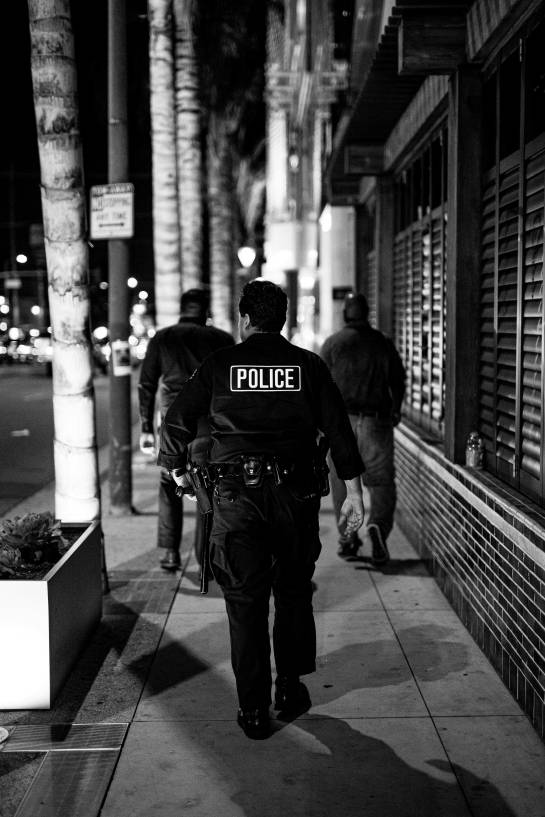
Image Source: Andrew Valdivia from Unsplash.com




A highly unexpected ending to a terse, dark narrative of crime. Something that Joel said to his father early on made me wonder if the father killed other than just his victims’ pets. It also goes unexplained why a vet with one child must lower himself to burglary, when his vocation is so profitable. A deep-seated need to further exploit those he victimizes? How much did Joel know about his father’s misdeeds? And how much did his mother know. A lot of questions, but I like it that way. Spellbindingly tense.