
The Canyon of the Colorado by James T. Siburt
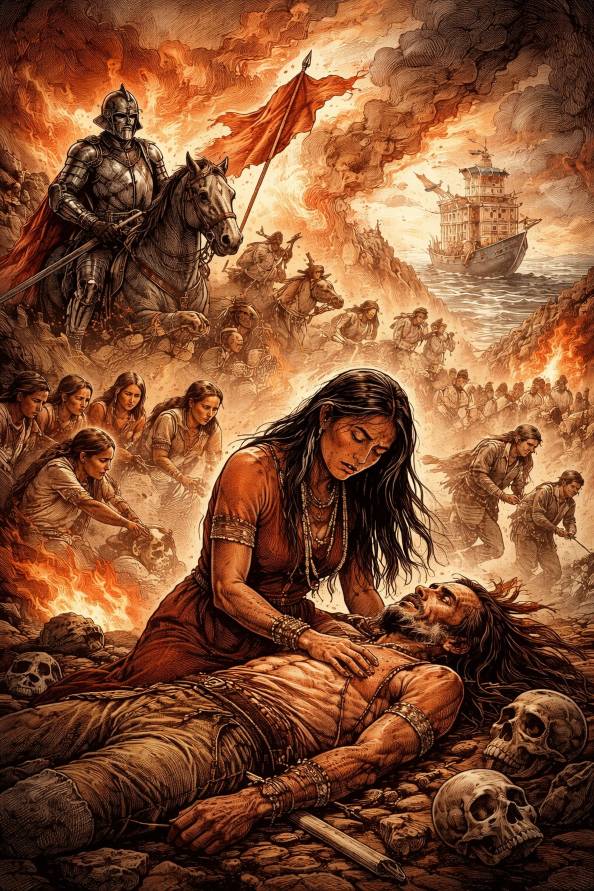
Publisher’s Note and Disclaimer:
This work is a piece of historical fiction and reflects the perspectives, language, and creative interpretations of the author alone. It portrays historical attitudes, events, and cultural viewpoints that may differ from contemporary values. The publisher does not endorse the views expressed and assumes no responsibility or liability for the content herein. Readers who wish to raise concerns about specific passages are invited to contact the publisher for review and discussion.
The Canyon of the Colorado by James T. Siburt
The years had taken a toll on the elderly man who sat in the serene quiet of his Mexico City hacienda. A gentle breeze brought scents of the lime groves through the screened windows of his study, and the trees marched away for a considerable distance. The room, lit by wall scones and a brass candelabra, featured a desk, two rattan chairs and a cowhide settee, all of a light wood. A plush carpet of Moroccan origin, red and gold in color, covered the floor. On the writing table lay many sheets of writing paper, an ink well, and a well-used quill. Looking at the manuscript he produced a weary smile, divided between relief at finishing his task, and of the memories the composition recalled to life.
He’d been a tall man in his younger days, but now he was stoop shouldered and white haired. He had what the young feared, a wizened, aged look, features seamed with countless lines and crevasses. His skin was a dried parchment, testament to many years of living and working out of doors; scorched by the sun and weathered by the wind. Aching joints, a condition caused by stoop labor and long periods of exposure in all sorts of inclement weather plagued him, and he experienced dyspepsia from too many occurrences in his youth of having to eat unhealthy food and drink barely potable water. Beneath the cotton shirt and breeches lay faded scars, purplish and puckered, vestiges of battle wounds, combats only a few still remembered. He’d led a soldier’s life for a time, some of it as a conquistador with Coronado.
Standing, he stretched for a moment, then slumped into one of the rattan chairs and called for his house servant to bring him a glass of Tempranillo. She brought it, and he asked her to fetch the manuscript, scanning the first page as he sipped the red wine. “I think about the old country more and more as my time grows less and less,” he murmured. “If it hadn’t been for the Italian War of 1536, I doubt I’d ever have come here. Strange that I remember that time so well, when I sometimes can’t recall what I ate for supper the night before.”
My name is Roberto Rijo, the narrative began; I was born on the family farm just outside the city of Seville, Spain. We had a dairy, raised crops, including some wine grapes, and sold at market the surplus above our consumption. It was a large family, many brothers and sisters; I was the eldest.
My father presumed that one day I would succeed him in running the place. Perhaps it was his dream, it wasn’t mine. Every day, almost from the time I could walk, was the same: milking, shoveling horse and cow dung, hoeing and weeding in the gardens, backbreaking harvest labor in the autumn, and, as I grew, helping with the spring planting, a task best described as sweating and straining behind a plow while looking at the ass end of an animal that was sure to piss or shit right where your feet would land next. Even that was better than listening to my father’s criticisms or feel the lash of his whip.
Right before my fifteenth birthday I ran away. Tired of him telling me that the world would discipline me if I didn’t heed his oft-repeated warnings, I went to Seville but fearing he’d find me soon continued on to Antequera. It wasn’t until years later I learned he made little effort in that regard. After a couple of days roaming about the city he returned home, said that my name was never to be mentioned again, and turned his full attention to molding his second son in his image. I was on my own and have been ever since.
For a short period I lived on Antequera’s streets and came close to starving. Fortunately, before I perished from want or being knifed in my sleep, a cantina owner gave me a job that included food and a corner of the back room for a bed. It was there my life changed. A late night brawl broke out between two groups of men, and I saved one of them by laying a cudgel alongside the head of a cowardly dog that was about to bury a dagger in his back. He was the leader of a band of mercenary soldiers. Restless again from the wanderlust that possessed me at that age, and not knowing better, I accepted his offer of employment.
The men called their captain, Hernando. He appeared kind when we met, turning into an utter bastard in camp, on the march and in battle. We were never out of discipline, the thing I’d always longed to avoid but needed most. If I thought taking orders from father was rough, I had a rude awakening.
I was being marched until my feet blistered and my legs felt like wooden blocks. We slept outside in all kinds of weather, and food failed to appeal in quality or appear in quantity. Hernando replaced my father’s whip with a club containing very hard wood, yet, unlike the lash, didn’t give warning when it descended on you. When you weren’t marching or drilling, there were dozens of distasteful duties, such as emptying chamber pots for example, that reminded the recruit he was not yet on the level of his companions. Being a soldier was worse than a farmer; who could have guessed?
I trained with the pike, a pole arm weapon about five meters long, quite heavy to manage, with a spearhead at the end. Pikemen operated as infantry, in tight formations, rank upon rank of iron points thrusting at the enemy. It was effective against cavalry charges and was effective on the attack as long as the shoulder-to-shoulder formation stayed together. For someone like me, though, being hemmed in on all sides with no means of maneuver or escape was frightening. Therefore, it was a happy day when Hernando offered me a chance to join the musketeers.
The musket was a recent weapon. Nowadays they are lighter, and musketeers are replacing pikemen in the empire’s armies. Then, it was so heavy that you had to use a forked rest to steady the barrel. The bore caliber was .60 or more, and the recoil often spoiled the aim of inexperienced soldiers. You had to be a vigorous man to use it, but I’d always been big for my age, and a life of continuous toil had put muscle on my frame. By itself that wasn’t enough. It was a complex piece to master; you needed a good eye for distance, be able to read the wind, and remain calm and precise under the stress of battle. I took to the musket like a duck takes to water.
It was fortunate that Rodrigo Valdez conducted my training as a musketeer. Barrel chested and broad shouldered, he was taciturn until he appeared on the drilling ground. There, his eyes blazed with intensity and his voice boomed at the slightest error. For endless days he led us through the manual of arms, searching for increasing competence, ever warning us that failure to master our weapon would result in grievous injury or death. Many didn’t meet his standard and found themselves returned to the ranks of pikemen.
The rest of us got to where we could load and be ready to discharge the weapon in twenty seconds, without thinking about the process. So ingrained was the drill that your hands moved automatically. From calculating the proper amount of regular powder to charge the gun, to measuring fine powder to prime the musket, to ramming powder, ball and wadding down with the barrel without breaking the wooden ramrod, to making sure the slow match didn’t prematurely ignite the powder, yet making certain it continued to glow, there was a lot to do at the same time. Added to that was heeding your officers commands to fire and maneuver.
Most musketeers I’ve known could only hit a target a few pike lengths away. Thanks to Valdez, I became effective at seventy-five meters, sometimes finding my range at a hundred or more. “Don’t be afraid of the match,” I can recall him roaring, “you will not get burned. Keep that butt square against your shoulder and your eyes on the target. You can’t hit anything looking away. One would think the physician was about to lance a boil on your nutmegs. What in heaven are you quaking about when you fire, the noise, and the recoil? Better to be giving than receiving! What are you going to do when you’re in the heat of battle, taking fire from the enemy, having dead and wounded comrades lying at your feet, with shouts and screams in your ears?”
I finished my training in 1535, and for a year lived on the largesse of King Charles V. He continued to pay us out of fear we would become brigands, roaming about the country raping and pillaging. The next year, though, the king renewed a long running argument he had with the French, and soon a war was underway in Italy. I was in an army that invaded France. Initially we had success but eventually withdrew across the Pyrenees. The Frogs, bolstered by a treacherous alliance with the Ottomans, increasingly beleaguered King Charles, and he concluded a peace in 1538.
It was a time of intense unease for me. I was now a veteran musketeer, but my circumstances weren’t the same. Hernando was dead, killed in a skirmish, and without him our unit dissolved in the treaty’s aftermath. Experienced in battle, with a record of excellent performance, I expected I would be in demand should hostilities resume; but what good is a soldier in time of peace? I continued to drill and prepare yet had to confront sobering reality. I had no home, no wife, no family, no employment and no prospects. In the winter of 1539, I learned of an expedition heading to New Spain.
My companions, Jose DeLeon and Enrique Romo, agreed to join me. The following spring we boarded the Maria at Malaga and embarked for the Americas. I watched the coastline until it decreased to a pinpoint and finally disappeared. It was the last glimpse of my homeland.
The journey was horrendous. Storms wracked the voyage, and the experience was so disagreeable that I’ve never wished to go to sea again. For days, wind driven gray rollers advanced on the ships, leaving the decks awash in white spume, soaking all onboard with a seawater bath that soon had all suffering with boils. The gales scattered the ships, some of them never to arrive, and many of us landsmen, myself included, spent so much time retching and vomiting in the scuppers that we knew moments when we didn’t care if we sank or not. The sailors, when they weren’t busy striving to keep the ship afloat, enjoyed our misery, the bastards! It was with great rejoicing that we arrived in June at the port of Veracruz.
The port city was teeming with wharf side warehouses, and the ships disgorged tons of provisions into to them. Adjacent to these buildings were chandlers, counting houses and various other businesses. Near to these places, down the meaner, darker side streets were taverns and brothels. A lot of listening and a few discrete questions in some of these wine shops, places where only abominably bitter vintages were available, got us work guarding mule trains hauling supplies to the capital. Bandits infested the mountainous, jungle bordered roads, and occasionally we had sharp fights with them.
By my count we made three round trips from Veracruz to Mexico City, each trip lasting six weeks. During the last trip a group of cutthroats, Spanish deserters and a few local tribesmen, ambushed us twenty miles from our destination. For a few harried moments it appeared they might overrun us, but unknown to them the wagon master had us concealed in the wagons. A close range musket volley killed three of their number and then we were bounding out of the canvas-covered enclosures with sword and pistol in hand. When it was over we’d shot down two more, and our blades were bright with the blood of those we caught. Them who outdistanced us heard our exultant shouts of victory as they fled headlong into the tangle of forest.
Stories of this exploit, embellished by the wagon master, and I confess, by ourselves, bought us some drinks and notoriety during the week that followed. We were about to quit the city for the return trek to Veracruz when a servant from one of the great haciendas in the city called at our quarters and requested we accompany him.
The Moreno estate, situated on high ground, was luxurious compared to most residences, perhaps only exceeded by that of the Viceroy. Two stories, a colonnaded veranda, upstairs balconies with screened windows that allowed refreshing breezes to sweep through the rooms, it was a world apart from our cramped, fetid lodgings. The family was a noble one and the patriarch, wishing to establish a worthy reputation for his caballero son, planned to send him on expedition with Francisco Vazquez de Coronado. Supposedly, there were cities to the north, in an area called Cibola, where Europeans had never been. Rumor alleged they contained fabulous wealth, predominantly gold.
Senor Moreno wanted a group of men to enhance his son’s status, and to be bodyguards for the inexperienced boy. He offered us clothes, armor, new muskets, and pay superior to what we were receiving to escort the supply trains. Influencing us most was the prospect of receiving a share of the treasure. Moreno even provided mounts, and for the first time we went on campaign without having to march.
A Franciscan monk claimed to have seen at a distance a fabulous city, or perhaps an entire region, awash in riches. Referred to as the Seven Cities of Cibola, it was, some thought, a refuge for Christian bishops who’d escaped from Muslim invaders in 7th century Spain. Taking their wealth with them, they’d crossed the ocean to establish an enclave in the New World. On hearing this news, Coronado and Viceroy Mendoza mobilized men and supplies. By February 1540 we were far to the northwest, in the frontier town of Compostela.
Compostela was a dusty, miserable place, and when our column marched away the clouds of powdery earth coated everyone in grime. Over two hundred horsemen led the way, about half of whom had chainmail or plate armor. Foot soldiers numbered sixty-seven, with me, Enrique and Jose among the five having mounts. There were twenty-one musketeers, ourselves included, and sixteen others carried the Genoese style crossbows. The rest had swords or halberds and, regardless of his weapon, everyman had a personal dagger or stiletto. Thanks to Senor Moreno, we all had leather jackets, only worn in combat, quilted cotton jackets and burgonet helmets.
The vast majority of this unwieldy cavalcade weren’t soldiers. In front of us were several Franciscan friars, there to convert the heathen tribes we would encounter. Personal servants accompanied their masters, Moreno’s son had two, and dozens of grooms were along to tend to the horses. Besides them were hundreds of Indians and a considerable number of women. While most of them were wives or consorts, some were camp followers. At the rear of the column came cattle and sheep to feed the marchers.
We tramped to the west for some days before pivoting northward. Every evening, thankful to be riding on campaign for the first time, we tended our mounts before looking to ourselves. Senor Moreno, we observed, was lazy, and soon, according to our promise to look after him, we tended his animal as well. Conversely, he wasn’t dilatory in sword practice. He drilled every morning, and after watching him I decided he wasn’t a person I wanted for a foe. Over time, many of these young gentlemen learned the value of mundane labor; it was imperative to their survival.
Our march led us along a road where a chain of outposts lay, then we were in unfamiliar country. Some caballeros had come loaded down with baggage they didn’t need, and soon it lay discarded in the ditches. Being veterans, we’d brought only the necessities, yet we were glad to obtain several wooden canteens. The extra water we carried with us was often more valuable than gold.
After marching through a valley Coronado named Sonora, we reached a river that flowed north. From here Coronado led a detachment, including most of us musketeers, through a rough, broken country of tall peaks, cliffs and steep canyons. We traveled through a pine forest and, when we were getting near desperate for water, the Franciscan monk, Fray de Niza, whose claim of a golden city launched this expedition, brought us to the site. I’ll never forget that day as long as I live.
We ascended a ridge, and before our eyes lay the pueblo of Hawikuh. There wasn’t the slightest gleam of precious metal to be seen. Coronado remained stoic in that moment but many of his captains cursed Fray de Niza as an infamous liar for his exaggeration of this place, adobe structures with a defense wall surrounding it, as a paradise of riches. Ordered out of camp a short while later, he returned to Mexico City in disgrace.
Coronado now labored with his intense disappointment and, likewise, what to do next. We were four months gone from Compostela and had nothing to show for our efforts but weariness, sunburn and lice. It was there that I first ran afoul of the monk, Ramirez.
There were six Franciscans with us: Fray de Niza who brought us to this barren waste, four others to convert the tribal people, and Ramirez. A zealot, his singular aim, it seemed, was to root out and see punished every transgression committed by members of the expedition. It wasn’t long before he decided I’d fallen short of the glory of God. Late on a Sabbath evening, when Enrique and Jose were off gathering firewood, he confronted me about it.
He stalked into our near empty campsite, finding me naked. I’d spent much of the afternoon seeing to my weapons and gear and was now engaged in the grim business of killing every louse residing in my clothing. With a satisfying pop I’d just crushed another when his shadow fell across me. “I noted your absence at services today,” he stated with an accusatory hiss, “do you not believe you require your Father’s blessing, or intercession for your sins?”
I was no more of a sinner or irreligious than anybody else in our group, save the Holy Father’s. Sprinkled at birth, I attended mass growing up and went to confession. This didn’t qualify me as a saint, yet it shouldn’t have singled me out for maltreatment either. “It’s probable Governor Coronado intends to attack this village, perhaps tomorrow even. I must prepare for that.”
“You might die tomorrow, and should have been at Mass, on your knees, seeking his divine protection and seeking absolution.”
Ramirez’s presence and his criticism made me uncomfortable. “Father,” I replied, squashing another louse, “I think God favors soldiers who keep their muskets clean and their powder dry. I think he favors those who make certain their match cords stay lit, and when they fire their weapons they aim low. I think he favors soldiers who keep water in their canteens and husband their rations. And to the extent possible, I believe he favors soldiers who keep themselves as clean as is possible.”
Ramirez’s face trembled with anger but there was a glint of excitement in his eyes, and this made me even more uneasy. “You’re a mocker and a blasphemer! You convict yourself out of your own mouth as an apostate, content to put your faith in man instead of God.”
He was about to issue another denunciation, when I rose to my feet and he realized my sword was within easy reach. Looking about, he glimpsed my companions emerging from the woods; their presence caused him to scurry away with many a backward glance. “What was he doing here?” Jose asked with distaste as he put down his armload of kindling.
“It appears he’s unhappy I missed mass. If you two weren’t there, he’s not happy with you either.”
“Just that?”
“I don’t know for sure, but we’d better be on the lookout for him. He may be one of those people that enjoy denouncing people to the Inquisition. If we get back to Mexico City he could bring charges against us.”
“Then,” Enrique said with resolution,” we’ll make sure he doesn’t get the chance.”
My declaration to Ramirez that Coronado was going to attack the Hawikuh town was speculation, a soldier’s instinct told me he’d do nothing less. He couldn’t come all this way, after committing so much of his wife’s fortune, and go home empty handed; not yet. This was the best location available to establish a base, which he needed to send out search parties for the golden cities. The inhabitants seemed hostile, and he didn’t try to pacify them. Two days later, at dawn, we advanced on the outer wall.
Unlike the normal Spanish tercio, a tightly packed phalanx of pikemen, we went forward in a more open order, Coronado and his swordsmen in the middle, with the musketeers and crossbowmen guarding the flanks. The commander’s armor gleamed in the risen sun, and this made him an attractive target. Moreno was in this group but there wasn’t anything we could do to help him now. We had our own lives to look after.
Coronado’s plan was for him and his swordsmen to get beneath the walls as rapidly as possible, then force a way through the narrow entrance gate that centered the town. He lacked scaling ladders or materials to construct them. Our job was to sweep resistance from the ramparts and keep the defenders from hurling rocks or arrows down on compadres below. This strategy went awry almost at once.
We musketeers deployed on the right, about thirty meters from the wall, and sighted our guns. On the left were the bowmen with weapons cocked and ready. As the swordsmen neared the barrier, heads sprouted above the palisade and boulders showered down on them. Some of the defenders, using the weapon David employed to best Goliath, hurled smaller stones and other bits of metal into their midst. Stunned by this assault, our men raced for the battlement and cowered in the doubtful shelter of its base.
The initial volley of our musketry astounded the enemy. Spotting a warrior raising a large rock above his head, I squeezed the trigger, felt the butt slam against my shoulder, and the target dissolved in a cloud of acrid smoke. When the burnt powder cleared, the man’s body lay slumped over the rampart, crimson streaming from beneath his form. By that time, I’d moved to the rear and was reloading while another rank advanced and fired. The thud of the reports, the crashing sound of rocks striking armor, the hideous war cries of our foes, and the screams of the wounded combined to create a hellish din that I can still hear.
Combat can take on a chaotic rhythm while one is engaged, it disorients sense of time. Short, savage intervals can seem endless and unendurable, while others are so hectic it amazes the soldier he’s fought so long. Load, wait for the Captain to bellow the order to advance, sight the weapon and fire, followed by a quick backward movement; we performed it repeatedly, two shots every minute. My musket fouled and the barrel became too hot to touch. Without a thought, I snatched up the gun of my friend Diego, who lay on his back, dazed by a stone that dented his helmet. I was too busy to notice when they carried Coronado from the field, felled by a rock hurled from the battlements.
The number of defenders showing themselves on the wall declined. Some, caught by musket balls, pitched headlong from their perches and struck the ground with a crash, others reeled backwards and disappeared. I sighted on one large warrior and was about to pull the trigger when a crossbow bolt pierced his chest. The impact cartwheeled him away from my view. Our swordsmen, now relieved from the volume of projectiles raining on them, rallied themselves and forced the gate in a flash of steel and triumphant shouts. Once inside, the wall defenders abandoned their posts, and we made a run for the enclosure. By the time I passed through the gate, the massacre was already underway.
Enraged by their losses and filled with the lust of battle, the noblemen pursued the defenders relentlessly. The rest of us deployed in their support, seldom taking a shot as friends and foes intermixed. The resistance crumbled completely, and our enemy was seized by panic.
When soldiers panic on the battlefield, their deaths are practically assured. A man forgets about defending himself or defending his comrades, no longer obeys orders, and flees as fast as he can. Usually he throws away his weapon so he can run faster. All he can see is the nearest woods, the sky overhead, and the ground as he races over it. This heedless flight makes him insensible to approaching danger and a pursuer easily slaughters him, especially if they’re mounted. The only thing saving his life will be rallying and recovering his composure, reaching safe cover, or the enemy’s bloodlust being sated.
Weariness and the rising heat of the day limited the carnage. However, for some minutes, the swordsmen cleaved, thrust and hacked away at any copper skinned figure in sight until their blades were drenched with gore. The fighting then lessened to small sputters and finally ceased. Sodden with sweat and practically ravened by thirst, we labored the rest of the day to consolidate our position, tend to our wounded, and keep on guard for a counterattack. That night, those of us not assigned to an early guard shift fell out where we lay and slept, boots and all.
Over the next two days a truce was made and Coronado, still recovering from his wounds, secured hostages from the tribal chief to ensure his future cooperation. The younger Moreno, unscathed in his first battle, was buoyant in spirit, yet for us old hands it was merely another hard fight we’d managed to survive, coupled with the nagging question of how long our luck would persist. For now, there were wounds to heal, equipment to clean or repair, supplies to replenish and, hopefully, a few precious days of rest.
Our leader did not permit us to be idle for long. The natives, amply convinced that we eagerly sought an opportunity to kill them for any reason, merited or not, brought forth quantities of bread, maize, and other vegetables, hoping that filling our near empty larders would cause us to depart. Instead, Coronado issued a raft of instructions from his sick bed that sent small parties in all directions to look for Cibola. Jose and I found ourselves assigned to a party of twenty-five, under the command of Captain Don Garcia Lopez de Cardenas. Enrique remained behind with Moreno.
I remember Cardenas as a hardened soldier, a premier horsemen who was as equally gifted with the sword. More than that, he was temperamental, easy to take offense, utterly dismissive of those he considered social or military inferiors. He loved everything about the soldier’s life and was capable of casual brutality when it suited him. But he cared about the welfare of his men, and that endeared them to him.
For three weeks we rode to the west. It was a country of impressive vistas, little water, red rocks, sand and juniper. There was not the slightest hint that any rich, elegant city might appear over the horizon, the only beauty being the radiant sunsets that closed each day. As remarkable as they were, Jose and I spent most of our time keeping a wary eye on Friar Ramirez.
The presence of Ramirez on this journey made me manifestly uneasy. Enrique, who was the most outspoken of us in doing something about him, advised me to quietly get rid of him while we were gone, and promised the man wouldn’t survive if either of us failed to return from this reconnaissance. Every time we turned around it seemed he was observing us, sometimes surreptitiously, his eyes hooded as if he was looking elsewhere; sometimes openly, with a bold impudence that was un-nerving. Having witnessed as a youth the work of the Inquisition in Seville, I was genuinely frightened as to what he might do.
Near the end of the journey we rode a lengthy distance, not dismounting until late into the evening. Cardenas ordered sentry posts somewhat further than normal, and I was unlucky enough to be assigned first watch. Two hours into my duty, on a moonless night, Ramirez appeared.
My musket was resting on two forked sticks, its match cord glowing a feeble light. It was within easy reach, but not so close that I was likely to avoid being struck by an arrow or spear whizzing from the inky blackness. I had my long sword in its scabbard and a dagger tucked in my belt beneath my cloak, which was wrapped about me against the chill of the desert darkness. In the deathly quiet I discerned his footfalls, and he must have heard the scraping sound as I drew my blade. “You’re not going to kill me are you, Musketeer Rijo?” he said in a slightly derisive tone.
“That depends,” I replied. “Are you planning to kill me?”
Ramirez snickered, nearly breaking into a chortle. “No, my friend,” he uttered disingenuously, “it won’t be me that takes your life, that’s the executioners job.”
The word executioner was a warning, a signal as to where this conversation was heading. I remembered my father taking me to an auto-da-fe in Seville, likely as an admonishment to mend my waywardness. It was an ostentatious public display, attended by the bishop himself, climaxed by burning at the stake those found guilty of apostasy. One of those consigned to the flames screamed incoherently as he died but the other, much to the awe of the crowd of onlookers and much to the discomfiture of the ecclesiastical officials, stoically succumbed without a sound. I knew I’d never be able to do that. With a feeling of dread I asked the inevitable question, “why are you out here?”
Even in the gloom I could see the insane gleam in his eye. “To speak with you alone of course. I purposely sought this opportunity.”
His delaying was testing my inner resolve, undoubtedly intentional on his part. I was surprised at the sweat that dampened my armpits, and my heart began to race. “Are you going to get to the point?” I said, somewhat hurriedly. “My relief will be here within the hour.”
“Oh, there’s plenty of time,” Ramirez cooed. “I continue to question why you fail to attend any of my services. It makes me endlessly wonder if you and your friends are apostates.”
“We attend services your brothers hold when our duties permit.”
“But not mine. Why?”
By now I was irritated by his deliberate lying and answered with more directness than I should have done. “Foremost,” I replied, “your sermons don’t interest me. You haven’t the slightest idea about the type of comforting messages a soldier needs from his heavenly father. Instead, so I’m told, you recently preached on motherhood and infant baptism. There hasn’t been a single mother in attendance at your services,” I concluded with ridicule, “and no more than one or two infants.”
“You ought to be more concerned with the sermon I’m going to preach about you and your friends when we return to Mexico City,” he purred in a silken rejoinder. “I don’t believe there is any golden city out in this wilderness, and the viceroy will be more than willing, don’t you think, to assuage his woe of squandering all those pesos on this expedition by burning a few blasphemers and apostates?”
“Yet we have done nothing such as you’re saying.”
Ramirez laughed harshly. “I know that, and you know that,” but I’ll be believed and you won’t. It will be believed that you’ve uttered expressions like ‘madre dios’ and even more detestable, ‘blood of the mother’ during battle, and deliberately avoided services and the confessional owing to apostasy. Can you imagine what the Inquisition will do to you?”
I felt an unpleasant tightening in my stomach, but I forged ahead. “If you’d ever been remotely close to combat, Ramirez, you’d be surprised what soldiers yell during the fighting. Some of it comes from exhilaration, some from anger, mostly from fear. The noise from the shouting, musketry, and other sounds, would drown out individual voices anyway. You could be unmasked as a liar and a fraud.”
Those comments seemed to enrage the friar far more than anything I’d said previously. “You’d better pray that arrogance will sustain you when the inquisitors begin to question you,” he said in a condemning voice. “Do you have any idea how they will respond to your obstinate disobedience?”
“It seems your entire visit has had little more purpose than arriving at this moment,” I answered, displaying far more resolve than I felt. “Why don’t you be about it and be gone.”
Ramirez’s face lit up with joy then, just as if he’d set down to a sumptuous feast of his favorite foods. “They’ll be thorough, Rijo. You may rely on that. I wouldn’t be surprised if they started you off with the strappado. That’ll mean having your wrists tied behind your back and being suspended from a crossbeam. Sometimes the inquisitor likes to jerk the person up and down to loosen his tongue. While that’s going on, maybe they’ll have that DeLeon friend of yours on the rack right alongside you.”
Once Ramirez began his discussion of torture you couldn’t shut him up. I imagine the sound of breaking bones and burning flesh affected him like a young man seeing a naked woman he fancied. “That’s only a fraction of what they can do, Rijo. Those men have inventive imaginations. They might tie you down, gag you, and pour water down your nose until you choke, or just make you drink it until your bladder bursts. Then there are the thumbscrews, hot pincers, the head crusher, the iron maiden and the knee splitter. There’s also a thing called the Spanish tickler. I’ll let you imagine what that might be.”
If what Ramirez had said was meant to terrify me, he’d succeeded all too well. “You know, Rijo,” he continued, “I don’t care if you and your friends are apostates or not. I simply intend to make examples of you as a warning to others who would defy the church and fail to give due reverence to its servants. For you, I’m going to recommend the knee splitter. They’ll put your knees in a vise and turn a handle that will cause spikes to enter from each side; that will completely destroy the joints. You’ll never be able to walk again even if you somehow escape the flames. That device can be used on other parts of the body as well.” And with that he gave me a knowing grin that erased any doubt about what he meant.
“What if I simply confess, what then?”
“You’d escape the torture, but it wouldn’t matter in the end. I’d see to it that you burned anyway. Mind you, the executioner would be merciful; he’d garrote you before the fires were lit. Still, you would be dead, now wouldn’t you?”
It was at that moment I came to a reckoning. Not only was I going to be killed for no real transgressions, so were my friends. Enrique’s determination to rid ourselves of this menace now became my own. I stood tall, threw my cloak aside and drew my sword with a purpose. The scraping sound of the steel exiting its scabbard took Ramirez aback and I stepped in front of him, blocking his path back to camp. “I’ve changed my mind, Friar,” I said in a whisper. “I’ve decided to kill you after all.”
Even in the pitch darkness I could see his eyes widen. “You wouldn’t dare. Everyone would know it was you. Then you’d burn for certain, unless Cardenas or Coronado decided to hang you instead.”
“No,” I countered. “You’re going to die by Indian attack. After I put you to the sword, I’ll clean my blade and then take off my boots and run around in my bare feet for a while to create all sorts of muddled footprints in this sand. After that, I’ll fire my musket. When the Captain of the Guard comes running I’ll explain we were set upon by warriors. I drove them off, but you died during the affray. You should, though, look on this positively. You’ll be a martyr, Ramirez, perhaps one day be beatified, maybe nominated for sainthood. I have an imagination as well.”
As I raised my sword into an attack position, the point aiming directly at his throat, the friar uttered a small cry, started to retreat, and then commenced to run. He plunged into the darkness, the sound of his feet rapidly scurrying away, then suddenly loosed a terror- riven scream that echoed again and again in the stillness. When the horrid shrieking ceased, all I could hear was his body falling from a great height, repeatedly thudding against rocks and trees in its descent. Looking rearward, I heard an outcry from the camp and then saw a procession of torches heading in my direction.
As calmly as I could, I explained to Captain Cardenas that Friar Ramirez had come by on a nighttime walk, before moving off and apparently falling over an unseen ridge or embankment. Following my lead we abruptly arrived at the edge of a deep chasm, so gaping that it absorbed the light of the torches before scarcely anything could be seen. “If he was out here to attend a call of nature, he sure picked a damn poor place for it,” the nobleman grumped. Guard Captain, pull in your sentries. We’ll have a look at this in the morning.”
Before going to bed, I hazarded a visit to Ramirez’s bed site but found someone had beaten me there. All of his writing paper and quills were gone, and I feared Cardenas had any denunciations of us in his possession. With me the last to see him alive, it might cast serious doubt on my version of how he’d died. Yet when I returned to my blankets I could detect the hint of burning parchment on the breeze. “Whatever he wrote about us is doing better service right now by keeping us warm,” Jose murmured.
Wind rose during the wee hours of the night, blowing sand about and awakening us to a mouthful of grit. We returned to the place where Ramirez disappeared and beheld at our feet a wonder of nature, an immense canyon stretching miles across and at least a mile deep. At the bottom was a thin, wandering ribbon of blue, a river still grinding away at the base. The walls shimmered with color, changing in hues as the light of the sun moved across them, red, gold and green. No one had ever seen anything in their life to compare to it.
Far below, on a rock outcropping, barely a speck to the eye, lay what appeared to be the battered corpse of Friar Ramirez. A couple of the men volunteered to try and go down to retrieve him but after two hours returned empty handed. The crags were simply too steep, and we had to leave him there. It was a long three week ride back to Hawikuh, where our friend Enrique hadn’t a single tear to spare for the deceased, largely un-lamented, Franciscan.
From Hawikuh we marched eastward in our endless search of the golden cities. Coronado was now in thrall of a northern Indian, a slave of the Pueblo, who told of such a place in his homeland. After spending the winter among other Pueblo tribes, we continued on in April 1541, passing through a vast, featureless landscape, inhabited mostly by immense herds of shaggy beasts called buffalo. They made good eating, much better than rattlesnake, which was another populous resident. With nothing but the infinite horizon to go by, men who went out on scout sometimes became lost and vanished. As before, there were no riches, and oblivion seemed to be our likely destination.
Near the end of May, in an area of rivers and canyons, Coronado, bewildered by his failure to find Cibola and tiring of the chase, decided to make one last thrust to a town called Quivira with about forty men. Despite local Indians telling him there was nothing there, he went anyway, with me and Senor Moreno in the company. Jose and Enrique went with the bulk of the force back toward the pueblo country.
When we arrived at Quivira, Coronado saw the Indians of the southern plains were no liars. The town was a miserable collection of mud huts, arid fields, and malnourished residents. Other than having the satisfaction of having the guide, whose infamous falsehoods had brought us here, strangled, there was nothing to do but retrace our steps and return home.
We arrived back in Mexico City in 1542, more than two years since our departure. We were disheveled, footsore, and dispirited. Coronado, having impoverished his wife’s fortune on the expedition, found himself in disgrace, charged with numerous crimes and malfeasances by the government. Cardenas, as I found out later, would serve a term in a Spanish prison for his actions during the campaign. The only happy person to see us back was Senor Moreno, the Elder.
By bringing his son home safe and sound we’d fulfilled our vow to him, and he was grateful. In addition to the amount he promised, he provided a generous bonus which Jose and I used to buy the land where our lime groves stand today. For twenty-five years we worked side by side building this place, married local women, and raised families who carry on what we began. When he died last year I locked myself in the storeroom and wept like a child. He was my brother, even though we shared not a single ounce of common blood.
As for Enrique, you ask, he wasn’t through with a soldier’s life and decided to return to Europe. During the voyage, the flotilla he was in encountered a gale. His ship failed to arrive at the rendezvous point and was never seen again. I mourn him to this day.
The elderly man drained the remainder of his wine and set the pages aside. He wanted to send a copy to his brother as soon as possible, its arrival in Seville would take five months. That would have to wait to wait a few days, he ruefully concluded, until he had enough time to excise Friar Ramirez from the tale. After all, he thought, gingerly massaging his shoulders, the Inquisition was still in operation.
* * * * THE END * * * *
Copyright James T. Siburt 2026
Image Source: Dey from Fictom.com


I thought James did a really creditable job of weaving history into a fluid, well-written historical narrative. The disclaimer given at the beginning of the story is, I assume, in response to the rather harsh treatment accorded the Catholic Church and its nefarious Inquisition from past centuries. Rather than be offended, however, I am gratified to see organized religion get payback for the terrible violence and tragedy it has visisted upon humankind. I do not confine my criticism to the actions of the Catholic Church, however, but enouugh of that for now. I applaud FFJ for publishing a controversial story. I checked out some of the historical precdents in the story and discovered that James was spot-on in his considerable research. I was surpriised in that, like many people, I consideredd Musketeers a French institution dating from Demas’ incarnation in the 17the century; James’ fictionalization dates a hundred years earlier. And for some reason–probably 1940s cincema–I thought using “Frogs” to denounce the French was a 20th century phenomenon, but no: it dates to the 13th century, keeping true to the story. Nice job, James!