
Horse Hunting by Robert Temple
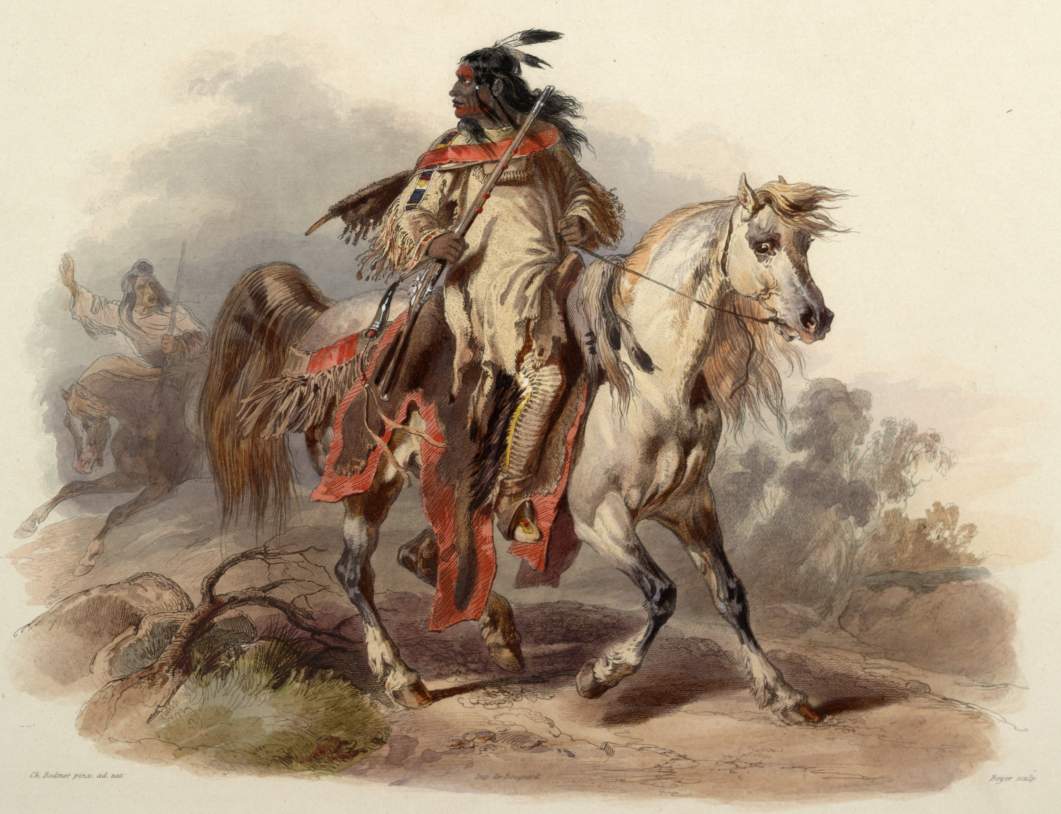
Horse Hunting by Robert Temple
“Far back, far back in our dark soul the horse prances.”
— D. H. Lawrence
Behind him, Kuruk heard the panting of Bimisi and Dahkeya, so he cast a glance over his right shoulder. Clouds of cold, grey vapor spewed from his friends’ open mouths. Heads down, with thick coils of hand woven rope, leather quivers, water bags, blanket rolls and food pouches slung across dark, sweat drenched, buckskin tunics, loin clouts and pants, they trudged using their unstrung bows as canes. Kuruk grunted, pushed his soaked headband higher, and turned his gaze ahead to the southeast. As he had all day, he scanned the horizon on his right hand for, hopefully, signs of wild horses or, more likely, hated mounted Comanche, and spying neither, shifted his gaze leftwards to Itza-chu, his fraternal twin brother. But as tireless as the great hawk of his name, Itza-chu strode on indifferent to winter. Lean and taller by a hand than burly Kuruk or his two friends, Itza-chu seemed to float above the ground, while Kuruk lumbered with the endless strength of a hunting bear.
“Bimisi and Dahkeya are played out,” Kuruk said. “We should stop a while.”
“We have two hands above the horizon till sunset,” Itza-chu said. “We must reach the Apishapa River today.”
“We left the Huerfano River at dawn.” Kuruk nodded behind him at his two friends. “They have marched all day without rest.”
“We have two hands above the horizon till sunset.”
“The Apishapa is more than two hands away.”
“Then we will walk in the dark.”
Kuruk grunted like his namesake, the grizzled silver bear, and pushed on. In knee high moccasins, his broad, splayed feet tromped rustling brown stubble, all that remained of last fall’s buffalo grass. Kuruk loved the long green plumes of grass and the red, yellow and purple blooms of wild flowers that swathed the plains in spring, but at least one more moon would pass before ice-crusted snow disappeared from depressions and the first green shoots dotted the valley plains just west of the rising cliff palisades of the Llano Estacado. Their Mother Gouyen had said that in late winter wild horses would most likely shelter in the warmer air of the lower plains just west of the high, cold, windswept Llano, and so she had sent these four young men of the Gulgahe’n band of the People Who Make Fine Baskets to catch those horses before Comanche broke their winter camps far out in the midst of the Llano. The Gulgahe’n needed those horses. What few horses the Comanche had not stolen in that terrible late fall raid the Gulgahe’n had been forced to eat to survive winter in the cold valleys of the Sangre de Cristo Mountains, where they were begrudged guests of their rival band the Saidinde who barely had harvest enough to feed themselves. If the Gulgahe’n were not to starve or turn to grubbing in the earth like the Saidinde, they must have horses for the spring buffalo hunts. Kuruk wished Uncle Nantan led this horse hunt. He would have seen the need to call a rest, but Uncle Nantan was dead.
Kuruk wondered what it would be like to spend a winter up on the Llano, where his people had lived for generations before the Comanche came out of the Great Basin and drove them away. Not even his mother’s mother had remembered life on the Llano, but all of the People Who Made Fine Baskets remembered that they had once lived there among vast herds of fat buffalo and had never gone hungry. When the two bands were one. Before the Comanche.
Then Itza-chu stopped and pointed straight ahead. Brown horse dung just now forming a dry crust. Itza-chu jabbed his index finger there and there and there. Pile after pile of round scat.
“Horses passed this way,” Itza-chu said, “just this morning.”
“They’re heading for the Apishapa,” Kuruk said. Itza-chu nodded and strode along the trail of what looked to be a small herd of maybe eight or nine horses. Kuruk grunted and strode after his brother.
& & &
That night beside the dark ribbon of the Apishapa, Kuruk, a thin woolen blanket draped across his shoulders, sat cross legged with his brother and friends in a circle around a thin wisp of orange flame. The fire was fed by just three sticks of dry pinion with one lit end of each stick touching one end of the other two sticks. The fire gave only a little warmth, but fuel was scant out here on the plains. They must make these three sticks last all night. “Flames in the dark attract eyes,” Itza-chu had said. But Kuruk had taken the three sticks Bimisi had found and started the fire with flint and dry moss he carried in a leather pouch strung around his thick neck.
“I am cold,” Kuruk had said and stripped off his sweat drenched tunic and cotton shirt, “and my clothes need drying.” Bimisi and Dahkeya had grunted agreement, tugged off their tunics and shirts, and shivering, sat down holding their clothes out to the fire. Itza-chu had sat down also, but on his face a scowl. Then and now.
Like a bear, Kuruk ground a chunk of horse jerky between his teeth with much licking and smacking. And like a bear, spittle oozed from one corner of his mouth and ran down his chin. Swallowing the last of his own cold dinner, Dahkeya nudged Bimisi with his elbow and rolled his eyes. Then he went whoof, whoof and grinned at Kuruk who grinned back.
“You are truly well named, my friend,” smooth-faced Bimisi said. The girls all liked Bimisi, the handsome joker who made them laugh. Dahkeya clapped Kuruk on the shoulder. Dahkeya’s forehead and cheeks were pitted, the leavings of pox that swept though their people every ten or twenty winters, sometimes killing entire families, other times, as with Dahkeya, leaving a mother to cling to one scarred living infant of many dead sons, daughters, sisters and uncles. Gulgahe’n said it rolled out of Mexico up the Rio Grande north through Spanish haciendas and Pueblo villages to strike the People Who Make Fine Baskets. Saidinde said it lay hidden in trade goods that strange, pale, red and yellow haired men brought onto the plains from eastern forests across the Great River.
Now, Itza-chu’s scowl deepened. He leaned forward and glared at Bimisi.
“Do not insult my brother.”
Bimisi’s face stiffened. Dahkeya slipped his hand off Kuruk’s shoulder. Why must Itza-chu be like this. Always.
“He meant no insult, Brother,” Kuruk said. “I do eat like a bear. And fart like one, too.” Kuruk let fly a noisy blast of fumes, and laughing, cried, “There, my friends, am I not a mighty old bear?”
Bimisi and Dahkeya doubled over, waving their hands and laughing. With tears streaming down his scarred face, Dahkeya said, “Oh, you are! You are!”
Itza-chu sat back, but his scowl remained. Sighing, Kuruk stretched, faked a yawn and then lay down on his left side, staring into the flames. His two friends lay down as well. After a few minutes, Itza-chu lay down with his back to the fire.
Why must my brother hate all around him? Kuruk wondered. Well, not all. Not me, nor Mother Gouyen. He had loved Uncle Nantan. And he had adored their three sisters, especially little Liluye. And he would surely say he loved all the People Who Make Fine Baskets. At least, all the Gulgahe’n. He despises the Saidinde. Calls them bean eating cowards who hide in the mountains from the Comanche, not like we Gulgahe’n who still go out on the plains to hunt even if we must fight the Comanche. Yes, Itza-chu hates the Comanche with every drop of his blood. And who can blame him? They killed our sisters. Uncle Nantan. I, too, hate them. And Bimisi and Dahkeya hate them. But they are my friends. Not his. He has no friends. He never has. Even before Comanche killed our sisters and Uncle Nantan.
Beneath his blanket, Kuruk lay still as a bear sleeping through the cold winter. He heard his two friends snoring, and after a while, he also heard the deep breathing of his brother asleep, finally. But unlike the bear, sleep did not come easily that night for Kuruk.
& & &
Through dry, bloodshot eyes, Kuruk watched the sun edge above the far, far cliffs that marked the Llano. He threw off his blanket, rolled over and turned to wake Itza-chu, but his brother already squatted on his heels studying the plains all around with the fierce eyes of a circling hawk.
“Before dawn,” Itza-chu said,” a distant neigh from a copse of pinion south of our camp woke me. But a little ways north, I found a dry, narrow wash that leads down to the river. It looks deep enough for our trap. Wake your friends. We have much to do and must do so quickly before the horses stir.”
Kuruk grunted, then reached and pulled the blankets off Bimisi and Dahkeya.
& & &
They searched north along the river for pinion trees with stout enough branches for corral posts, but most of these pine trees were stunted with thin, twisting branches, so they made do, erecting a barrier of branches webbed together with two coils of rope where the narrow end of the wash opened onto the plains. From there, rain had carved a sharply sloping channel about ten paces at its widest point with walls as high as Kuruk running some thirty paces to its mouth a few paces short of the river. At that end, they blocked the north side with another branch and rope barrier, but left the south side as the open entrance to the trap.
Following Itza-chu, they headed west several hundred paces into the plains and then circled south to get behind the horses they hoped were still at that copse of trees. When they neared the river within a hundred paces of the copse, Itza-chu motioned to form a rough line running east to west. Then they got down on their bellies, and at Itza-chu’s signal, crawled north through frosted, brown grass.
Every ten paces or so, Itza-chu held up his hand, and they halted while he rose up just enough to see above broken, crumbling stalks. Halfway to the copse, Kuruk heard chuffing and soft knickers. The herd was still there! He looked to his left. Bimisi and Dahkeya sported his same wide grin. He looked to his right. Itza-chu’s teeth were clinched, and his eyes blazed with a fierce hunting glare.
They crawled another ten paces, and then Itza-chu motioned for them to stand. Slowly, so as not to spook the herd, Kuruk and Bimisi and Dahkeya and Itza-chu stood up. One stallion, seven mares and a little gangly colt raised their heads from the grass and regarded them for three long moments. Then the stallion, a thick necked, chestnut brown and white paint, jerked its head aloft and danced on its front feet. At his shrill neigh, mares and colt broke into a trot north along the river bank. Prancing and circling, the paint stallion kept guard just behind his herd.
Itza-chu, Kuruk and his friends spread their arms wide and walked forward, each step slow and short, with as little noise as possible, encouraging the herd to sidle along the river bank a little wary, not alarmed, but away from the humans. The four men had to keep the herd bunched together. If the horse hunters moved too fast or made loud noise, the herd might bolt and scatter in ones and twos all across the plain and evade the trap.
Ten paces from the opening of the trap, the lead mares paused, a couple circling with their heads up eyeing the opening, the rest pawing the turf and stretching their heads forward and low to the ground snuffing. The little colt, a dark bay with a splash of white on his left hindquarter and another across his throat latch, danced around his dark bay mother with flared nostrils and shrill whinnies. The stallion turned and stood a moment facing the four Gulgahe’n. Then Itza-chu spread his arms and said, “Hup, hup.” The stallion spun and nipped the croup of the nearest mare. She jerked away and then trotted forward, along with the other mares and the colt that still danced and tossed his head back and forth. Into the wash went the herd.
Itza-chu, Kuruk, Bimisi and Dahkeya sprinted forward, each waving a coil of rope with a sliding loop and yelling. The herd, frightened mares neighing, surged up the wash, legs thrashing for purchase, hooves skidding on slick river gravel. Then the two mares at the front slammed to halt at the rope and branch barrier, with mares behind them ramming into them and bouncing off each other. The little colt took a kick to its face and went down. Screaming, the stallion spun and reared, front hooves lashing out at Itza-chu, Kuruk and his friends.
“Snare him!” Itza-chu shouted. “Get your ropes around his neck. Now! Now!”
But the paint stallion dodged and weaved, evading their sailing lassos, spinning and kicking with his hind hooves, keeping them at bay. Then the lead mare, a wily, old, dappled grey, sprang at the barrier, smashed through it, stumbled to her front knees, and then tail high, bolted up and away into the dry grass plains with the other mares and the stallion racing after her.
Only the little colt was left sprawled on his belly, head shaking blood from the gash above dazed eyes. With Itza-chu striding ahead, Kuruk trudged up the wash with Bimisi and Dahkeya trailing. When Itza-chu reached the little colt, he snatched his knife from its sheath on his hip and slashed the horse’s white throat in one smooth motion, as swiftly as a diving hawk snatches a rabbit from the grass. Then he strode onto the remains of their rope barrier and shook the bloody knife at the mother mare that had stopped to see whether her colt followed.
“YIIIIEYIII!” Itza-chu screeched. The mare turned and trotted after the herd.
& & &
Juices running down his chin, Kuruk savored his last bite of tender shank meat, but he was still troubled. Across their tiny fire, Bimisi swallowed another gulp of steak, then looked up and belched while Dahkeya, both hands gripping a thigh bone, gnawed its charred flesh. Itza-chu wiped palms and long nailed fingers on his pant legs.
“Is the colt not to your taste, Brother?” Itza-chu asked. “For once, I thought Bimisi’s cooking was just fine.”
Bimisi grunted and spat a chunk of gristle into the flames that sputtered and flared. Dahkeya lobbed his stripped bare bone at Bimisi, who ducked, then raised a butt cheek and farted at Dahkeya. Both Dahkeya and Bimisi laughed, but Itza-chu sat cross-legged staring at his brother.
“Fresh horse meat is my favorite, especially one so young and tender,” Kuruk said, “but he would have better served us as buffalo runner in a couple of springs.”
“We need full grown horses we can break for riding now.” Itza-chu beat one fist on his thigh. “We must mount a vengeance raid while the Comanche conduct their spring hunt. We must catch their warriors unaware and scattered across the plains while their women cluster head down around fallen buffalo with nothing more than skinning knives and their children laugh and play.”
Kuruk wiped a forearm across his chin and looked at the fire. He saw what Itza-chu had described and saw that it was a good plan. A just plan. A plan that called to the terrible pictures in his mind. Uncle Nantan with feathered arrow shafts sticking out of throat and chest. Scalped Zi-yeh and Kushala in a single twisted heap. Liluye’s smashed in skull.
But Kuruk saw also pictures of the plains in mid spring. Lush purple and yellow and blue and white and red wild flowers bobbing in wind gusts. Long, waving buffalo grass so bright green. Green. He loved to see green things grow.
Kuruk shook his head and looked at his brother. “How many warriors for this raid?”
“I will take ten.”
Kuruk shook his head again and said, “All told, our band has less than twenty, even if you count the old, old men, and those not so old, and neither will follow a warrior of less than twenty springs.”
“You, Bimisi, Dahkeya, all the other young men will. All lost kin to the Comanche. All burn for vengeance.” Itza-chu leaned forward. “The fires of hate fade with age. The old ones long for the long sleep, so while they wait, they content themselves singing dirges and telling old lies of great deeds in their youth.”
“Our elders do not lie.”
“Maybe, maybe not.” Itza-chu turned his head left and right, but his eyes stared straight at Kuruk. “But the old ones’ memories slip. They forget how to hate.”
Kuruk heard again that terrible raid. Comanche war cries. Children’s screams. And that awful roaring. He stared at his brother, watched flames reflect in Itza-chu’s eyes. “Must one hate?”
“Yes,” Itza-chu said.
Kuruk climbed to his feet and walked toward the river. After a moment, he heard the crunch of grass as his brother stood up and followed, but Kuruk pretended not to hear. When the sound of rushing water drowned out the crackling of the fire, Kuruk stopped on the river bank and lifted the front flap of his loin clout. Then Itza-chu stood beside him and lifted the front flap of his, but Kuruk ignored his brother and watched light glisten and sparkle in his own stream until it ended. Then he let the front flap fall back into place and turned to face his brother. Distant firelight still shone in Itza-chu’s eyes.
“Hate is the soul of a warrior,” Itza-chu said and placed his right hand on Kuruk’s shoulder, who even through his cotton shirt and leather tunic felt nails dig into his flesh. “His strength. The stronger his hate, the greater his strength. That is why a warrior must drive all weakness, all softness from him. Even his love must feed on hate. Then he is truly a warrior.”
“But I love to see green things grow.” Kuruk nodded over his shoulder at Bimisi and Dahkeya. “And I love to joke with my friends.”
“And they love you for it, but they follow me.”
Kuruk shrugged off his brother’s grip, but Itza-chu jabbed two fingers into Kuruk’s chest.
“The hate lies within you, Brother. I have heard it and rejoiced. But you must hear it, too.”
& & &
They tracked the paint stallion’s herd north for a day across dry plains west of the Apishapa River. At some point, they knew the herd would have to find water, but would the paint stallion lead his mares back to the Apishapa or continue north to the Arkansas? Or would he strike west and head all the way to the Huerfano?
With head up, Itza-chu strode in front of Kuruk, Bimisi and Dahkeya. His eyes searched out traces of unshod hoof prints, broken stalks, crumbling scat fading into brown earth. In growing twilight, they groped onward often following nothing more than the chance reek of horse urine and dung. Then a rising wind out of the north wiped even those scents away, and a dark moonless night blinded them. Itza-chu called a halt. Out here in the treeless plains, they had no fuel for a fire, so they ate a few mouthfuls of cold jerky, lay down together, and drew their blankets over their shivering heap. That strong northern wind dusted the sleeping men with grit, crumbled rabbit brush and shredded buffalo grass.
At first light, Itza-chu was up and followed ever fainter, dust covered signs. At mid morning, eyes flaring, he trod a broad looping circle over and over, while Kuruk and his friends stood watching. With a slam of his fist against his thigh, Itza-chu halted, but when Bimisi looked at Dahkeya and rolled his eyes, Kuruk stepped alongside his brother and knelt on one knee. He swung his head back and forth low to the ground, sniffing right, then left and right again. Then he rose to his feet, but hands on knees, leaned forward, mouth agape. He sucked in a huge lungful of air through both nose and mouth, tasting it, licking his upper lip with the tip of his tongue. Yes, the lingering scent of salty, bitter urine. There back toward the Apishapa.
“My old bear’s nose says they’re headed northeast toward the river.” Kuruk grinned at his brother. “We should move fast and see if we can pick up their tracks again.”
“Are you sure?” Itza-chu asked.
“No, but we have to go some way.”
“Yes. Yes.” Itza-chu clapped Kuruk on the shoulder and then broke into a lope northeast.
& & &
By mid morning the wind had shifted to out of the west and slowed to a breeze. When they saw sign of the paint’s herd, even Itza-chu smiled. As the miles rolled on, tracks were fresher, scat moister, the stench of horse urine stronger. They could pick out the stallion’s heavier prints. Then other horse sign crossed their herd’s tracks. Sometimes, tracks of a single horse. Other times, those of two or three or even four or five horses. Itza-chu pointed how these tracks often crisscrossed those of the paint’s herd.
“Something else is stalking our horses,” Kuruk said. “Or someone.”
“Do you think it’s Comanche?” Dahkeya asked, and Bimisi looked the same question at Kuruk and Itza-chu.
“I hope it is Comanche,” Itza-chu said and jerked the knife from the sheath at his hip. “They don’t know we’re out here. We can catch them tonight in their camp asleep.”
Face muscles tight, Bimisi and Dahkeya stared at each other a moment and then looked at Itza-chu. Bimisi nodded. Then Dahkeya and Bimisi looked away.
“I don’t think these other prints are from mounted horses,” Kuruk said, squatted and placed the fingers of his right hand in one of the tracks. “They’re not deep enough. Most likely, young stallions without their own mares. They’re trailing our herd, hoping to steal one or two mares from the older stallion.”
Bimisi punched Dahkeya in the shoulder and grinned.
& & &
That evening, as they neared the river, they heard horses screaming, so they strung their bows and hurried forward, but when they caught sight of the river, they saw a young sorrel mare with a white blaze on her forehead thrashing in yellow mud up to her breast and stifle, screaming at the herd that milled about on the far bank. Halfway across the Apishapa in water up to the points of his shoulders stood the paint stallion screaming at his trapped mare.
The four Gulgahe’n dropped their bows, water bags and other gear, and ran toward the mare each man carrying a coil of rope, but all four stopped at the edge of the muddy ground. The mare was stuck in a shallow bend of flowing water barely covering the mud. In her struggles, she had managed to turn her left flank to the river channel, but now stood nostrils flaring and mouth gasping for air. Her answering screams to the stallion were ragged and croupy. Itza-chu tossed a loop around the mare’s neck, Bimisi did the same, and they braced their feet in dry ground and stretched the mare’s neck toward them.
Then Kuruk dropped his rope and tugged off his leather tunic and cotton shirt, cold air biting his flesh, but nodding at Dahkeya, he sat on his butt and pulled off his moccasins, pants and loin clout. After a shake of his head and a loud grunt, Dahkeya stripped off his moccasins and clothes. Then the two naked men grabbed opposite ends of Kuruk’s coiled rope and waded through freezing water and sucking mud to the mare. Sinking halfway to his knees, Kuruk slipped one end of his rope under the mare’s left elbow, and sliding his left hand under her breast, grabbed the rope end and pulled it up and got both numb hands on it. Dahkeya tried to circle his end of the rope under the horse’s right elbow, but she lurched and slammed her shoulder into his face. Nose smashed and bloody, eyes dazed, he fell back and rolled away from the horse. Then he lay on his back gasping and spitting blood.
“Get that rope around her!” Itza-chu cried. “She’s going to break a leg. We have got to pull her out of the mud.”
With his left hand, Kuruk seized the loose end of the rope, and ramming his right shoulder into the mare’s breast, worked his left hand into the gap between the horse’s right elbow and mud. Straining to hold the weight of the mare with his legs and spine, he let go of the rope with his left hand long enough to jab his fingers under her breast, grab the rope end, and yank it through. Still grasping both ends of the rope, he fell on his back and with his heels pushed himself clear of the horse.
Blood streaming from his flattened nostrils, Dahkeya floundered through the mud and seized one end of the rope while Itza-chu shouted at them to move, move! Slathered with icy mud, shaking, Kuruk and Dahkeya, hand over hand, hauled their rope snug around the mare’s withers. Then staggering onto dry ground, Kuruk on one end of the rope, and Dahkeya and Bimisi on the other, dragged the mare at the end of their makeshift harness inch by inch out of the mud until with a final lurch and kick she stood trembling on dry ground.
“One of you grab hold of this other rope!” Itza-chu shouted. “My one won’t hold her when she gets her wind back.”
Bimisi and Dahkeya exchanged looks with Kuruk who nodded at Bimisi to go back to his rope around the mare’s neck. Then Kuruk looked at shivering Dahkeya and said, “You and I need to wash off this mud before we put our clothes back on.”
Dahkeya coughed, mopped a hand across his bloody, muddy face and grunted.
& & &
When Dahkeya and Kuruk were clothed again, Dahkeya sat down and coughed bloody froth while Kuruk cut two lengths of rope and fashioned hobbles and a halter. Head down, drool hanging from open mouth, the mare allowed Kuruk to snug the hobble loops around her cannons and slip the halter over her ears and muzzle. Then he untied Bimisi’s rope from her neck, retied it to the halter and slipped Itza-chu’s rope from around her neck. All the while, the paint stallion splashed back and forth on the far side of the river calling to the mare until Itza-chu drove him away with a shower of rocks. Then the paint and his herd vanished into the growing dark.
While Bimisi held tight to her halter lead, Kuruk murmured soothing words and caressed the mare with his palms and fingers, probing her neck and spine and legs and flanks and finally her rump. Itza-chu came up and patted the mare’s neck.
“Is she alright?”
With his left hand, Kuruk felt the dock of her tail and ran his right hand up the muscles of her buttocks to the vagina. Then rubbing his thumb and first two finger tips together under his nose, he sniffed.
“She’s fine, just worn out, but,” Kuruk said and held out his right hand to Bimisi, “my old bear’s nose says she’s just coming into season. She’s young so probably her first.”
Bimisi thrust his head forward, took a whiff and then grinned at Kuruk. “We can—“
“Use her to lure those young stallions into our trap!” Itza-chu said.
& & &
Next to a cluster of stunted cottonwoods mixed with pinion crowding the banks of the river, they made camp. After tethering the young mare to the trunk of a cottonwood, they set about groping in the dark for fallen branches and tiny pinion cones at the bases of the trees. While they searched, Dahkeya’s teeth chattered loud enough for all to hear, and his cough deepened. When they had enough fuel, Kuruk lit a fire. Despite Itza-chu’s glower, Kuruk built the fire much bigger this time. After a while, Dahkeya’s teeth ceased chattering, but his cough persisted throughout the night.
& & &
They were up before dawn, and with Dahkeya leading the horse, hiked back to the bend in the river where they had found the mare. Ten paces from the river, Kuruk went to work digging a hole with his hands as deep as his arm’s reach while Bimisi and Itza-chu searched the river bank for something large enough to use as anchor in the hole. About the time Kuruk finished digging, his friend and his brother returned with a large, flat stone about the thickness of three fingers. Then Dahkeya handed the free end of the rope tether to Kuruk who looped it several times around the stone, laid it at the bottom of the hole, pushed all the dirt back in the hole, and stomped it flat. They made sure the hobbled and tethered mare could reach the water for a drink. Then the four men ranged themselves in a rough half circle some twenty paces to the plains’ side of the mare and laid their blankets flat, plucked handful after handful of buffalo grass and camouflaged their blankets. Itza-chu glared at Dahkeya.
“You must not cough.”
Dahkeya grunted and slid his feet under his blanket.
“I said you must not cough,” Itza-chu said.
“He is Gulgahe’n,” Kuruk said. “He will not cough.”
& & &
Kuruk was right, but they lay there all day without any sign of the young stallions or any other living thing, so when the dark of night settled around them, they gathered up their blankets.
“To guard the mare,” Itza-chu said. “I will stay here tonight.”
Kuruk nodded. Then he, Bimisi and Dahkeya headed to their campsite. While the three men ate cold jerky and handfuls of corn meal, Dahkeya coughed and snorted and spat globs of phlegmy blood.
“We must mend your nose, cousin,” Bimisi said. Dahkeya grunted, so Bimisi grabbed hold of Dahkeya’s hair and held his head still. Then Kuruk yanked Dahkeya’s nose into place. After a few moments, the bleeding stopped as did the snorting and choking, but the cough came in fits the rest of the night.
& & &
When the three men rejoined Itza-chu just before dawn, he said that he had heard other horses calling to the mare most of the night, but he worried that their human scent kept the wary horses at a distance. He said they should rub themselves with horse urine, so when the mare next relieved herself, they stuck hands under her stream and washed their hair and necks, arms, legs and torsos with her stench. Then each with a coil of rope crawled under his grass-covered blanket.
When the sun stood three hands above the eastern horizon, a pair of young stallions, a dun and a buckskin, biting at each other with bared teeth, trotted past the concealed men toward the mare. All together, the four men rose, and arms widespread, stepped quickly toward the stallions. Before the dun took notice of them, Itza-chu, with the lighting strike of a diving hawk, sailed his rope’s loop around the dun’s neck, and wrapping a bend of the rope around his torso, dug in his heels. The dun reared and twisted, dragging Itza-chu, while the buckskin bolted toward the river.
“Bimisi!” Itza-chu cried, but even as Itza-chu shouted, Bimisi lobbed his rope loop around the dun’s neck and added his weight to the struggle.
Ten paces apart, Kuruk and Dahkeya chased after the buckskin, blocking his escape to the plains. Lunging into the muddy river bend, the buckskin soon found himself thrashing in mud up to his forearms and gaskins. Kuruk tossed his loop around the stallion’s neck, and so did Dahkeya. They let him fight and scream until played out he stood gasping and shaking. They hauled him onto dry ground. Only then could they risk a glance over their shoulders at Bimisi and Itza-chu.
The dun still bucked and screamed and reared, but foam sprayed from his nostrils and mouth. As he fought, his neck bent lower and lower. Then he, too, stood dazed and gasping.
Hand over hand on their ropes, the four men worked slowly toward the two stallions. When they were about two paces away, Kuruk set his feet and nodded to Dahkeya who flicked the free end of his rope around the buckskin’s front legs. The horse tried to rear, but Kuruk put all his weight on his rope and dragged the horse back to earth. Dahkeya looped the rope once more around the buckskin’s front legs and yanked the line to the right, tumbling the horse on his left flank. Kuruk hauled on his rope stretching the stallion’s neck, and Dahkeya, holding the rope around the horse’s front legs in his left hand, darted forward and with his right hand flicked the free end of his rope around the cannon of the horse’s back right leg. Then he pulled the two rope ends together and hogtied the three bound legs. At which point, the buckskin with his unbound leg smashed Dahkeya in the face with his right hock.
Spitting blood, Dahkeya crawled away and sat up.
“Kuruk!” Itza-chu called. “We need help over here!”
Kuruk tossed his rope to Dahkeya who stared at it a moment and then picked it up. So Kuruk went to help his brother and Bimisi.
& & &
Overnight, Dahkeya’s cough worsened. Whenever he sneezed or shook his head to clear his nostrils of clotted blood, his nose flopped back and forth, and he showed no interest in food, so in the morning, they left him wrapped in his blanket beside the coals of last night’s fire and told him to keep an eye on their two short-hobbled stallions. During the next three days, they caught two more young stallions—a two year old red dun and a strapping, three year old bay piebald fifteen hands tall. Then they went three days without any sign of more wild horses.
“In the morning, we should move farther north to the juncture of the Apishapa and the Arkansas,” Itza-chu said.
“Brother, four unbroken stallions and a mare in heat is all we can manage,” Kuruk said and nodded at Dahkeya. “He needs Mother Gouyen’s tending.”
“I’m alright,” Dahkeya said.
“No, you’re not,” Bimisi said. “Kuruk’s right. We need to go home.”
“But we need more horses!” Itza-chu slammed his fist against his thigh. “For the raid.”
“We’re going home, Brother.”
& & &
In the morning, the wind blew out of the south, still cold, but reminding Kuruk that spring would come with dark green buds on cottonwoods along the riverbanks and light green sprigs of buffalo grass swathing the plains. They headed west toward the snow covered flanks of the Sangre de Cristo Mountains, where even now, he told himself, the Saidinde turned the earth in rich valley bottom lands, mixed it with compost and manure, and heaped it into small mounds to seed with the Three Sisters, corn, squash and beans. When he was a child, Mother Gouyen and Uncle Nantan had often taken them in the spring to visit kin among the Saidinde. Kuruk had loved to help plant—the moist, sweet aroma of freshly turned dirt, the thick reek of compost and manure, the smooth texture of seed—but Itza-chu had hated it.
Kuruk and Bimisi lead the four hobbled stallions tethered well apart to one lead rope, while in front, Itza-chu lead the hobbled, sorrel mare with a separate rope. With the others’ bows and quivers slung across his shouders, Dahkeya walked at the rear, pale, head tilted forward to let pink snot drain, and coughed and coughed.
Even with all four legs hobbled, each stallion sidled left and right, straining at the rope, planted his feet and danced and skipped, dragging Kuruk and Bimisi back and forth, but Itza-chu strode ever on, the mare content to follow, drawing the stallions after her. As the sun traveled west, Kuruk and Bimisi wrapped their blistered hands in cloth, but at the stallions’ jerks and lunges, the rope slipped more easily through their hands, and despite the sting, they fought all the harder to grip it. Dahkeya trailed along behind, head tilted down, coughing, coughing. Every time Kuruk stole a glance east or south or north, one or more of the stallions pulled against the rope and yanked Kuruk’s attention away from the horizons, but by late afternoon, the stallions, nostrils flared, eyes dull, ceased fighting and trudged after the mare.
At sunset, they knotted the ends of the stallions’ lead rope together to form a loose circle, ten yards from the staked out mare. Then dodging hooves and teeth, they shortened the hobbles on all the horses and let them graze.
“They need water,” Kuruk said.
“We should reach the Huerfano tomorrow evening,” Itza-chu said.
Then exhausted, they wrapped themselves in their blankets and slept.
& & &
The next morning proved as trying as yesterday’s march, but by noon, the foam-drenched stallions plodded with heads sagging, air whistling past wooden sticks the men had added as bits to the halters. At the front, Itza-chu, head pivoting left and then right, led the mare. Once again, Kuruk scanned the horizons for movement or dust spires while Bimisi called encouragement to Dahkeya who stumbled along, coughing, always coughing.
Then as the sun raced toward the mountains, Itza-chu came to a halt and pointed. “I see a line of cottonwoods. Must be the Huerfano. Get a grip on the horses before they smell water.”
& & &
That night, they sat cross legged around the fire, its flames reflecting off the flowing river. The looming bulk of the mountains shut off a third of the western sky, and the quarter moon stayed hidden behind mountain peaks, but above them and to the east, the stars stood clear and bright in cold, thin air.
“Once across the river and into the cover of the foothills,” Itza-chu said, “we will turn south and brush away our tracks for half a day before we turn west again and head for home.”
“Why take so long covering our trail?” Bimisi asked. “Off the plains, a Comanche can’t find his own ass. They won’t follow us into the mountains.”
“We’ve come a long way for these horses,” Itza-chu said. “We must not lose them now.”
“My brother is right,” Kuruk said. “We can’t get careless. We’ve been out on the plains a long time. We’ve left a lot of tracks.”
“And a long, stinking trail of Dahkeya’s snot!” Bimisi said and poked Dahkeya in the ribs who lifted his head and despite his ashen face forced a smile. Itza-chu leaned forward.
“In a couple days, we will reach home,” Itza-chu said. “Then you can rest, and Mother Gouyen will set your nose properly. All will be well. Come summer, we will have plunder to trade in Taos, lots of plunder.”
Bimisi clapped Dahkeya on the shoulder. “I don’t know, Cousin. You were pretty ugly before, and I don’t care how well Mother Gouyen sets your nose, she can’t cure ugly. None of those pretty Tewa girls in Taos will have anything to do with you, no matter how much Comanche plunder you offer.”
“I don’t care about pretty girls.” Dahkeya coughed and waved a hand at Kuruk. “I just want old bear here to smell me out a woman in season.”
“She will have to be a fat, ugly one,” Bimisi said and shook Dahkeya with both hands.
“I don’t care as long as she’s in season.”
& & &
While Bimisi and Itza-chu snored, Kuruk lay awake listening to Dahkeya cough. Deep rattling coughs trailing off into short, rasping breaths. Then rattling coughs again. Kuruk did not think Dahkeya would ever see the summer market fair in Taos. He hoped his friend lived long enough to see his mother again, and the rest of the Gulgahe’n.
Kuruk shook off his blanket and rolled away from the fire. Then he stood up and walked toward the horses that stood munching withered grass while vapor obscured their muzzles. It would take two or three moons to ready these horses for Itza-chu’s raid. Yes, they would have to geld the males. Stallions would never run together. But didn’t the band need the mare pregnant? Keep her back in camp to build up the Gulgahe’n’s herd? Would that mean keeping a male intact, as well, for breeding? That left just three horses for a raid. Or did Itza-chu mean to geld all the stallions, even that magnificent piebald, and take them and the mare raiding? Still not much of a war band. But Kuruk knew his brother would have his raid.
Yes, Itza-chu meant to payback the Comanche in kind. Fall on a small family band while its men were scattered across the plains hunting spring buffalo. Slaughter women, children, old men. Plunder the camp. Ride away with the band’s horse herd. Leave nothing for the Comanche men but ashes and the sick taste of impotent rage. Blood, bodies stood out in Kuruk’s mind so clearly. Was there no escape from the images in his mind of that terrible day?
With a deer carcass slung across his shoulders that fall morning, Kuruk had walked toward the Gulgahe’n camp at the edge of the plains, so proud to lead the men back to the women and children with fresh venison. Then he had smelled smoke. Heard wails and screams and Comanche war cries. He had flung carcass and his bow aside and ran toward those sounds. An awful, awful roar had filled his ears.
Startled Comanche spun their horses away from their game of jabbing bloody lance points at Mother Gouyen. Ear bursting roar. Comanche warriors clapping hands to their ears. Uncle Nantan filled with arrows. Roaring. His butchered sisters. Roaring. Smashing a horse’s skull with a blow of his right palm. Caving in the face of its rider with his left. Roaring. Roaring. Chasing terrified men. His fingers rending faces. Roaring. His blows snapping necks. All while the sky filled with that thunderous bestial roar.
Then shock of cold water dashed in his face. Roar choked off. Arms raised for another blow, he had gasped, throat raw, body shaking. Mother Gouyen had stood holding a dripping basket.
“Stop that awful sound! My son is not an animal.”
& & &
When they reached the Gulgahe’n tucked in a narrow valley well back among the foothills, Kuruk dragged Dahkeya, coughing blood, into camp on a travois he and Bimisi had rigged that morning. Taking one long, silent look at her son, Dahkeya’s mother had fallen to her knees beside her boy and sent up a harsh, keening wail. Mother Gouyen and the other women with their small children gathered around the travois and joined their voices to that shrill drawn out cry, but men and growing boys swarmed around the horses, patting their flanks, dodging hobbled kicks and twisting heads down by the ears to examine eyes and teeth.
Kuruk slipped off the travois harness, sat down and dug his hands into the cold ground. He felt the promise of spring in clots of moist earth and sand clinging to his fingers and palms. And he saw Itza-chu, hawk eyes blazing, shouting to all the men, exhorting them to join him in a great spring raid against the hated Comanche. The old men shrugged and turned to add their voices to the women and children’s wail. The mature warriors stood stone faced, studying the horses, squinting at Itza-chu out of the corners of their eyes, and staring at each other, while the young men barked sharp, yipping war cries and crowded around Itza-chu, slapping his back, even Bimisi.
Shortly after sunset, Dahkeya ceased coughing, but his mother and the other women’s wail rang long after the moon had sunk behind the mountains.
& & &
At dawn, Itza-chu’s screams of outrage awoke Kuruk who kicked off his blankets and hurried with Mother Gouyen to see what was the matter. At the edge of the camp, they came upon Itza-chu still screeching his wraith at the remnants of rope tethers neatly sliced just above the knots that had tied their precious horses between two trees. Soon, the whole band surrounded Itza-chu who at last fell silent. Mother Gouyen approached him and put a hand on his shoulder.
“In a few days, you will go back to the plains and capture more horses,” she said. “We must have them for the spring hunts, or we will starve.” Then she let fall her hand and turned to the rest of the band. “Who will go with my son?”
“I will go,” Bimisi said and took a step toward Itza-chu. Three more of the young men did the same. A warrior of thirty springs named Ka-e-te-nay stepped forward.
“I will go and make sure things are done right.”
Itza-chu’s eyes flared, but Mother Gouyen said, “My son will listen to an experienced warrior.”
Then she looked at Kuruk who returned his mother’s stare. On the plains, the grass was still withered brown, the ground still cold. Nothing green would grow there for at least another moon. He shrugged.
“I will go west to the Saidinde. They can always use another strong back at planting.”
* * * * THE END * * * *
Copyright Robert Temple 2025
Image Source: Timeship from Pixabay



A powerfful account of the life and death struggle common to Native Americans in their strugglle against the elements, other tribes and even amongst themsellves. Kuruk found hiis own way, saving lives in the process. The characters reveal traits found in a lot of fiction: the easy going, the self effacing and the unsmiling, unengaging Alpha male. Well done. Good ending..
Bill Tope,
Glad you enjoyed the read. Thanks so much for your kind words. This short story is also one of the chapters in my episodic novel entitled _The Romance of Horse and Plain_. I have published three other stories from that work, but am still seeking a publisher for the novel.