
State Lines by T.C. Sundberg
State Lines by T.C. Sundberg
The first reporter calls the morning after I show Carl what I found. He sounds too young for his job but maybe I just feel that way because his youth reminds me of my age. He asks to come over and see it. I don’t say no. An hour later he arrives in a bright red sedan.
The rain has halted temporarily but the dirt in the yard has been pounded into a dark brown sludge. The reporter has a thick beard which almost hides his displeasure as the glossy black leather of his shoes makes contact with mud.
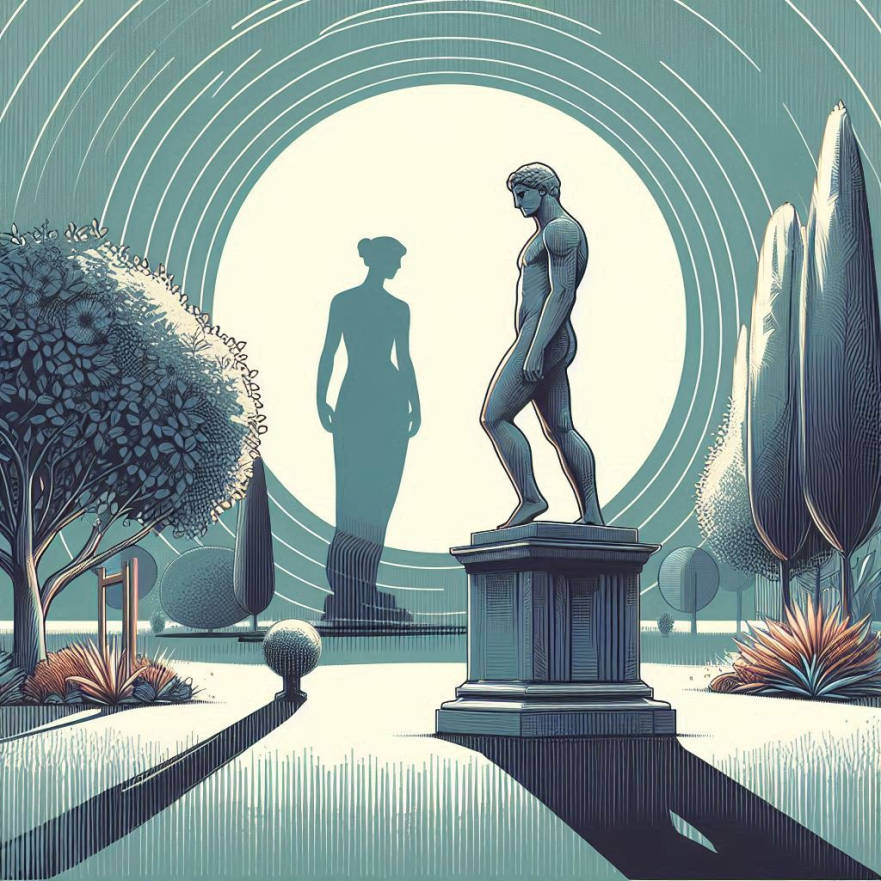
I take him to the place where I found it, shifting the wet earth away with the toe of my work boot. A nose emerges, then an eye. Then the earth clears enough to reveal the chiseled sternness of the stone man’s face.
“Fascinating,” the reporter breathes. He isn’t talking to me.
& & &
The New Mexico Sentinel features a picture of the stone man along with the caption “Local Woman Finds Ancient Statue in her Backyard”.
I go outside and sit next to the stone man’s ditch. I read the article out loud to him. I feel he should know what people are saying. I let my tongue linger on the word “local”.
My house straddles two state lines. My bedroom dips into Arizona while my kitchen stove is firmly rooted in New Mexico. If people were to ask, I would tell them that I lived in Arizona this year because I didn’t do much cooking. I say this to the stone man. He doesn’t laugh. The blank granularity of his eyes continues to search the sky.
The second reporter calls after lunch.
& & &
“The Daily Sun has just claimed you as an Arizona resident,” I tell the stone man the next day. I wipe some dirt off his face. The clouds are thick and heavy. There will be rain within the hour.
When Carl delivered the mail, he just shook his head at the headline. I think he knows what he started.
After the storm breaks, I stomp out into the soggy yard with my shovel and hack at the dirt surrounding the stone man’s torso.
& & &
The reporters come in droves now. They drive up to my house leaving dense tracks in the monsoon-soaked grass. They have added measuring tapes to their arsenal of camera equipment, and they seem more interested in talking to each other than asking questions about the stone man. The flooding in the backyard delays their plans but it doesn’t stop my afternoon ritual of freeing the stone man just a bit more.
As soon as the monsoons ease slightly, the reporters return to measure and re-measure the stone man’s position in my yard. They calculate the angle of his body and the percentage of his volume occupying each state. They talk about potential seismic shifts and how these could indicate where the stone man came from. They need to classify him as if the question of where he belongs can be answered simply by where he is from. Just when a conclusion is reached, a new inch of his stone form is revealed, and the debate begins all over again.
& & &
The last clump of earth breaks free from the stone man’s body in late August. It’s mid-afternoon and the reporters have left for the day. The heat from the last gasp of the monsoons is oppressive. The stone man regards me coolly from his position in the ground. He looks unbothered by the heat though the hard line of his mouth does not indicate comfort.
When Carl arrives with the mail, I tell him my plan. He shakes his head again but agrees to help. I grab my shovel and he gets one of those wheeled carts he uses for big packages. Together, we try to coax the stone man from his hole. We work gently at first but soon we are then straining, all muscles screaming, sweat pouring down our faces like rain.
We take a break. I fix Carl a lemonade and then he goes to get his back brace from the car.
We try again; the sweet acidity of the cool juice fueling our efforts. I jump down into the ditch and lodge my feet under the stone man’s left shoulder. I feel his weight and it’s like he has grown roots tying him to this land.
Suddenly, I am jealous. I am angry. The stone man is important. People are clamoring to have him share their labels. His identity is questioned only because people want him to belong. I hate the stone man and his roots. Rage boiling inside me, I heave his body upward and he tears free.
& & &
When the reporters arrive the next day, I lead them to the backyard so they can see the havoc wreaked by the flash flood. They wade into the yard and claw through the muck desperate to find some trace of the stone man. I serve them lemonade. I shrug. I shake my head sadly. I look at the ground. Finally, as the sun sets, they give up. They pack up their cars and reverse out of the well-worn drive.
I return to the kitchen to wash their glasses. The stone man watches me from the corner. I tell him things will get back to normal now. He seems relieved.
Once I’m done in the kitchen, I flip off the lights and wheel the stone man on his package cart out into the hall. Somewhere between the hallway light and the framed newspaper pages on the walls we cross the border of New Mexico and Arizona.
* * * * THE END * * * *
Copyright T.C. Sundberg 2025



Fun tonngue-in-cheeck narrative of identity and belonging and not belonging. Good fun.
Great story. Amusing commentary on the arbitrary lines that control our lives. Or fail to!