
Memorial by Tony Warner
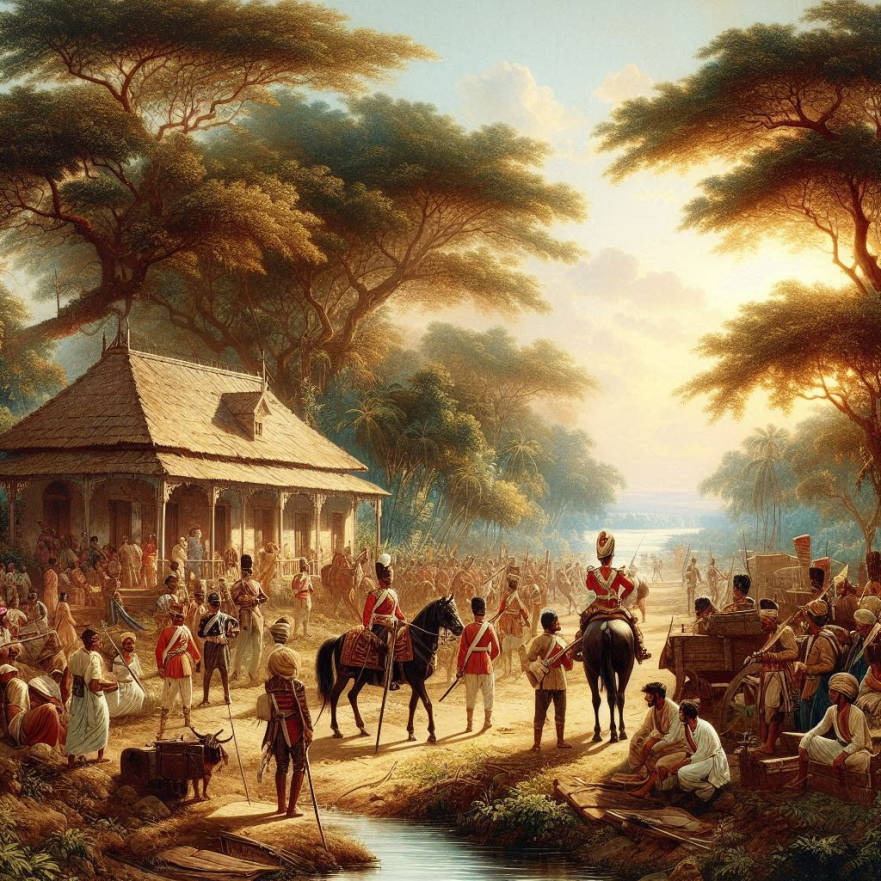
Memorial by Tony Warner
Calcutta
November 1757
Madam
I have the pleasure to inform you of my imminent departure from these shores on the first of the proximate month. This missive, being despatched by His Majesty’s man-of-war, should reach you well in advance of my arrival in the Company vessel ‘Gloriana’. I adjure you to prepare the manor house fully, with all furniture and chattels in good order. Should you wish, you may purchase for yourself a new gown and clothes for the children also. Thanks to the patronage of General Clive and my good friend Hastings I am now well provided for, as I will divulge to you on my return.
Take care most to stop all draughts within the fabric of the house. Have Gedge sweep the chimneys and lay in a bounteous supply of dry wood. He may cut some more of the box from the copse for laying down in the coming year should he require. The Captain informs me we may dock within some days of the beginning of April or end of March should winds prove favourable, though weather in the Channel at this time of year is notoriously unpredictable. Recall, I leave India in the middle of summer to arrive in England at the close of winter! Even a stoic such as I must admit to the need for some extra soothing and coddling on first return; yet still do I desire the comforts of my house and above all the comfort of my own sweet lady.
I presage the boys will now be long out of skirts and my little Amanda, her who I have never seen, will be speaking and singing as sweetly as her mother. I commend the children to your care and command them to be obedient to you. Greatly am I desirous to see them once more and listen to their lisping sounds. Most of all I dream of your own sweet face from which I have been too long absent.
Hastings has much for me to arrange prior to my departure. He has gifts for the king, as well as for others of influence, which he wishes me to convey. Pray that the messenger on this occasion will be rewarded for what he bears!
So I rest, your loving husband. Wish me ‘God speed’ and send me your blessing, as I send my blessing to you.
William Hailwood Esq.
Boxwood
April 1758
Dearest Hester
What joy it is to have my darling husband once more by my side! Since his arrival we have been like two young lovers, walking arm in arm along the country lanes, dancing together at the assemblies in the city, progressing to the church of a Sunday with the children in our train. Our dear little church, which has felt so cold and lonely for so long, now feels the warmest place on earth since my prayers have been answered and William has been delivered to me safe and sound.
Before he arrived, I was fearful he would take from me all I have won for myself over the years. Gedge, the steward, obeys all my orders without demure. Where I am unsure or ignorant he discusses the matter with me as if I were a man. When I make sound decisions I see the approval in his face. All too often I make poor ones, which he accepts, not reproaching me but doing what he can to ameliorate the harm I have caused.
I was trembled lest I should lose all I had gained, that my husband would throw me aside, taking on all the management of the estate, treating me like a useless vessel fit only for the bearing of children. No! He sits there in his great armchair, swaddled in blankets against the cold and damp which he says pierce him to his bones, while I receive Gedge’s reports and give him his instructions. The gardener he leaves to me also, alongside all of the indoor and outdoor servants, the dry nurse and the governess.
Do I make him sound lazy, uncaring? It is not so. Every evening we sit together after dinner, once the servants have been dismissed, and discuss the day’s doings. Why have I done this or that? How is the estate faring? Which of the farms are productive and which are failing to produce? Is it determined by the quality of the land or the quality of the tenant? When we are silent I catch him watching me fiercely, like a hawk considering a tasty vole. Surely no vole can be as content as I to be so regarded!
But he is not completely happy here in this cold countryside. I tell by the way he moves, how his hands tremble when first he lifts his goblet of wine or port, how he is never satisfied when he returns from a day’s shoot, no matter how many birds or coneys swing from his belt. Of an evening he sits huddled in the chimney twisting his hands like an old man, as if they were the icicles that only recently dangled from the eves of this ancient house. Oft-times I see his face, brown as oak from the fierce sun of India, turn grey and yellow as the east wind blows in from Russia, finding its way around the door jambs, rattling the windows in their frames.
Yet I am happy and determined to make him happy. We share such closeness and I well know how to warm his heart and body. I have become such a wanton! Perchance it is all of the tenderness I have stored up in the three years we have been apart. I fear it will lead the way all of our couplings have led since we made our acquaintances. One more will not make much difference, though I fear a fate like that of our late queen, Anne. ‘Tis said she gave birth seventeen times, though none of them survived for long. We have both been lucky in our broods, dear Hester, and in our husbands. May we continue to live long in love and amity.
Your dearest friend and sister
Georgiana.
Boxwood
April 1758
Your most gracious Majesty
I beg leave to attend Your Majesty at Your Majesty’s pleasure to present to you letters of import form General Clive, subsequent upon his recent glorious victory at Plassey, and from the Honourable East India Company’s representative Mr Hastings on the governance of the Indian territories. Mr Hastings begs me to present to you the written submissions of various Nawabs and Rajahs alongside their gifts and representations.
I remain, sir, Your Majesty’s most humble, loyal and obedient servant.
William Hailwood Esq.
St. James
May 1758
Dear Hastings
His Majesty was gracious to grant me an audience at his palace of St. James to receive the letters and communications from yourself and General Clive. As you can imagine he was most pleased with the gifts, particularly the bronze elephant with the amethyst eyes and the ivory tusks wrapped in gold foil. My own bronze monkey wearing the coat studded with diamonds found more favour with the Duchess of Yarmouth than with the king.
Still, it has achieved its purpose, alongside Clive’s recommendation. I am to be appointed quartermaster-general for the expeditions to North America and the Caribbean to eject the French from their holdings there next summer. It is said that Lord Pomeroy had previously secured the post for his son and is now most put out. General Wolfe tells me he was never happy with Pomeroy’s appointment, he having no military or supply experience, being merely a salon popinjay. The king knows from his own experiences against the Scottish Jacobins how important it is to keep the army fed and supplied. “We starved them of shoes!” he said to me when I mentioned the matter. “They got as far as Derby then had to slink off back home in their bare feet.’
Wolfe has been a great friend and supporter, introducing me to many factors, shipowners and merchants, whose assistance I shall need. I suspect it was his word in the ear of the king that saw me raised to my current distinction. As you know, my estate at Boxwood comes to me through my dear wife Georgiana. Her father, Lord Phillipon who was, died leaving her the estate but could not bequeath his title to her. Thus the line of the Phillipons which goes back to the conquest, has died out and I had no title for me or for my sons. Wolfe conveyed this to the king, alongside the comment that it would be difficult for a mere gentleman, however well connected, to demand obedience from men in trade or to deal on an equal footing with officers and others who bore titles as well as holding His Majesty’s commission. Hence I am now (or soon to be) Viscount Hailwood of Boxwood. Doesn’t that sound grand! If the missions against the French prove successful I may yet grow to be a full baron!
I have petitioned the king to be allowed to accompany the expedition to Guadeloupe, to no avail. Even though spring is almost over and summer upon us, this poxy climate still chills me to the bone. I feel the damp melting my bones, the cold freezing my marrow until I shrivel like a sour and discarded ancient medlar. Here in London, at least I have respite from the cold, which in Boxwood shrieks through every slit and crack in wood and stone. If it were not for the warmth and comfort of my darling Georgiana, who holds me so tight and fierce through the long cold nights, I would forever leave it for the squalor and sea coals of our foggy capital. Business forces me to stay in town and her advancing condition keeps her in the country. How sick I am of us being forever apart, even though now it be only a hundred miles.
Last week I took me to Woodstock and Marlborough’s magnificent palace. It is built in the Italian style, in what they call Palladio. All is symmetrical, ornamented only in the severest of fashion. I have a mind to tear down the rotting corpse of the Phillipon mansion in Boxwood and replace it with another Blenheim. One not so grand, for they say the old Duchess bankrupted herself in its completion and never did pay the architect for his troubles. I shall cut my coat according to my cloth, not allow ambition to get the better of me, for the will of kings is fickle and we must all be prepared for royal patronage to crumble into royal displeasure at any moment.
You, too, should remember these words. Much is said against you in London; that you bear yourself too proudly, consider yourself a king in your own right among the maharajahs. Worst of all, they say you are corrupt, defrauding both the crown and the Company. Be kind wherever you can, take the sons of important men under your wing but, most off all, hide your wealth from all, so you may appear a mere clerk and servant, underpaid and overworked.
Your dedicated friend
William, Viscount Hailwood of Boxwood.
St. James
May 1758
My dearest Hester
Are you not surprised to hear from me in town when I should be coddling myself among the cows and the sheep in the countryside? If I were not so delicate I would tell you of all the balls and entertainments that abound here, but as yet I have attended none. William says that next week, if I am not so feeble, he will accompany me to a performance of a piece by Mr Handel. He says that Handel himself will be there, though he is much reduced by cause of his near blindness and his advanced age.
William is delighted to have me with him, as I am with him, but neither is happy with the cause of this connection. As I was descending the stairs, having prepared my most sober gown for church, I lost my footing, tumbling to the landing below. Fortunately, no limbs were broken but my body was much disturbed. The doctor ordered me to bed and rest at once. To no avail. The child had been shaken from me and I bled most prodigiously and was despaired of by the servants who insisted upon all sorts of village remedies, all of which the good doctor refused, prescribing only rest and drafts of hot brandy in milk.
At last the child lost its grasp upon me and released itself. I was too shocked to look, but Tabitha, my maid, told me it was no more than the merest kitten of a thing which she could not believe would ever have survived even if I had gone my full term.
She is a foolish child but it is comforting to be told such things, even it is the comfort of childish ignorance. So, I have left the children behind and taken lodgings with my husband here in London. Being with him once more is my heart’s desire, though it will be long before I may be able to allow him to share my bed. The doctor insists I can bear many more children but my body tells me my mothering days are done. So much the better, that I may enjoy my sweet William for himself alone with no interruption to our daily felicity.
William is much exercised about the king’s business, settling orders for the supply of ships and men for the continuing campaign. As if he were not so much occupied, he has engaged an architect to assist him in new designs for changes to the house in Boxwood, which he says is too small and too damp for our thriving family. For me, I do not find it damp at all, or cold for that matter, but William feels it so. Even here, now it is summer, the fires blaze in the hearth day and night, especially in his office where he wraps himself yet in blankets as he goes about his work and negotiates with the king’s tradesmen. I find this unbecoming but he says he must be comfortable or his mind goes awandering far from the business in hand.
Part of the business he conducts in a dangerous part of town, the haunt of low women and cut-throats called Covent Garden, though they say the only gardens there are the ones belonging to the prostitutes that the men water every night. I am not allowed to accompany him on his trips even though he is always attended by two stout chairmen with heavy cudgels. His object is a Jew from the Low Countries, a most unsavoury character of low repute even among his fellow religionists.
I admit I am anxious to see this person and the whole of the garden. Maybe it is the way we wish always to look upon wickedness and become excited by it, as long as it does not come too close to our persons. Do you remember clinging together as the governess read us the stories from the Arabian Nights with all the jinns and genii, witches and wizards and sultans cutting off peoples’ heads?
There, I have made myself shiver! Write to me when you can and I will tell of all the sins and wickedness that I discover in this city of dirt and smoke.
Your devoted sister
Georgiana, Viscountess of Boxwood.
Is that not grand!
June 1758
Aldwych
(first page missing, believed lost or burned)
and you should see the state of her shoes, no better than a common tart’s.
To the Duchess of Yarmouth yester eve for a large supper. Warm champagne and a tenor who could not hit the higher notes, not like the sophisticated entertainments we used to see when Suffolk was the maitresse en titre. Having a crude German royal house is bad enough, but they will import their own German mistresses instead of sticking to our home grown variety, who have so much more taste and sophistication.
Talking of which, the belle was once more the delectable Countess Boxwood, in the lowest cut bodice you have ever seen on a public forum. Perhaps her husband bought it from one of the doxies he visits in Covent Garden. For a woman from the backwoods who has had three children she has worn pretty well, even if she has recourse to yards of muslin to hide the stretch marks on her bosom, which she hoists up on layers of the best whalebone. The gentlemen spent much time trying to penetrate the mysteries of the muslin whilst we women had our eyes upon the sumptuous necklace which she wore. Quite barbaric in its design, there is no denying the beauty and value of the stones. Stolen by her husband from some harem in the east, I expect.
Her complexion is that of a summer apple, unless her paint has been applied by an expert in the art. Her colour, though, is too dark, typical of those country women not content to leave the real work around their estates to their husbands or their stewards. Fine ladies may sneer but the young men, and some of the old ones, cannot tear their eyes away from her. Lucky for her the Viscount is black as any negro, for she appears pale by comparison. He stands by all night watching her, like some beached whale. Have you seen the old beggar women in the streets who even in summer are bundled up in rags, carrying upon their persons every scrap they own for lack of a safe resting place for them? My Lord is exactly the same. He pretends to be a fat man but all know he is a mere stick bundled up in four or five layers, to pretend he is in Calcutta still. My cook says he demands meals of such fiery heat none but he can touch them, hoping to stoke the fires within to compensate for their lack without.
As for his wife, he will need to stoke her fires. Others would be all too delighted to take the task upon themselves. Philip, Lord Pomeroy’s eldest, dances with her every chance he gets. I have heard him extolling the grace of her ankles, the charm of her conversation, the sharpness of her wit. Whenever they visit concert hall or theatre Sir Philip contrives to be of the party, willing to share his father’s box with the happy couple.
Quite how happy they are we may well doubt. The husband’s regular visit to the stews of Covent Garden suggest he may not find his home comforts completely to his liking. That, or he prefers the perverse practices of the doxies there, more in keeping with what he has discovered in his foreign travels, than delicate and refined couplings with his own wife.
Old Pomeroy is another such to be found in the dens of that quarter, though it is not girls he is after. Like Boxwood he funds his visits by recourse to the old Jew who has his squalid quarters in the gardens. Pomeroy is busy selling his wife’s jewellery, Boxwood doles out diamonds from time to time. Once the necklace fails to shine upon the Duchess’s neck we will discover to where it is all this foreign wealth flows. They say he is the most honest of all the king’s servants; not a penny within his care but is diverted to the procurement of goods and men. Such probity cannot long survive in this wicked world. One only needs to study Lord M. to know that the king’s service is a road to riches and advancement. I have invited the good lord to my soirée this evening. I believe him to be a man much in need of some entertaining female company.
Your affectionate friend
Cecilia.
July 1758
St. James
Dear Hastings
When will this damn country ever get warm? I sit every day shrouded in blankets. Then last night I could not sleep for the sweats, soaking the linen so it needed to be changed. Yet here I am once more huddled before a roaring fire, the only one in any drawing room in the whole of London. Georgiana fusses over me like a mother hen. To be honest, I enjoy it greatly, the attentions of her who is of such a tender and sweet disposition. She is not just admired at home but all abroad dote upon her beauty and tenderness of understanding. I am indeed a fortunate man to have such a wife. Many say to marry for love is a recipe for disaster ,whilst for me it has been a recipe for constant joy and delight.
Work upon the new expedition moves on apace. Many of the dealers try to exact my trade by offering bribes and other inducements, just as the maharajahs in India have offered you all manner of things to retain power in their principalities. I trust you are resisting and refusing them as I am refusing these villains at home. It is not yet time for cargoes to go aboard but I shall be sure to be on deck, ready to inspect each delivery as it is loaded. Any but the best quality will be rejected without payment. No rotten pork or spoiled beef on my watch. The 1759 will be the best supplied expedition of any of the whole war.
Some continually seek to profit from it, knowing I cannot hold all in my hands or resolve all matters in my head alone. Aristocrats vie for places for their sons and nephews; incompetents and grasping nonentities all. Most pressing is Lord Pomeroy, who throws his eldest son upon my attention at every step. We cannot visit theatre, concert or ball but he is there, seeking to gain his suit through constant conversations with my Georgiana. I remember Wolfe’s warning and give him no credence. If he is so anxious to enter the king’s service he should ask his father to purchase him a commission in the Guards.
My architect, Macready, is a serious, morose young man in love with the buildings of the ancients. He travelled widely through France and Germany in his youth and before the recent wars visited King Louis’s new palace in Versailles. Which new palace instructs us, he says, that to design a building in isolation is insufficient. Any dwelling of consequence must be planned together with its gardens. To which end he insists that the old red brick and stone building must be demolished completely as it is unsightly, even as a ruin. Of that I am fully glad, for I find it the most banal and unsightly as ever was, with its bow windows and twisted chimneys, as well as being a colander through which the winds blow incessantly at all seasons.
Dear Georgiana will be furious once she learns what I and Macready contemplate. Now is the time for dissimulation. We maintain we are merely repairing and extending the old building. I intend to appease her by requesting she design the grounds. In his zeal, Macready already has his initial ideas on paper, which I shall present to her alongside a new box of pencils and watercolours.
For now I have ceased my visits to the Jew. The more frequently I visit him the lower the price he offers me, claiming the market is flooded with raw stones from Amsterdam which no-one wishes to purchase on cause of the war. He is deceived; not I. My absence will squeeze a better price from him, for I know he has made promises of supply to his jeweller friends. Building and the services of a man such as Macready do not come cheap and I am determined the house will be finished entire without leading me into bankruptcy and the children into poverty and want. Once the jewels are gone I have but the rent from my tenants, or a descent into peculation.
Enough for now, dear fellow. You are ever in my thoughts. Much as the king and the Company have need of your undoubted talents in India I cannot wait to see you in this windswept isle once more.
Boxwood.
15 July
Long Acre
My loveliest Aurora
For such you are, my dawn risen in the east, the light of my life. Lovelier than Ophelia. Wiser than Portia. More virtuous than Lucretia. How my heart leaps upon the barest glimpse of your features, how it languishes in your absence from my sight, becomes a veritable necropolis of love, darker even than that of the fair Juliet and her love-lorn Romeo
Every day I drive my valet to distraction. ‘Will I see her again today?’ I ask him. ‘Will she like me in this waistcoat, approve of the buckles on my shoes?’ Three or more times I change my mind, daring to aspire to Aurora’s rays, ready to melt beneath the heat of her gaze. Last evening I dressed and re-dressed so many times, knowing you would be at Lady M’s reception, fearful I should not find favour in your sight. And there you were, shimmering in gold, the jewels at you throat surpassed by the jewels of your eyes.
And what joy when you graced me as my partner in the quadrille! Surely not often enough. And I held your hand in mine as we progressed, the graceful embodiment of all my sleeping and waking fancies. Do not tell me that you did not feel the heat of my love, my longing, my sincere and abiding passion surging like the larva from some re-awakened volcano, besotted as I was by your beauty and your delicate touch upon my fingers. Could you have been, madam, impervious to my longing, engulfed as I am by your charms which have caused me unspeakable agony of mind?
Long have I endeavoured to smother my passion, but how may I endure if Aurora be not mine? I beg you to have mercy upon your servant, your lover for all eternity, your slave. Grant me but a few moments alone for me to tell you of my passion, so you may see I am no dissimulator but constant in my ardour. How may I say all this to you in the in the midst of the madness of ball or assembly? My heart has had no rest since I saw you last and I confess I never was so full of sorrow as I am this moment removed from the vision of your loveliness. Revive the light in my life, o glorious Aurora. One word from you suffices to spark the fires of my ecstasy; I burn beneath your glance, struck dumb by the sight of you across a room.
Be merciful, I pray you, to one so true of heart. No! For heart I have no longer, now it is stolen away by you, leaving me desirous at your feet. I die your eternal slave, for how may I endure if Aurora be not mine?
P.
July 1758
St. James
Dear Hester
What a wicked city this is! Seduction and adultery are the pastime of most of those in the best society. A wife who has borne her husband an heir is assumed to be ready to take a lover. A man of any age knows all the stews as well as keeping a mistress, even into his dotage. As long as marriage continues as a market such things will continue. A man takes a wife to sustain his family name, a woman takes a husband to maintain her in luxury and satisfy her desire for children. Love is not a question, except with oddities such as me and William. He had no name and little money. I had property but no name or money. We should both have been seeking safety, instead we found one another. Only now, after living apart for so long, are we as comfortable in our pockets as we are in our hearts. But more of that later. For now I have much gossip to impart.
Lady M has taken another lover. Not unusual, you may say, except she has kept the old one as well. Her husband frequents one of the stews in Covent Gardens but not one where there are members of our sex. Lady M must feel slighted in the extreme! Others are trying to supplant the boys in her lord’s affections, to little effect.
The fashion in polite society is a competition to see who dare the lowest décolletée. A competition I have entered into with the greatest enthusiasm. You know how proud I have always been of my bosoms, a pride which William shares with me. Despite the three children they are still quite firm and smooth, especially when reinforced by my new stays. Perhaps this is what has brought me so many admirers, young men who crowd me like bees around a honey pot. Sadly, I cannot recall their faces, for I spend much of our conversations staring at the tops of their heads! They are very flirtatious and, to avoid their solicitations, I spend as much time as I may either on my husband’s arm or dancing with as many as I may, to avoid any scandal should I show particularity.
And I have a lover!
Not that his love is reciprocated. Yesterday, as you know, was my thirtieth birthday, signalling my youth is gone and done with. I am now a middle aged matron, though that seems to add to my attraction to the young men who suppose I am no longer an object of affection to my husband. My lover is a callow youth of some twenty years, the son of Lord Pomeroy. He is handsome enough in all honesty: tall, well featured with an upright and stately bearing. His conversation is easy and witty, if lacking in real substance. From it I gather he has been schooled in Shakespeare and the classics and has read much of the current spate of what is called ‘novels’. As for serious matter and holy works he is totally deficient, which may account for his lightness of mind.
From him I have received several declarations of undying love, incoherent nonsense worthy only of a village schoolboy. He reveals himself as a mere empty fop, a would-be Lothario intent upon filling his bed in the interval before his marriage. Which is imminently expected. The bride to be is a little dark thing, the eldest daughter of the Duke of T. She has a settlement of some five thousand a year from her father, who is one of the largest landowners in the county of Lancashire. Lord Pomeroy, my lover’s father, is said to have wasted his fortune at the gaming tables and has little but a name to pass on to his son, a name which the Duke is anxious to attach to his waspish daughter.
I know she suspects young Pomeroy’s attentions to me by the way she stares at me with her sharp little black eyes as if they would bore a hole in my skull, pierce my brain and leave me lying dead upon the ground amongst a flurry of excited onlookers. I allow Pomeroy to dance with me no more than twice of an evening and encourage William to believe he attaches himself to our party purely as a way of achieving appointment to an office of profit under the crown. To succumb to his blandishments would be evil and disastrous to my peace of mind. At the same time, the flirtation is exciting and attractive enough to keep me dangling the boy upon my string, if only as a distraction while we are forced to remain in town as the new extension rises from the ground.
It is the grounds with which I am concerned. Macready has sent me his ideas of a possible design, to which I have added an ornamental lake or canal leading out from the new building, which will be reflected in it. Not as grand as Marlborough’s lake and river at Woodstock, of course, but still one of the finest in the county. What a joy to wake of a summer’s morning to see the sun glinting on the waters, view the regularity of the box hedges, the brilliance of the flowers in their beds! I am sure the children will love it as I will. With this letter you will find the rough plan Macready and I have determined upon. I trust you approve! If you do, perhaps we could re-plan your own curtilage in a more modern manner?
Now I must rush to dress, or rather undress, since I will again be showing my bosoms to their best advantage. At their best they are sufficient to make William’s eyes sparkle and make him forget the cold for a moment.
Your loving sister
Georgiana.
August 1758
Boxwood
My Lord
Her ladyship insists that I should report all matters relating to the management of the estate directly to you as well as to her. As she says, all that is done is done in your name and reflects to your Honour. I also have tidings anent Mr. Macready’s activities which he wishes me to convey.
To agricultural events first. Harvest has begun and is well advanced. Crops are good this year. Corn is ample and will fetch an excellent price on the market as the war continues. The turnips have proved a success, for a change, and the sheep will be let upon them to graze on the tops in the coming weeks, before they are lifted for winter feed.
The geese have been gathered into their temporary enclosure and the tar cauldron set up. Betts, the smith, will assist with the tarring of their feet from tomorrow and the drive to London will begin the moment all are ready. Her ladyship has engaged with the Duke of Argyll to fatten his herds in the southwest meadow over the winter. His Grace writes to say the drovers have already set out from his lands. They are expected to arrive in the first week of next month when the harvest will be complete and the geese will be gone.
Her ladyship is most insistent upon detailing to you the terms of the arrangement with His Grace. He will pay an agreed fee for the accommodation of his herd, plus a bonus for the general increase in size of the cattle, to be determined in discussions between his head drover and myself and with the agreement of the two principals. In spring, the cattle will be sold to the king’s quarter-master general, yourself, for supply of the North America expedition. Her ladyship is adamant that the sale is solely between His Grace and the crown, the Boxwood estate having no part in it. Hence you have no conflict of interest and your Honour and Reputation are preserved intact.
As for Mr. Macready, he has completed the demolition of the old house and has stored such tiles, timber and stone as he deems appropriate for use in the new building. More will be required for the new foundations than was at first thought. The clay is only a foot and a half deep. Beneath is sand, forcing us to dig further in order to provide a solid base. Once the harvest is complete and the cattle settled in, our men will start work upon digging the foundations and upon the excavation of the ornamental canal which her ladyship has planned. Mr Macready says that the clay taken from the foundations can be used to line the canal in the same manner that the common folk use it to line their ponds.
At your instruction, I have not informed her ladyship of the demolition of the ancient building, although she has been informed that Boxwood will not be suitable for a family Christmas celebration or for the harvest festival. The Rector has agreed to host both the harvest dinner and the Christmas celebrations in the church, it being large enough to hold the whole population of the village. I have kept back four geese for him to have cooked and disbursed to the congregation as has been the tradition at Boxwood for many years. Often have I been asked whether the tenants will be welcome for festive celebrations in the new manor once it is completed and have conveyed your assurances to them that such will continue during your lordship’s lifetime.
I leave you, sir, as your humble servant
Isiah Gedge.
December 1758
St. James
Dear Hester
Pomeroy has become most tiresome. Although he praises my virtue he is determined to maintain his assault upon it. Consequently, I do all I may to avoid him, dance with him only when it would create a scandal to refuse him in public. His behaviour is a matter of most annoyance to me, for I have to forgo many amusements which I would otherwise enjoy because of his insistent presence. Nor do I relish the eyes of his intended upon me at all times. It is like facing a firing squad of king’s grenadiers.
Not that these troubles lessen my pleasure in our residence in London. Each week we have concerts by the finest singers and musicians as well as operas in full costume. Mr. Handel’s oratorios are moving and conducive to one’s finest religious feelings, which I find to cement me firmly into my faith, but there is nothing as exciting as a full blown opera! Once the new extension is completed my duties on the estate entail my presence in Boxwood, where the children will once more run wild, free of the dirt and dangers of the city. Much as I look forward to those days, the winters here are delightful, especially as we are now together as a family. And it is so much simpler to find tutors for them, men of distinction from the universities of Oxford and Cambridge versed in Latin, Greek and the new continental philosophers as well as the tenets of the Christian faith. Where will I find such paragons in the wilds of Boxwood?
The geese have arrived and are selling for excellent prices. Only a few were lost upon the road, most of which we were able to sell for enough to keep the drovers in ale! The Duke’s cattle are fat and strong, so I anticipate a good bonus when they arrive in Smithfield in March. He is responsible for any losses on the road and for supplying the ale to his own drovers. A not inconsiderable expense, for these wild Scots have unquenchable thirsts.
As does Mr. Macready! Not for ale, but for money and materials. Every letter from him contains requests for more of both. The foundations need to be deeper, he says; more cement and lime are necessary; our farm workers cannot dig fast enough and other labourers have to be brought in from the surrounding villages. William visits the Jew increasingly often, each time returning with a lighter bag. It will not be long before we have to rely upon rents and bonuses from the Duke, a precariousness I do not welcome.
There promises a short respite. All the workers have returned to their homes for the Christmas celebrations, which is good news, since there is no work for them to do. With the winter frosts the ground is frozen solid, impervious to pick and shovel. No-one may dig and the foundations have filled with water above the level of the broken brick. No cement may be added until the water seeps away. Even my lovely canal is only half dug, a danger in the dark to humans and animals alike.
William freezes even harder than the ground. His body grows smaller as his public silhouette grows larger. Now he is no longer brown but yellow as a Chinaman and frequently too ill to venture out of doors, lying wrapped in his bed under as many blankets as we can command. Yet his brain is as sharp as ever. When we discuss projects in the estate, such as using new crops like lucerne or introducing beans and peas into our rotation, he gives me such excellent advice, having read all the new thinking of Young, Tull and Coke. Once back in Boxwood, what a team we shall make! How lucky I am to have such an intelligent, honest and diligent husband who appreciates my good qualities and forgives my bad ones. What need have I for fops and popinjays like that idiot Pomeroy? The sooner he is married or shipped off to the Americas to fight the French the better.
Your loving sister
Georgiana.
St. James
January 1759
Sir
Much to my displeasure I have received yet another importunate missive from you.
I inform you once more that your intentions are disagreeable to me. All you say of my qualities is mere hyperbole, except in one regard. My virtue is highly praised and so it will remain. No doubt you are accustomed to women who prate of their virtues whilst cunningly deceiving their husbands, cuckolding them with a string of lovers. I am, sir, a resolute Christian women who has preserved her Modesty against all temptations of rank, fortune and appearance. I refuse to have any more social intercourse with you, be it at ball, theatre or place of worship. Should you present yourself at my abode you will be informed that I am not at home to you.
My relations enquire why I have not informed my husband of your conduct. They fear many may impugn my honour and constancy, but I take this action merely to defend the life of the man I love and respect so dearly, my beloved husband. I reply that, should I inform him of your unwelcome pursuit despite my protestations that you desist, he will surely call you out. All know that such meetings end badly for all parties, especially ones where one of the principals is racked with illness.
I reiterate. Your attentions to me dishonour both yourself and your family. They are insulting to me, impugning as they do my Virtue and my Constancy.
Georgiana Hailwood, Vicomtess Boxwood.
April 1759
St. James
Dear Hastings
Tidings reach us of great doings in Murshidabad. By the end of the year the French will have been ejected from India for ever. Company officers here are delighted, having their eyes on Danish and Portuguese holdings to boot. My expedition has departed for North America despite the recent severe weather. With God’s grace we will see the end of French pretensions north of the Great Lakes and in Guadeloupe.
I have urged you in the past to beware of jealous and wicked people who will seek to do you harm. I, too, have had recent experience of such underhand practices seeking to undermine me and impute my Honour. His Majesty is not well, leaving much of everyday business in the safe hands of Mr. Pitt and the Prince of Wales. It was the Prince who approached me, having been told I had made large amounts from selling my own cattle to the Expedition for grossly inflated prices. ‘Not what he would have expected from a servant of the Crown with such a reputation for honesty as my own.’ Never was I so grateful for my good Georgiana’s care and dedication to my wellbeing.
I required the Prince to visit me in private at our lodgings in Jermyn Street where I keep my private papers. Or, rather, where the excellent Georgiana keeps our papers. There I was able to show to him the notarised agreement with the Duke of Argyll for the fattening of his cattle on our land, the agreement ‘solely for foraging, all weight increase to be subject to an agreed bonus to be paid to the Boxwood estate. Any further sales of the animals to be purely an arrangement between the Duke’s representatives and the purchaser, from which the Boxwood estate will not receive a pecuniary benefit.’
Naturally the Prince was most apologetic that he had entertained thoughts of my misbehaviour. I intimated to him that I felt his secret informant was connected to a person who I supplanted in the King’s favour and who I had subsequently refused to employ. His Highness was most gracious, assuring me of his continued favour and patronage, which was most welcome given the current poor health of the King, his father. I have given orders to the servants that the person in question be not admitted to our residence. They inform me that my wife has issued a similar fiat concerning the son, which may account for his lack of persistence in our presence recently.
Work on the new building progresses rapidly at last. The sharp weather over Christmas did not last long and the east winds have dried out the land rapidly, allowing Macready to finish the foundations and start work on erecting the walls. God willing, most should be complete by the autumn, though the harvest will draw the majority of the workers away to the land. As for the workers themselves, they have been a great expense, even over the winter when there is normally little work to be had on the land and wages are normally lower.
The war has made much for clothiers, metal workers and others to do, supplying uniforms, arms, horses and other necessities for the army and navy, which has forced up wages, even for the least skilled and least able. My last jewels are jingling at the bottom of my bag, but I expect them to last at least until I have put a roof over the head of my family, come October.
Georgiana is delighted with the news, though she was hoping we might finish earlier. As well as looking forward to returning to Boxwood she is also looking forward to another season in town, where there is so much to do. Her dedication to the dance has abated in favour of Italian opera and the theatre. Many of the plays are scandalous, tales of adultery and misdeeds which I would not wish my children to witness. Georgiana quotes the Greek theatre to me, saying that we witness scenes of vice and wickedness so they are burned out of our desires, leaving us free and pure within. I am not wholly convinced and only attend such entertainments at her insistence, for she requires my escort at all times in public. Given our financial situation I have no choice but to remain in this dirty town, when I would much prefer to spend time in my new residence. Macready assures me it will be free of draughts and be the warmest country house that ever was. With the Prince’s patronage and, one hopes, the success of the North American expedition, I am assured of a lucrative position at court or in the administration.
My health is not good, which I ascribe to this filthy weather and dirty city. You are well advised to linger in the friendlier climate of India as long as you may.
Your intimate friend
William
August 1759
London
Sir
The little plays of Fidelity that you see enacted in your drawing room are far from the truth, a farrago of Nonsense which far exceeds the twisted imagination even of Mr.Congreve.
You live, sir, with a woman famous for her loose and immoral behaviour far exceeding the licentiousness of the strumpets of Covent Garden or the stews of Poplar and the docks. A woman who displays her ageing charms to all and sundry in public, a spider spinning its web to entrap unwary young men into her snares. And some older men, too, it is said. A woman who regularly receives missives of undying affection from all and sundry, placing their hearts and their bodies at her feet. ‘My life is bound up with yours’ they say to her; ‘my good heart, my dear heart’ no doubt she replies.
Why do you suppose she pines so to remain in town when your lordship’s heart and health yearns to return to the country? Is it not to fulfil the Assignations she has made with her numerous lovers, counting upon your impending presence at the harvest celebrations to free her from all constraints? There is one young man in particular, one who is about to marry, she has ensnared, playing with like a cat with a tasty mouse, refusing access to her presence, avoiding in public, all the while trifling with him at secret meetings, enticing him away from his betrothed.
I counsel you, sir, to remove your wife from the temptations of the flesh and yourself from the Sorrow and Contempt of all those who know you and revere your excellent qualities. If I esteemed you less I could say more of the misbehaviour of one who you mistakenly believe to be a paragon of Piety, Loyalty and Virtue!
Please forgive my importunity in so addressing you, which I do only out of respect for your Honour and Constancy.
Mercury.
St James
October 1759
Gedge
I may no longer endure the noise and dirt of London. Despite the warm commendations of His Majesty and the offer of the post of Equerry to His Highness the Prince of Wales I must return to Boxwood to oversee its continued prosperity, for the good both of my heirs and the people of the village.
Mr. Macready informs me that much of the new house is complete and the whole of the living space made safe from wind and weather. Whichever new parts are fully habitable you are to prepare for our arrival today sennight. At the very least we require a dining room, two bedrooms for the children, a bedroom for myself with the largest fireplace and another for her ladyship. For now, the nursemaid must share a bedroom with the children and her ladyship’s maid will sleep with her.
Pay careful attention to the cooking arrangements. If the roofing for the kitchen is incomplete obtain canvas from the shipyards in Lowestoft to provide a cover. It is imperative that there is an adequate supply of wood laid in both for the kitchens and to heat the house. Coppice the willows, supplement them with further amounts of box and yew if necessary. Leave the two old oaks for now. They have been sold to the king’s shipwrights, who will fell and trim them in due course. We will retain all trimmings for our own use once they have had time to dry.
As for household servants, you must make do with such as we bring back with us from London. Under-cooks and scullery maids bring in from the village. None are to live in until all of the servants’ quarters are finished; proper arrangements must await the completion of the building. Mr Macready has been directed to make all haste, to which end he is to employ as much labour as can be found in the vicinity now harvest is ended.
Even with his best efforts I do not expect all to be ready before Christmas. Kindly inform the Rector that the celebrations for the village people will once again be held in the church, for which we will supply candles and various comestibles. Once over, I expect all able bodied men not required on estate work to be directed to whatever activities as Mr. Macready requires on the building. If he is in agreement, the people may now remove such of the old stones from the ancient manor as they please. Reserve old wood for burning to heat the house in the coming winter. Most of it is oak which, in its matured state, should burn slow and hot. Mr Macready assures me this is the warmest and driest house in existence, but I fear I shall continue to suffer from this accursed English climate.
Over the past weeks, with her ladyship’s assistance, I have prepared a list of our tenants with a statement of their holdings and their rent, which I enclose with this missive. Alongside the list I require you to prepare a statement of the efficiency of each tenant, his accuracy in meeting rental payments, his income and a calculation of earnings against the acreage he holds. Should this calculation prove trying to you, you may consult Mr. Macready who is well versed in the arithmetical arts.
William Hailwood, Viscount Boxwood.
Boxwood
March 1760
My dear Hester
Never would I have imagined I would ever come to hate my lovely Boxwood so! The old house with its memories of our childhood and our dear mama and papa is no more. Without telling me, William has caused it to be destroyed. The very stones are gone, used as rubble for foundations or carted away by the people to line their meagre plots or provide a flooring over the beaten earth of their cottages. Every day sees another beam sawn into lengths to heat this already over-heated Italian box.
And it is so ugly! Absolutely square and mathematical; not a curve or an elegant alignment anywhere. Every window is exactly the same, all at exactly the same distance from one another, all right angles like some school lesson in trigonometry. How I miss the odd smoke blackened corners we used to hide in, the sudden discovery of a secret room, the curve of a turret or winding staircase, stones cracked or exfoliating from the great fire a hundred years since! All our decorative twisted chimneys have gone, the new ones hidden behind extended walls.
The decorative canal I designed is a huge disappointment. Macready has had it lined with the local clay, but this is so impregnated with sand and impurities it allows the water steadily to drain away. There is so little rain in this part of the country it is only ever half full, although now is the wettest part of the year. All the fish have died. Come the summer all we will be left with will be a stinking streak of slime and stinging insects.
William has spent much money on decorative plaster work, even before completing the kitchens. No doubt he has done so to please me, imagining that swags, putti and plaster leaves are to my taste. I would rather he had spent the money on extra tulip bulbs or decorative shrubs and bushes as I had in my design. I suspect Macready eliminated them in favour of his manicured lawns and geometrical walks, now so badly out of fashion.
Nor is the house complete, even yet. Labourers bang and crash at all times of the day, laughing and cursing, singing their vulgar songs. Henry is away at school, which allows James to have his own room, with the nursemaid and the governess sharing the room between his and Amanda’s. The governess is a treasure I discovered among the nonconformists in the city. Quiet and restrained in demeanour, dull in her dress, she is well read in literature, including the great poets Pope and Dryden, and even has passable Latin. She has agreed any religious instruction is to be purely from the Bible with nothing from any sectarian texts of any description. Each Sunday she spends in the city with her co-religionists, many of whom I have met and found to be both eminently well behaved and properly deferential.
No longer do I have to sleep with my maid, who has taken up quarters in a commodious room at the top of the house. She even has a fireplace and William has her supplied with a monthly allowance of sea coal, which is shipped in to the city along the river from Yarmouth. Yet am I displeased. William and I both have our own bedrooms, so there is no discord of a morning as to who is to dress when or how much room is taken up by my hairbrushes and unguents. His bedroom has a huge fireplace but is much smaller than mine. I am sad he never offers to share my bed, much as I entreat him. He says he is tired from supervising the builders or visiting the farms, that his illness bothers him so. His illness never bothered or constrained him in London!
London I perceive to be the cause of my resentment and discontent. There I was able to taste the culture of the great metropolis; here I am buried away in the country far from music and entertainments of all kinds. Nor do I understand why William has forgone the opportunities offered to him by the Prince of Wales and the King himself. I fear I may be the cause, that he has listened to gossip and slander from those who hate me. Tis true I have flirted outrageously with many gallants and have endeavoured to show my figure to its best advantage, but I have never exceeded the bounds of propriety or forgotten my marriage vows.
One in particular I suspect of having whispered poison in my dear William’s ear. Lord T’s daughter, her of the gimlet eyes and minute waist, owner of a mendacious turn of mind, affianced companion to Lord Pomeroy’s son Philip, he of whom I have complained much of to you in the past. She has finally achieved all she has sought. I am well out of the way, a hundred miles distant from the court. Philip and she have married; they wait only for the old man to breathe his last before she becomes Lady Pomeroy in her own right.
Evil has its own reward. Old Pomeroy is said to have lavished all of his fortune upon the boys and girls of Covent Garden, his son further consuming his fortune at the gaming tables. Their land is much mortgaged, more than its rents can sustain. The bankers lie in wait for the crash, which will come when the current war is ended and wheat prices return to normal, for even her settlement of five thousand a year will not be sufficient to save them. Those few who still write to me from London tell me that the marriage does not go well. Despite her condition she is seen about heavily painted to hide the bruises on her face and scrawny shoulders and he is to be seen more in the company of the Duchess of D than in the company of his wife.
Am I wicked for wishing ill to those who have done me disservice? If William were to admit to me the real reason for our hasty departure hence and his unwillingness to share my bed perhaps I could behave in a more Christian manner. I declare, I should be a better example to the children and the servants. I know my dear Hester will chide me for my discontent and will give me good counsel. Once the roads have dried sufficiently I will inflict my discontent and my noisy children upon your good will and good sense.
In the mean time I remain your loving sister
Georgiana.
April 1761
My darling William
How do I miss you! My heart was never so full of sorrow as at this moment when we have laid you to rest for ever in the earth. You are gone, you who was full of such wonderful civility, a man of prodigious charm and generosity. You were always part of my existence, part of myself. To the last hour of my life you are fated to be the one I long for, the one who has stolen my heart and keeps it waiting for me in the tomb alongside your own.
Why could I not say this to you when you were alive? What has driven us apart over these past two years? Not only your advancing illness but some evil and malignant and malevolent force has been at work, casting aspersions upon my character. Would that you had told me of your suspicions, opened to me the poison that has been slowly dripped into your ear. I can brush away all, find an antidote to restore me to your good opinion, for I was ever much obliged to you for your good opinion of me.
Have I not always been a good wife, exulted in your company, a companion in your conversation, your nurse, advisor, person of business? Wherefore do you thus desert me for a second time, first with your heart, now with your body, your very presence. Oh, my love, how I yearn to have you by me once more. A thousand times I would forgo the pleasures of London, the stairs and chimneys of my old red house, the attentions of gay, young men, if only I could feel and touch you one more time.
I know you might say in London I was too free, too audacious, too forward in my manners. But I was like so, as a child newly released from school running and skipping among the meadow, taking pleasure in the sun and light but always ready to return to its house when recalled to duty, indifferent to the lures and snares that surrounded me. For I swear that never did I stray from that course upon which I first embarked when dashing Will Hailwood took my hand sixteen years since. That Will Hailwood who, as the vicar said only yesterday, is now cut down like a flower, leaving me but a short time left to live, a time full of misery now his shade has departed.
But I shall not repine. Your children shall be the sweetest tempered, best beloved and cherished of all of the kingdom, for part of you lingers still in them. Your estate will grow in size and wealth, your name shall be honoured throughout the country, your Honour, Benevolence and Faithfulness recorded for all time, or as long as Boxwood exists.
My darling, the love I have for you will ever increase, it shall never decay.
I remain yours for ever, your faithful, grieving and obedient wife.
Georgiana
“The Norfolk Mercury”
July 1761
In the presence of Lady Georgina Hailwood and her children was yesterday erected in the parish church in Boxwood a memoriam to her late husband, William. A service of thanksgiving and remembrance was conducted by the incumbent Rev. Charles Betts in which he praised the late Lord for his Probity, Sanctity and Generosity. A letter of condolence from His Majesty King George iii was read in which the king praised Lord Boxwood’s part in the success of the late expedition to the Americas which gained the lands of Canada and Guadeloupe for the crown. ‘No man more Efficient nor more Honest could be found in all of the king’s realms,’ the letter concluded. Lord Boxwood leaves a sole male heir, Henry (14 years) a second son: James (10 years) and daughter Amanda (7 years).
The plaque is a large classical monument in grey marble. An heraldic shield sits on top of the central inscription which is flanked by columns. Three cherubs representing his Probity stand at the base, an open arched pediment on top. The memorial is the work of Joseph Lyle of Norwich, being inscribed as follows:
Sacred to the Memory
of Ld.William Hailwood of Boxwood
(Son of EDWARD and SUSAN his Wife) Who in An Age exposed to Temptation and prone to vice In Spite of the Contagion of corrupt Examples, blushed at every Vice, practised every Virtue
every generous Principle
was implanted in his Soul by Nature
Improved by Education matured by Practice:
a large and diffusive Benevolence distinguished Him to the World:
to his Friends, Faith & Constancy inviolable,
to his Relations the purest Affection
and to his Mother, Piety & Tenderness beyond Example. At the University of Cambridge
for the Space of three Years He pursued his Studies with Diligence and Success,
And being ready to enter into
The publick & busy Scene of Life,
Fully prepared to Satisfy
The Expectation of his Country, the Hopes of his Friends, And the fondest Wishes of a Parent;
A malignant Fever put an end to his Life,
In the 41st Year of his Age.
He died Ap: 7th. 1761.
* * * * THE END * * * *
Copyright Tony Warner 2025





This is the longest fiction (nearly 11,000 words) that I’ve read on FFJ to date. I have mixed feelings about it. On the one hand, the vocabulary and word play seems authentic to mid-18th century Britain. And I always enjoy well done epistolary prose. Historically, regarding Clive and Hastings and India and Gen. Wolfe and all the rest, it was true to form, very accurate. But, though the story told a great deal about several years in the lives of a couple, it all seemed a little too subtle. Nothing major occurred (as an editor once told me, she was a “meat and potatoes kind of gal,” and that if, in my own story, someone would have gotten their head blown off, all would’ve been well). I think the only thing resembling a problem is the fact that, by its very nature, epistolary fiction is reflective and not current; it shows what happened, not what’s happening. And there is zero actual dialogue. So, for what it was, it was excellently done. But, for a piece of this length, it didn’t offer me enough.