
Low-hanging Fruit by Christopher Narvaez
Low-hanging Fruit by Christopher Narvaez
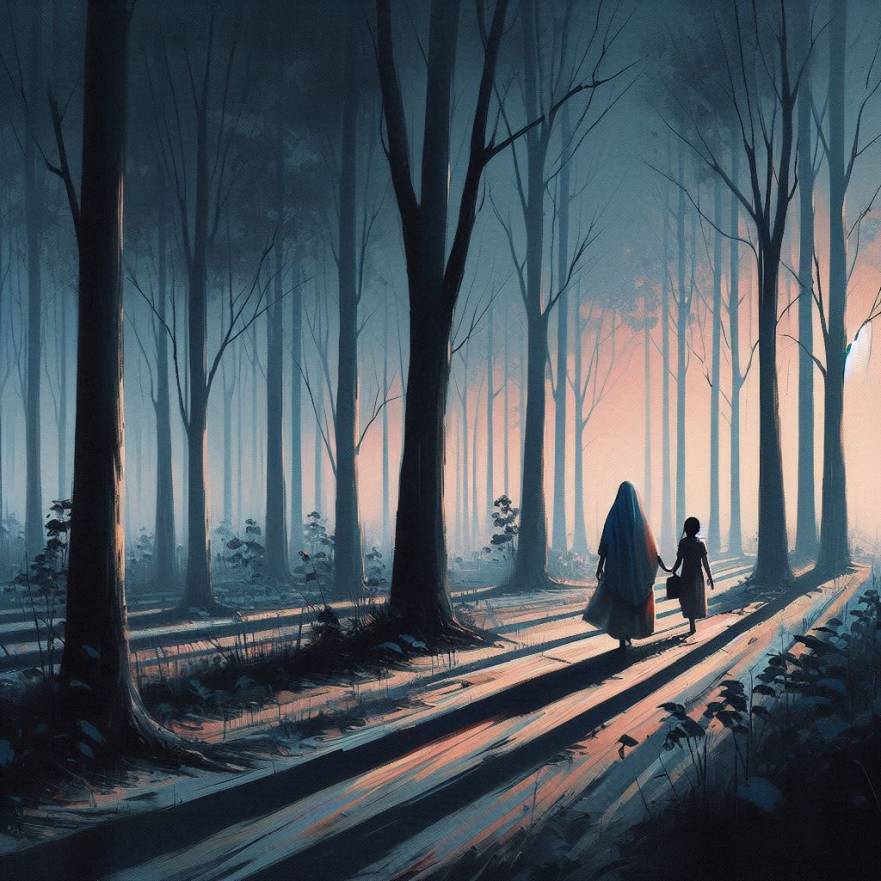
Cere feels the steady rapping of her heart against her ribs as she nears the edge of the property. The air is thick with tension, and the breeze is slight, but she can feel it pour over her when it picks up, pushing the hair on her arms on end. There is a bird call, then its response. Call. Response. Until the two animals have had enough of themselves and either move on or engage each other. She should not be there, that far out from the safety of the house, and if mother finds out…but she needs to know.
The dream from the night before had been quick. She was walking, much as she was currently, but the sky was milky white, and the ground steeped in blood. Cere had crossed the vast expanse of land her mother worked in seconds, which is how she knew it was a dream, until she reached the very edge of the tree line. The marker, the totem that wards off the encroaching strangers, was gone, leaving her and her mother defenseless. Cere had woken up with a scream coiled in her throat that she’d somehow kept caged behind her teeth. And now she is here, hoping to prove the dream wrong.
Cere passes a hand along the bark of a tree when she neared it, petting it affectionately. She loves the trees there, sturdy pines wider at their base than she could reach around when she wrapped her arms around them. She walks carefully, as the roots form a gnarled mass at her feet that waits to snap bone should one be foolhardy enough to not watch their step. Cere reaches the edge of the property where the forest gives way to open field. The trees are thinner here, choked out by some unseen force wielded by the people beyond. She draws even with the furthest tree and traces her fingers along its bark, feeling the ridges against the pads of her hand, trying to intuit a message. She feels exposed, because she is.
Cere takes a steadying breath and circles the tree before her. She looks for the heavy-gauge steel nails that glint daylight from the dark ridges of the bark. Her mother places them at her eye-level, which is over a foot taller than where Cere’s head stands. It’s there, haloed by the faintest hint of rust, but nothing hangs from it. Her mind searches for reasons. It’s decayed. Some animal, maybe, has plucked it off to feast on in its warren or nest. Either way, it’s gone. Cere looks at the nearby trees and, now that she knows what to look for, sees the other nails. All bare. She looks out at the prairie grass waving at her in the distant pasture that extends as far as she can see. Cere knows something else is out there, the people beyond, marching toward them now that the markers are gone.
She walks back into the forest, careful to avoid the gaping chasms where erosion has washed away the ground beneath the tree roots. The earth here is strange and craggy, with open pits that her mother told her were natural, but Cere suspects she’s dug herself. Cere takes the circuitous route home so she can stop by her favorite tree. A spindly crabapple that in late summer produces tiny little knots of semi-sweet flesh around a single, large seed. Cere loves chewing them down to the pit and spitting them as far as she can. But it’s too early in the season for crabapple. At the base of her crabapple, Cere’s made a nest, having lied there enough times that the root bodies have bent around her body, creating a hammock that just fit her. Cere looks at the sunlight through the tree branches, highlighting the imperfections in the bark. The scabs and scars made by beetles and worms. She should be with the goats right now. Milking. Herding. The damn goats need so much of everything. They’re like children. Her children, which is a thought that makes her giggle.
The first buds of have sprouted on the nearby trees. Peaches. Enough come in each year that Cere should be tired of them by now, but no. Bad peaches, maybe, but these will be sun-ripened and gushing with syrup with each bite. Cere’s mouth waters at the thought of them. They will need plenty of fertilizer, but there is an endless supply of that, now that the markers have gone.
“Cere!”
The world, through the lens of tree branches and sunlight, creates tiny prisms of space. These are much more manageable than the world Cere lives in, without borders. Expanding so they take up as much space as they want. All the serious adult things. Love. Chores and responsibility. They do not exist here in her own private oasis. Cere watches an object streak through the clouds in a pocket of branches and sky. The people beyond, traveling, bound for some place other than the home they’ve known their whole lives. They take up more space than anyone, always hungry for more. Cere envies them and their freedom. If only they’d share. If only—
“Cere!”
She rises from her root bed, having stolen enough time. If she dares for anymore, she’s liable to get a beating. Cere looks up through the branches for a last glimpse, but the streaking object is gone. “Coming!”
Cere’s home is simple, small, but she’s known none that weren’t, so, to her, it is a mansion. It has so many secret places to hide that it would be impossible to find them all. The simple hiding spots behind furniture hardly count. Under the bed. Beneath the table. So obvious. But the others. Beneath the floorboards. Above the rafters. To either side of the hearth. Cere is always looking, mindful of spaces just big enough to fit her tiny frame. Cere is terrific at hiding, almost as great at it as her mother is at everything else.
A comfortable fire eats its supper of kindling in the hearth, flicking light across the room, wrapping warmth around Cere as she observes her mother. “Forest and woods,” Cere’s mother prompts, passing her blade along the honing steel. Aside from Cere, the blade is the thing her mother cares for most. “What is the difference to the hunger?”
Cere shrugs, a smile curling on her lips, knowing her lack of response will annoy her mother.
Cere’s mother wags the knife like a scolding finger. “I know you know this. Don’t play dumb.”
“I like when you tell it.” Cere pulls her knees up to her chest, resting her head against them.
Cere’s mother returns her smile, erasing the worry lines and scars, making her radiant. She tests the blade with her thumb; the skin kissing the knife’s edge. Satisfied with the honed edge, her mother slips the blade beneath the skin of the game she’s processing, some sort of small mammal, loosening its hold from the body.
“The forest is real. Wood and bramble. It is alive, but also filled with life, and life-sustaining. It is knowable. Navigable.” Her mother’s hand as it grips the bone handle of her knife is sharp, angular, and the two move as one object. One flesh. Her mother cleaves a section of hindquarters off the carcass and holds it out for Cere. Cere holds it in both hands, but the weight of it nearly brings her to her knees. Her mother looks down at her, smiling through the spattered blood stains across her lower lip.
“The woods,” her mother gestures with the knife point, the sixth finger on her hand, threatening the expanse of woods beyond the open door of the cottage, as if to keep them at bay, “is the forest transformed by panic. Trees fall together, their branches intertwining to blot out the star’s ability to guide. Shadows swell. Noises grow claws and teeth. The unprepared hunter snivels at the base of a tree, waiting for their last moments to come.”
“The markers are gone,” Cere says.
Her mother looks at her for a moment before settling the knife into a joint of the carcass and popping it free. “You shouldn’t be out that far.”
“I know.” Despite the fire, a deep, intimate chill settles into Cere, a frigid slice that strikes her heart and leaches heat. But the cold doesn’t come from outside Cere’s body. It seems to bleed from somewhere inside her. From a worry tickling the nape of her neck. She steps away from the table and moves to the doorframe where two knots in the wood stare back at her.
Cere sees movement at the edge of the forest and tries to track it. She catches a shadow moving between trunks. It doesn’t reemerge, but just because Cere can’t see it doesn’t mean it’s gone. She notices the lack of moonlight on the leaves of the trees. “Quarter moon tonight?”
Her mother sets down her knife and pushes her fist into the strained muscles of her lower back. “You’re the one staring outside, Cere. What do you think?”
“It’s dark out there,” Cere shrinks from the window. It was the heart of summer. Summer skies were clear and endless, but tonight the clouds made a quilt that stretched from horizon to horizon. Above the forest hung a dusky pearl where the moon should be.
“Hmm.” Her mother grunts, and stops what she’s doing to stare out the door. “Come,” her mother motions to her, “supper’s nearly done, and I need you to draw water for our tea.” They eat in silence, save their utensils’ rhythmic beat against the bowls. The fire hisses in its bed, growling when it reaches a moisture pocket in the wood. Cere clears the table, while her mother sits, staring out into the night, her jaw tight. Cere returns from the sink and immediately registers something in the room has changed. It’s the same room, but the three men standing just outside the door seem to make it smaller, almost claustrophobic.
These are the people beyond their home’s borders.
The fire reaches another pocket of moisture and barks, flames dancing across the logs. Cere looks out the window. The light is dim, but serviceable. There are more figures stepping from the woods. From a distance, it’s hard to tell them from the stilled, shadowed forms of the trees. Cere’s heart pushes against its cage, but she thinks of her mother’s words, and tries to keep the panic from snatching hold of her thoughts.
“Cere,” her mother calls from the table, her sizzling gaze leveled at the men, who have not moved. Cere steps quickly to her, and her mother pulls her close, kisses her on the forehead, and presses her sheathed knife into Cere’s hand. “Run.”
Her mother reaches an arm out, the muscles churning and flexing beneath her mahogany skin, and sweeps Cere behind her, while her other arm flips the table and holds it by one of its legs to use as a shield. Her mother’s on her feet, reaching for the cleaver hanging from a hook by the hearth when the table explodes in a shower of splinters. Cere doesn’t register the form of what crosses in front of her before it’s split in two against the cleaver.
Three more men slip in behind their downed comrade and Cere’s mother dispatches them like she did the carcass for dinner. The cords in her mother’s neck tighten. She is beautiful, raw fury, and her hand practiced in its motions. A butcher on the killing floor. She exhales thunder with each strike, her breath a scream. She looks back at Cere once, her eyes still blazing. Why are you still here, they tell Cere. She scampers to their shared loft upstairs. Hiding places call out to her, but she can’t stay inside. If the men set fire to their home, she’s trapped. Just another thing for her mother to worry about. Cere runs to the window and unlatches it. It’s only a ten-foot fall. She’s jumped from tree branches higher than that. She hears her mother roar, and sees her figure cast in the firelight, the outline of the cleaver as she works through the men, and Cere leaps out into the night.
She lands on the ground, keeping a tight hold of her mother’s knife, and sprints for the southern woods. Cere’s breathing is shallow and labored, the air hot in her throat. She hears her footfalls swishing in the grass, but the cadence breaks as another set of steps trail behind her. And another. Then again. Cere does not look back. She doesn’t need the confirmation; she knows there’s at least three behind her. Cere is nowhere near the woman her mother is and stands no chance against the things at her heels out in the open.
Cere’s eyes search for, and find, hideaways. The roots of a towering tree. A fallen log. The short, scrubby bramble that grows between the trees. But she must make it there, first. Cere drives her arms across her chest, willing herself faster. She doesn’t stop when she reaches the first tree. She waits, putting more between her and her pursuers. Soon she’s thick in the woods, her figure just another shadow. At last, she reaches the bramble and falls to her hands and knees, smells the damp earth, and breathes into her arm to deaden the sound. Cere hears her pursuers approach, their steps pausing, uncertain. They have run into the forest, focused on catching her, but have lost sight of each other. Separated, alone, and stumbling in the dark, the people beyond are helpless. Cere’s right hand grips the bone hilt of the knife, but she waits.
She hears them speaking to one another; the panic rattling in their voices. They bleat and moan and curse. First for losing Cere, then at having lost themselves. Their feet are unused to treading with caution. They stick out their legs, trusting that the ground will be there, instead of a jutting root or a sunken hole in the earth.
One of them cries out. Cere hears the snap of wood and bone, followed by the dull thud of a body falling to the ground. That one will be easy to find. Cere leaves him to whimper in the dark and follows the other two, moving soundlessly in the bramble. Instead of retracing their path, they trudge deeper into the woods, wasting energy. Making themselves known. Finally comes exhaustion—the hunter’s most vital leverage over prey. One, a portly man, staggers to a stump and sits. The other, a man with yellow hair, continues, groping the darkness in hopes it will keep him from running into a tree.
Cere emerges from the bramble behind the seated man. Her mother’s knife is out and glimmers in the pale night. Unlike the men, she is steady. Quiet. She reaches her left hand under the man’s chin and pulls up, drawing him a second smile with the blade. Cere’s right hand is slick, but her grip on the hilt is solid, just the way mother showed her. Quick as a snare, she’s back in the bramble, right when the blonde man returns. He stares at the body on the ground, his mouth moving like he’s chewing on something.
The man with the broken leg releases a scream out into the night. Cere is grateful for this, as it stokes panic into the blonde man, who sprints in a random direction. The ground here is treacherous and uneven, and Cere watches the blonde man fall headfirst into a crevasse. She hears his body land, the sound of his vertebrae snapping loud and distinct. She knows the sound well from having to prep game meat for dinner.
Cere finds her way back to the broken man, who’s dragged himself to her nest under her favorite tree. Whatever bravery he’d brought with him to Cere’s home is gone, and he presses himself against the tree, trying to keep his back against something. He stinks. Cere can smell him from where she lurks in the bramble. Urine and the skunk smell men give off when they’re frightened. His eyes barely register Cere as she emerges before him.
“Please,” the man stammers, spittle flying from his mouth.
But Cere knows. If allowed to escape, he would return with a larger hunting party to take what wasn’t his. In exchange for her mercy, he would extinguish her life. Wasn’t that what he was chasing her for? Cere’s response is the sharpened steel birthed from its sheath.
Heavy footsteps approach and Cere pulls the knife from the man’s limp body and listens, her muscles taut and ready. But it’s her mother, carrying a burlap sack with a widening stain of red in one corner. Blood cakes her clothes, but they will burn them, anyway. She holds out her hand and Cere places the knife in it, recognizing how light her hand is without it.
Cere’s not allowed to do the next part. Her mother cuts off the clothing from the man at Cere’s feet because the clothing doesn’t break down like flesh does. The man’s body is pale with hair in strange places. Her mother grabs the marker from between the man’s legs and cuts it free before tossing it into the burlap sack.
“Take the fertilizer to the fruit trees,” her mother says.
Cere nods, but lingers.
“Did you not hear me?”
“I want a knife,” Cere says.
Her mother cleans her blade against the burlap, but stops. “How many did you get tonight?”
“Three.”
A smile, that same one from earlier, appears on her mother’s face, quick as the hare from its warren, then gone again. “I think you’re right.”
Cere drags the fertilizer. The arms on the bodies catch hold on every loose root, and the bodies are heavy, but Cere’s body is growing stronger, and she doesn’t complain. They’ll bury them later, after they’ve had breakfast. It’ll be a long day come morning, Cere knows, but all the days are long, so it’s easy to forget the work.
She watches her mother head to the perimeter of their property, pulling the culled markers from the sack, and impaling them on the nails. Her mother walks to the next tree just as the sun rises. Framed against the light of dawn, her mother looks angelic. The blood on her clothes nearly matches the ripening sky. Cere cocks her head and sees herself in that tall warrior woman. Or, at least, the woman she hopes to become.
Cere once thought there was a magic at work with these markers, and that’s what warded off the people beyond. But now she knows the markers are merely a warning, and what keeps them safe is her mother’s strength and their love for each other. Cere wonders what day the peaches will come in. What color her knife handle will be. Most of all, she wonders why sunrises look so starkly beautiful after a hunt. Scarlet and orange, like their peaches. Low-hanging fruit. The sun is a fruit, Cere thinks, and giggles. Then she hefts up the legs of the body and does as her mother says.
* * * * THE END * * * *
Copyright Christopher Narvaez 2025


Powerful, affecting, impactful and violent story spelled at times by the beautiful metaphors of the magnificent prose. The reason for the unassailable aspect of the district occupied by Cere and her mother is not clear, but it harkens back to Lesbos and the isolation of the Amazons from men. When I saw the title it brought to mind other “low-hanging fruit,” the bodies of the thousands of African American lynching victims in the history of America and for a time, I thought that was perhaps the allusion. But, no. There is another, more symbolic meaning. Lovely writing, with vivid, bold and heartfelt descriptions of the love between mother and daughter, combat between male and female and the awful fact which is disclosed in the end. Great work, Christopher!