
Humanity and Genre Fiction: An interview with author J. D. Strunk
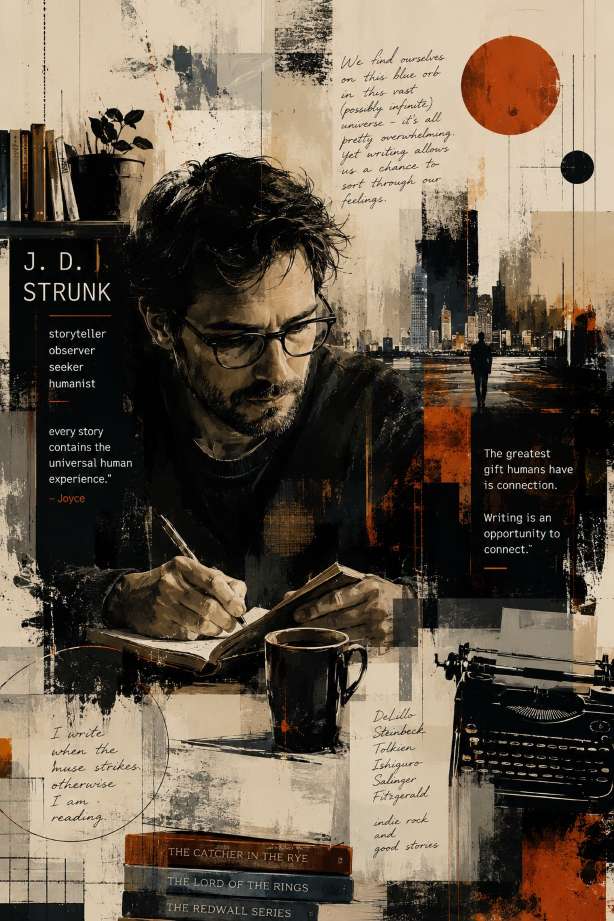
FreedomFiction.com presents an interview with J. D. Strunk, hoping to highlight a popular independent author, his personality, philosophy, influences, creative process, career journey, and outlook on publishing and writing life.
Dey: What first made you want to become a writer?
J.D.: Growing up, my mother would read to us frequently. The Narnia series and the Redwall series both come to mind. It instilled a love of reading at a young age, and stoked the fire for writing.
Dey: Was there a particular book, author, or moment that influenced your decision to write?
J.D.: In high school, I remember reading The Catcher in the Rye and thinking, “Hey, I could do this!”
Dey: What kinds of stories or subjects naturally attract you as a writer?
J.D.: I like stories that deal with the big questions, but in a sly way. Joyce said something along the lines of “every story about Dublin contains the universal human experience” (paraphrased) and that resonates with me.
Dey: Which themes or ideas keep appearing in your work, even unintentionally?
J.D.: The general strangeness of existing/existential angst. We find ourselves on this blue orb in this vast (possibly infinite) universe—it’s all pretty overwhelming. Yet writing allows us a chance to sort through our feelings.
Dey: How would you describe your writing process from idea to finished manuscript?
J.D.: Most of my stories generally begin on my Notes app as a sentence or two. I may add to those sentences for a day or a week. When it has some substance, I will send it to a computer and make it a Word file to polish it.
Dey: Do you write with a detailed plan, or do you discover the story as you go?
J.D.: I generally have an ending pretty early on. But that’s as much of an outline that I do. With a longer story, I may write a couple scenes, and then link them somehow. But there is no detailed outline, generally.
Dey: What part of writing do you enjoy the most—and what part do you struggle with the most?
J.D.: My favorite part of writing is the editing, once the first draft is over, and you can go looking for the smaller details to “perfect” (never perfectly) the story. The first draft is always the hardest. It’s to get out of your head and just let the story breathe, sometimes.
Dey: How has your writing changed over the years?
J.D.: I think the more you write, the more you understand what is important to the story and what isn’t necessary. That being said, I’ve had some 15-year-old stories published recently, and that feels validating, knowing that old stuff still holds value.
Dey: Are there writers, artists, filmmakers, or thinkers who continue to inspire your work?
J.D.: Many! I love Don DeLillo, John Steinbeck, J.R.R. Tolkien, Kazuo Ishiguro, J.D. Salinger, F. Scott Fitzgerald. Music plays a large role too, as I’ve written several stories inspired by songs, mostly early 2000s’ indie rock.
Dey: What role does personal experience play in your writing?
J.D.: About half of my stuff is slice-of-life stuff, much of which is based on personal experiences. And I try to keep my sci-fi stories human and relatable, even as the setting may be fantastical.
Dey: How important has discipline and routine been in your writing career?
J.D.: I don’t really have a writing routine. I write when the muse strikes. Otherwise I am reading. Per discipline, I feel when you have a good story rolling, it is harder to quit it than to finish it.
Dey: What have been the biggest challenges in your journey as an author?
J.D.: I would certainly like to be further along with it all. As a younger writer, I definitely underestimated the difficulty of making a living with words.
Dey: How do you deal with rejection, criticism, or creative self-doubt?
J.D.: Rejection has become so routine it doesn’t bother me at all. Most criticism I’ve received (if it’s not mean-spirited, which it rarely is) has been useful, often leading to a story later getting published. Self-doubt is always lurking, but it is a good check on the ego.
Dey: What does success mean to you as a writer?
J.D.: Connecting to people I’ve never met, and sharing for a moment the bizarre gift of being human.
Dey: Do you believe publication is essential for a writer, or can writing itself be enough?
J.D.: Hopefully the writing is shared in some way, if it is meant to be disseminated, but publication is certainly not a requirement for being a writer. I wrote for years without really trying to get published.
Dey: Has publishing changed your relationship with writing in any way?
J.D.: Gratefully not really. On occasion I will attempt to mimic the writing style of something that got published, but that is more of a writing exercise than a change in my own style.
Dey: What is your opinion of the modern publishing world and today’s reading culture?
J.D.: For having been writing for years, I really have very little idea how the big publishing world works. It all feels very inward-looking and hush-hush from an outside perspective.
Dey: What kind of emotional or intellectual experience do you hope readers take away from your work?
J.D.: That “empathy” is not a dirty word. That most humans are doing their best in this life.
Dey: What advice would you give to aspiring writers trying to find their own voice?
J.D.: Read often and broadly. Every genre (at least some).
Dey: Looking back on your career so far, what has writing taught you about life and/or people/society?
J.D.: The greatest gift humans have is connection, and most people are seeking to connect with others in a sincere and humble way. Writing is an opportunity to connect.
* * *
Read fiction from J. D. Strunk at FreedomFiction.com





I really got into this one. Your story telling kept me enthralled. I didn't want it to end.