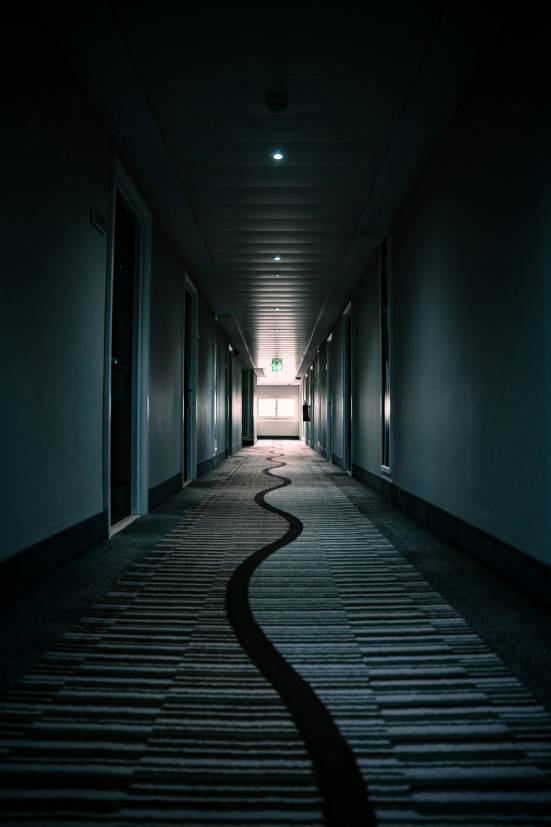
There at the Show by Steven Robnett
A bumpy, unpleasant ride later, the shuttle bus finally drew up to a stop in front of the Madeline Hotel. Traveling light, with only a garment bag, containing his rented dinner attire and one small sample case, he hurriedly exited the shuttle bus, along with the other passengers.
The hotel was actually quite charming. With its red brick walls and white Grecian columns, it resembled a small-town bank or post office. The landscaping couldn’t have been nicer—lots of expensive, carefully tended plants and shrubs, a subtle mélange of tree types, colors and textures. The summit of the hill was surrounded by a mature forest, as deliciously wild as the ones depicted by the famous landscape painter, Asher B. Durand.
Entering the foyer, he went up to the front desk with the burning question on his mind. A dark haired woman, wearing a green dress, looked up from her reading material.
“Hello, I am here with the Ghulam Madrid party—the M H & S D. We are having an event at the convention center today through Sunday. Do you know whether or not there is going to be a shuttle bus running out to the convention center this evening?”
“Your name?”
“Manny Tanaka.”
“Just a minute. I’m not showing anything. Can you spell your name?”
“That’s T—A—N—A—K—A.”
“Manuel?”
“No, Manny, just like I said. Manny, that’s my name, not Manuel.”
The woman consulted the computer screen. “There seems to be a problem. Did you make a reservation?”
“Yes, I made a reservation. Here is the printout from my online receipt.”
“We’re still not showing you here.”
He could feel the grind of impatience wearing him down. “Is there something you could do to speed things up? Please, I’m in a hurry.”
“We’re not showing you in our system.”
“Well, obviously.”
“The best course of action would be for you to reenter your reservation.”
“What would that accomplish?”
“It might go through.”
The desk clerk insisted that all his information should be entered fresh. That way, Tanaka would be forced to review the correctness of the information and consequently the process would more prolonged than it would have been had the clerk merely copied the information off the receipt printed out from her computer. The presentation was slated for five in the afternoon. Although Manny’s presence was deemed an absolute necessity, he actually performed a very tangential role. In addition, his supervisor extolled group unanimity as a means for the company to attain the competitive edge. That would leave Manny only two hours and fifteen minutes to shower and shave, get dressed, grab a bite to eat, rush outside, and hop onto a taxi or shuttle bus and hurry on over to the convention center.
Manny checked his watch for the second time and shifted his burden to the opposite shoulder. Observing the other guests at the hotel walking past, like they didn’t have a care in the world, he thought: “Why does this always have to happen to me?” It always made him feel slightly queasy being in these places. He asked: “How much longer is all this going to take?”
After all this, the desk clerk could only offer him a false hope. While she had successfully entered his information into the computer, there were no longer any rooms available in the Tourist Class. However if he didn’t mind upgrading to an Executive Suite, she could place him in one without delay.
“How much are they per day?”
The desk clerk told him. Manny had to have a place to change and he could not very well arrive without a shower. If the company did not agree to pay all, he trusted his reimbursement would be at least partial, with himself down only about what an ordinary room would have cost.
The bellhop would insist on carrying the garment bag. Rather than make a scene, he did not protest very much. He put on airs to melt into the social fabric, assuming a languorous attitude, unconcerned and bored. The room was magnificent. Every feature that deviated from the norm was like a laceration in the flesh.
The annual occurrence had been six months in the planning. The D-Team was slated to appear at five with an active presentation. A hologram would remain afterward on site to showcase the product with team members in pairs assisting this, the immersion phase of the presentation, all of this ending at eight, Sunday evening. The product was a good one, a vast improvement over the one the company had previously promoted.
He thought of his friends at the center as a raft of faces: glad, sad, smiling, scowling, serious, intent over some problem, flashing a sudden smile, talking to him, saying something ordinary but welcoming. He would be glad to be part of the team again.
The shower spray was disappointingly thin, like warm air oozing from out of the spigot. The thing too was how obviously engineered it was. What with the sunlamp to make things all warm and inviting, so you don’t linger in the shower and use up all the water.
Above the sink counter the hazy image of his twin self: a blob of a shape streaked with water droplets running down the glass, a large soft man wearing size 16 shoes, who had muscles under the flab which he didn’t know how to use. When he was out walking he could look down on most people and sometimes he would discover debris that people were carrying around on their shoulders and on top of their hats.
He stepped into a fresh pair of undershorts and pulled up the trousers. He had promised himself a treat afterwards at the restaurant: a cheese omelet. He tucked in the tail of his shirt, buttoned the lower tab on the inside of the waist, snagged the metal loop, buttoned the outside front and pulled up the zipper. There was something ceremonial about this, donning these rented clothes. They seemed confer on him some extraordinary feeling of power.
Manny Tanaka went downstairs for that omelet. He had promised himself an omelet, and he was a man who always kept his promises.
He snatched a food tray and laid it down on the rail, using more force than necessary, and sliding the tray into position with one hand, the other hand holding the sample case by the handle. He stopped before a glass case containing scrambled eggs, bacon, and sausage rolls. From the kitchen came the sounds of meat sizzling on the grill.
The television sets continued projecting their silent images throughout the dining area, an effort to inform that went largely unnoticed and unappreciated, as the modern art prints on the walls, and the artificial ferns decorating the short walls between groups of tables. The diners were seated apart from one another, engrossed in their own affairs.
After bussing his own food tray, Manny went outside to discover a means of transportation to the convention center. He stood there in front of the hotel with a sour expression on his face. There was no parking lot directly in front of the hotel or in close proximity to it. There was one way down the hill and down a steep flight of steps, but he hadn’t the slightest inclination to investigate. Then he noticed three people standing, like himself, in front of the circular drive, and one of them he recognized as somebody from his department.
“I was beginning to think I was the only one.”
“Right, ha, ha. We’re like little lost lambs that have lost their way. There’s not even a trail of breadcrumbs for us to follow.”
“Ha, ha. All they are going to find are our bleached bones in the desert.”
“Say, did you have any trouble getting here? What did you think of the ferry boat? I’m going to have to come out here again with Cynthia and the kids. It’s getting so crazy with all the gunshots going off in the city. Just two days ago this little old lady we used to see walking with her little dog past our building—well it turns out she got herself killed. Shot in the back.”
A black sedan pulled up to the turn-around and the back door flew open. Manny’s coworker hopped inside and slammed the door, saying, as he did so, “Sorry, we’re full up.”
Manny Tanaka watched the receding tail-lights of his friend’s lucky ride.
A woman, dressed in a black pants suit, came out of the hotel. “Excuse me—are you here for the Ghulam Madrid party? A shuttle bus will be arriving in a few minutes to pick you up and take you to the convention center. Just hold on for a little longer.”
Manny looked at his watch. It was now a quarter to four. Almost one hour to get there and that was not counting going into the building, going through security, and walking to the place where he was supposed to be, where they would be waiting for him.
He was on his way to the steps, going down to the parking lot, when he heard the screech of brakes. He looked back over his shoulder. It was the shuttle bus.
Thereafter, it was a consistently unpleasant, lurching ride. He could see the driver, a heavyset black woman wearing a blue jumpsuit. He was sitting very straight on the bench with his sample case propped on his knees. The cost of living here must be through the roof. Even a modest sized house with two bedrooms probably cost over two million dollars.
They were coming to the end of the residential area. A succession of drab little businesses and woebegone, rundown houses, interspersed with open fields and parking lots. The bus had to stop at a school to let some people off. Then it continued, now along the edge of an athletic field. Waiting to get back on the main road—the driver suddenly shifting gears, the bus coughed, jolted, and leapt ahead. A little further along the driver had to stop to pick up a passenger, a heavyset woman in a raincoat, toting two bulky shopping bags.
There should have been a sign somewhere warning people not to sit here in these awful sideways-facing seats. You end up flailing around just to keep from falling on your ass. It didn’t help the driver with the abrupt way she drove: twisting and turning, starting and stopping.
At last they arrived at the convention center, a modern-looking building in the middle of a field. A sign pointed the way to the front entrance. Getting into the building you were immediately confronted by a line winding back and forth between temporary, roped-off lanes. A little further along, there were screeners checking identification cards, and after that a metal-detector gate, and after that an x-ray machine that checked everyone’s belongings.
When it was his turn and, looking down to make sure that his feet were behind the line, he held up his identification card with its miniature portrait. A certain note of offhandedness crept into the proceeding, when the screener, now checking the monitor, gave a little snort of derision.
“You’re going to have to wait while this gets fixed; you’re not showing up on my files. Go on and sit down over there where you came in. See those chairs under the windows?”
So now it’s the penalty box. Manny checked his watch: only fifteen minutes to go. Why do people like this have to exist? They drift into these jobs only because they don’t have the right stuff to establish real careers, making these arbitrary decisions. There is nothing you can do about it. One word of complaint and they will only come down on you harder.
Some workmen came in through the door, pushing some heavy object covered in blue plastic, about the size and shape of a grand piano, to the right of where the security screeners had people lined up. Seeing this made him wonder. How would it be if he tried to sneak around to opposite side—and would they snitch on him to the screeners?
The security guy came back. “I’m going to have to ask for that brief case.”
“It’s not a brief case; it’s a sample case.”
It annoyed him when people were so imprecise with language. The security guy, let’s call him Francis, wasn’t going to be put off by idle criticisms. It was clear that his training had prepared him to some extent for what he was doing now.
Manny Tanaka picked up the sample case by the handle and held it out at arm’s length. The security guy took a half-step back. To Manny’s annoyance, this innocent gesture had set off an emergency situation in that guy’s mind.
Slowly enunciating each word, Francis issued the command, “Put her down on the floor and scoot her over towards me.”
Manny slid the case forward a few inches.
While fate had been in the balance, Francis had held his breath. Now that the worst was over, he let out his breath, along with the briefest of nervous laughs.
“Now sit way back in your chair while I pick up this here thing.”
Manny thought of telling him to relax, it’s only twelve bottles of Selerac. But that was not quite accurate. In point of fact the bottles were empty; so they only contained air. But how was he going to communicate, to him, that it had all been intended as a gag, to get a laugh and to loosen things up—when, with these people, the more you tell them the more they want to know.
Francis picked up the case. “All right then, you might as well tell me what’s in this thing, so I know what I’m dealing with.”
“It would take too long to explain. Would you mind just phoning my supervisor, who should be here at the show?”
“Cell phones don’t work in here,” said Francis, speaking all tight lipped.
“Could you page him then?”
“Pagers don’t work either. You could radio him if he’s got one of those belt de-vices.”
“No, I don’t think so.”
Francis was more affable now, for some other agent had taken his place in line, and probably this was a welcome change of pace from what he normally had to do. “Well don’t worry about it,” he said. “We’ll figure something out.”
“I’m supposed to be there in fifteen, no, ten minutes. Could you hurry? I mean really, really hurry, like right now.”
Now Francis started to get mean-sounding, this civilian having crossed the line into noodgering and whining. Affable Francis had turned into stern Francis, stabbing the air with his index finger.
“I’m not sure we can help you. You should have got here earlier.”
Manny stared, projecting rays of negative energy at this stupid yokel. Look here, it’s written on the back of the card. All you have to do is call up the number on the back and we can clear this up in one minute. This is f****g ridiculous.
Manny left the building and followed the sidewalk, along to the back of the building. There was no plan; he just felt like walking, and the air was fresh and cool, the light a little dimmer. At a service entrance in back, he discovered the food preparation area—where he was challenged: “What are you doing here?” Manny backed away; his intention being to scoot out the back door. But then, when he got to the end of the work tables, he turned and headed the other way, up the aisle and toward the doors leading back into the convention center.
This had turned out to be a marvelous way for him to bypass security.
The man called out to him, “No, no!”
This didn’t discourage Manny from doing what he was determined to do. It was like someone taking a plunge into the deep end of the pool. That queasy feeling just before taking the plunge is part of the experience which gives it an undeniable zest.
Manny waded through the crowd, waded through it unconcernedly, unconsciously drinking in the visual impressions, the jumble of color and motion. So many people were assembled there and so much effort had been expended. Amid the rollicking atmosphere of this forced event, Manny’s ears were assaulted by overloud sound effects, blaring fanfares, and the fizz and the sound of popping champagne corks, all these stock sound effects running on a continuous loop—taking a sledge hammer to the brain, touting the rollout of some new commercial product, stretching of the boundaries of the possible.
The next stage of his progress found him sitting, all on his lonesome on a cheap plastic seat, like those found in institutions such as the unemployment bureau, within earshot of a vibrant living world. There should be a crime dangling a person within reach of something nice and then snatching them back, just as they had thought they had made it.
And what was he going to do now? He could wait until they got their act together or he could take the initiative, like one of those motivation posters that say this is the day. He stood up and made his way slowly to the door, opened it slightly and looked out—nobody standing there. He opened it a little more and stepped outside, the noise of the show a notch brighter.
A sense of invulnerability taking hold of him, he walked straight back to the kitchen. It was either that way or the fire exit—and that would only be as a last resort. The astonished looks of the brown smudge (his ugly term for them) as he strode past the food preparers’ tables. He gloated over them, considering himself vastly superior, for he would soon be free.
He strode out onto the loading platform and directed his gaze back the way he had come. The blacktop road and beyond that the green lawn stretched invitingly on. Only a short distance in the open and he would disappear.
The grass was short and dry. As he walked, he could feel every declivity and bulge through his thin soled shoes.
Through the slats of the fence he could see into the back yard of somebody’s house, which showed through, like one of those trick picture shows, when you look through a vertical slit of a drum that goes round and round, revealing a circular patio area with lots of barbequing equipment, tables, and so on, and several of those lights that run on solar energy along the edge of the sidewalk. The next fence he came to was chain link, and he got more of an eyeful: A really neat and trim backyard shrubbery assortment with a probable overactive sheers cutter. He could have practically stepped over the fence or jumped over it—but on second thought, he thought that was no longer possible, for he had gotten too old. The next fence wasn’t any better—no gaps for him to squeeze through. The next one had a barking dog that tore across the yard and lunged at the fence, rebounded and lunged again, with loud continuous barking that gave him a scare.
The rest of the backs of the yards were all the same, tall fences over which he could stand with his chin resting on top, but with nothing, on those vertical planks, upon which to gain a foothold. Eventually he was led back to grassy field where he had first set out. He looked up toward the convention center and there he saw the blinking lights of a squad car.
This circumstance altered his plans. Now rather than cut straight across the field, he would have to go the long way, walking along the edge of the field and keeping as low as possible. With a little hasty looking around he was able to find a worn path in the weeds leading down into the forested area. Going along, without any adjustment for the change of terrain, his feet slipped on the loose, sandy loam and he fell. After that he proceeded more cautiously, sometimes walking down sideways with one foot higher than the other and on the sides of his feet. The air became musty and dank, smelling like an old cellar. At the bottom, he stepped across a rivulet of brown water; the ooze on the other side releasing each footstep with a sucking sound.
He emerged onto a side street with a residential area, straight ahead. An alternative route leading to the left, toward the main road, was a little further ahead. Ahead, the street continued downward, shaded by mature trees whose spindly trunks afforded an almost unimpeded view. Here too the homeowners had a mania for back fences. He skirted their collective fence-lines, walking along where the township’s property-utility easement began. Back up the way, he caught glimpses of traffic through the foliage. The sun was low by this time and something was rising from the earth like a blue mist. The floor under the tree canopy was the color of decay, from the rotting leaves of previous years, along with withered stalks and burst open seed pods.
Mrs. Evans, of 418 Wilbur Street, looked out her back kitchen window at 5:47 pm and saw a strange man looking in her direction. She interpreted this manifestation as a vagrant person who was clearly up to no good. A minute later she was dialing 911.
At 5:50 pm, Alfred Thomas, of 424 Wilbur Street, was peering out his back window with a pair of binoculars. James his brother was noodgering his brother to hand over the binoculars.
At 5:55 pm, Mrs. Sturgis, of 428 Wilbur Street, had just emerged from the garage where he had just returned a pair of pliers—and was startled by the unexpected sight of a strange man walking past with a stately gait, reminding her of an elk. Regaining her speech after a few moments, she let out a barely audible “what?”
At 6:01 pm, Marsha Stenhaven went to the back door of her house only to witness the unfolding of a little conflict at the back fence, a strange man poking a stick at Little Bits, her wire-haired terrier, who was barking like mad.
Approximately one half hour later, Deputy Sheriff Nolinque Harrison parked her cruiser at the end of the 600 block of Koch Street in pursuance of certain reported sightings of a non-resident, trespassing male. Using her satellite-guided map device, she plotted the direction of travel and the most likely vectors in which to intercept the individual.
Manny Tanaka had observed the squad car earlier between houses, while standing behind a small tree, and then made his escape, back into the woods. The road he had been on previously bent too far north, before going south. It would be a pretty clever trick when he finally marched into the hotel lobby. He was not sure when this would be, but probably it would be after dark.
“I said to my James, this is the sort of thing we were trying to get away from,” said Mrs. Evans. “It damn near turned my heart into ice when I looked out my back window. I had to look twice. I just couldn’t believe my eyes.”
Further canvassing the neighborhood, the deputy acquired a physical description of the trespasser from Alfred Thomas, a freakishly mature sounding fifth-grader who was the one who opened the door. After taking down his statement, the deputy inquired whether or not his mother was available for questioning. She was lying down he said and would prefer not to be disturbed. Working on the assumption that this constituted a possible child endangerment exigent circumstance, the deputy let herself in—and only a few moments later encountered a second and much younger child, suddenly emerging from a doorway, as she went along a darkened hallway, and, without thinking, one hand reached for her sidearm.
Coming to the end of the hallway, the deputy announced her presence. There came the sound of thumps from inside the room of furniture possibly being moved. Rap, rap, again, with the flashlight. The door opened, and a woman appeared, looking at her with a querulous expression. Black, zombie-style makeup, the tops of her breasts spilling out of a black cocktail dress. The lady was going out on a date—or she was working.
“Ma’am, do you have supervision for these youngsters? I don’t want to have to come here later and find them home alone. Because I can’t help but notice that you are preparing to step out for the evening.”
“Yes,” she stammered—“there’s a babysitter coming over in a little while.
The woman reached behind her, for a purse lying on the bed. She opened it and fumbled around inside it. The woman took out a pack of cigarettes and asked the deputy if she minded if she smoked.
An unmarried woman, living alone, with two children—there on a dresser was a photograph of a third child, a little girl. The absence of a male presence was glaring. All those woman-things piled on the dresser; it was evident that the woman liked to acquire beauty products; yet, at the same time, she kept a messy house.
“Well, I won’t keep you any longer, Mrs. Thomas. I only wanted to give you a heads-up about the prowler roaming around the neighborhood. So I’ll let myself out.”
“Oh all right. Thanks. Thanks for your help.”
The tantalizing details of the domestic situation loomed in her mind. What mystery individuals remained yet to appear—a boyfriend, possibly a junkie boyfriend, who sponged off of her and benefitted from her ill-gotten gains; and to protect her boyfriend from prosecution, she might be willing to give up certain information leading to more arrests.
But things were such that she had to get on with the job. When she had entered the house, the sky had been quite dark. The sun’s orange glow had been visible at the top of distant cumulus clouds in the east. Now coming outside, she glimpsed a bright star in the west. The luminescent, reflective strips on her cruiser looked back at her, as she walked down the sidewalk. All part of the trappings of office—along with the sharp creases of her uniform trousers, the bulky harness she wore on her chest, the Glock pistol hanging from her belt.
The trees were throwing out alarm signals that she was in immediate danger. Danger, she had learned, was almost always accompanied by darkness. She couldn’t get over all the trees and the wildness of everything. While she understood the attraction of living out here, she only knew that she would never want to. All this darkness—and the insects making that incessant noise gave her the heebie-jeebies.
Calling in, to the sheriff’s office, to make her report, she was ordered to respond to a call, out at Hobb’s Farm, by a frantic-sounding dispatcher.
“It’s too early for this,” said Deputy Harrison, thinking of the usual Friday nights—the brawling and drag-racing, centered about a certain rustic tavern. It would be pitch black by the time she had arrived at the location of the emergency.
Deputy Harrison drove her cruiser into the driveway leading to a farmhouse. In the distance she could see the flashing, blue strobes of another cruiser. It would be her advisor and senior member of the staff. Chief Deputy, Clyde Brewer was there with a man lying face down on the ground. A large, white dog with black spots was standing with both paws against a wire fence, barking incessantly, furiously.
The chief deputy called to her. “For God’s sake, help me get a hold of this guy!”
They worked together the chief deputy with one knee pressed into the man’s neck with Deputy Harrison snapping on the handcuffs. Together, they pulled him onto his feet.
“You never can tell with these big guys,” Chief Deputy Brewer offered.
The guy seemed not putting up much resistance at this point. Most of these types were not too bad—she had to admit. Once they had gotten it in their skulls that they were no match for what they were up against.
She could see that the guy wasn’t going to be any fun. He was one of those sad cases, whose ego is so fragile that getting arrested just about kills them. The worst part about it was when sometimes they cried. She had seen it go down like that.
This guy wasn’t going to be in any trouble. He was going like it’s over, it’s over. And what a state he was in; it looked like he had been rolling around in the mud. Probably stole that tuxedo from somewhere—or had acquired it from some charity, like the Salvation Army.
The sheriff’s department housed an expensive new lockup, owing to a generous state grant, to the tune of forty million dollars. Since the village was forced to play host to the rowdy dregs from the city, it was only fair that the state pitched in, to endow the village with adequate funds to provide decent housing for their miscreants.
The prisoner found himself deprived of shoes, belt, bow tie, and his personal items. The psychologist, being not at his desk, an assistant warden entered the prisoner’s information on the computer.
Along with a pair of paper hospital-type slippers encased in clear plastic, the new prisoner was given a suit of cotton flannel pajamas and a thin wool blanket. Despite his fragile, emotional state, he was not allowed even a moment to compose himself, but was urged on.
The hub-bub in the place was distracting. The prisoner sat hunched on the edge of his cot with his elbows on his knees. All he wanted to do was to sit and think, sit and think, go over and over it all. He thought that if did not keep thinking about it, it might come sneaking up on him. If he was relentless in his remembrance of everything, he would not be lured into a state of forgetfulness—so that he would not have to renew the discovery of what happened with the same rawness of the experience.
He discovered the wall clock, which provided him some amount of solace. He watched the second hand revolving, knowing that time was on his side and that eventually all this would be in the past.
Somewhere the prisoner’s image, in grainy black-and-white, was flashed onto a screen, before someone leaning back in a swivel-back chair with a cup of coffee within easy reach.
Manny Tanaka got up to take a leak, lumbering over to the contraption; but then some little guy was there assuming a threatening stance. Manny was feeling so washed up he gave it up as a lost cause and went back to his blanket, telling himself that he would try again later.
The plundering of blankets was a regular sport; so that some prisoners had as many as three blankets to keep them warm, leaving the others, shivering, and sometimes getting up and rubbing themselves briskly, to restore the circulation.
A late-night telephone call, to the Madeline Hotel, verified some of the prisoner’s assertions, but also revealed a disturbing fact—that the prisoner’s line of credit had been denied, and that his belongings had been put into storage, until he could pay up his bill, at a cost of twenty dollars per day. His total bill came to about five-hundred dollars. The manager of the hotel said he was sorry but they had to think of the solubility of the hotel and their responsibility to their stockholders—and besides, they provided a lot of people a livelihood, not to mention all the vendors who relied on them to sell them goods and services.
Wake-up call was at precisely six in the morning. Breakfast was after that; and then names of some of the prisoners were called up, who were slated for a court appearance. “If you gain your release, you will be given sack lunches, which I believe today are peanut butter sandwiches. Those of you whose name I have announced are to line up here for the showers. You’ve got to be hosed down, so that you’re decent when you appear before the judge. The rest of you can walk slowly into the chow hall.”
Manny was one of those to appear before the judge. After showering, he was given an orange jumpsuit to put on, along with a pair of paper slippers.
The whole thing was quite perfunctory—the group of prisoners was ordered to stand up en masse while the judge rattled off the legalese that cut them loose, with the stipulation that they were to be trespassed from the island for no less than ninety days. At the conclusion, he gave a heartfelt statement about something, maybe something about his hope that this experience will have taught them a valuable lesson and that they would not let this happen again.
Riding along with the other prisoners, the air inside the personnel transport vehicle was permeated with the aroma of corned-beef sandwiches, kept in paper bags, and kept for safekeeping inside a picnic cooler, under the supervision of the driver and his assistant. Arriving at a small park, the prisoners were cut loose, for real now—each prisoner, as he got off, being handed a sack lunch and a complimentary one-way ticket, for a ride on the ferry boat. Manny proudly passed on the complimentary ticket, saying he would buy one for himself.
The several prisoners, then, went their separate ways. One man, of intimidating size and mien, went right over and smooshed his sack lunch into the nearest trash can, with such violence, that he must have flattened anything inside.
There was an advantage to being tall that it was possible to hunch the shoulders in the most dejected manner and still be in a position to look squarely at people. His posture was now pretty much the same as it had been last night, when he had sat on the edge of his cot, sulky and indignant over being arrested.
Manny walked up and down. But no restaurant, in sight, seemed to be in his price range. He could tell, right away, because the menus were invariably pasted to an outside window, and he could see what they were charging. Finally, he located a fish place whose prices weren’t too steep. There was an ATM machine, nearby, and it would probably have been a good idea to get some extra cash. But he was so hungry, he decided to skip it.
Inside the washroom, he washed his face and brushed his hair back, the best he could using just his fingers. There wasn’t anything he could do about that nine o’clock shadow; he just hoped nobody would notice.
When he placed his order, his mind was focused upon this giant breakfast, he was going to have—pancakes, three eggs and sausage, maybe, a side order of glazed breakfast rolls.
On the table next to him sat a mother with her two children, a boy and a girl. The little boy was playing with some animal figures, a black rat and a cartoonish-looking lion, bobbing them around and dashing one against the other. The little girl was sitting there all prim and nice, sitting up straight. The mother was talking to the girl about what she wanted her to order.
A waiter came over. “Excuse me sir. How are you going to pay for this?”
Manny took out his wallet and checked inside, finding only some singles and a five dollar bill. His fingers fluttered nervously over the bills.
“Will you accept credit?”
“To you, no. However there is an ATM machine inside, in the back hallway.”
Manny got up and disappeared for a little while, to conduct this business.
Moments later, the mother with the two children looked up, from the table, to the sound of a loud banging inside the restaurant. She had not been paying attention to the earlier exchange, with the manager and this customer sitting at her table. But she had observed the large man slinking away with his shoulders hunched. Now there was this loud banging. She noticed a worried expression on her daughter’s face. But don’t worry—it’s nothing that concerns us.
The little boy chased the black rat to the top of the napkin holder and was holding it at bay with the miniature lion. Soon the rat was going to get down, to chase after the lion.
The woman saw motion back there—but, from start to finish, the banging had only lasted for a few seconds—then she saw the large man coming back, then three of the restaurant staff, all males—it seemed as though they were escorting him out, to make sure he didn’t come back.
It was a beautiful, bright morning. It was nice, this being Saturday, when there were so many visitors from the city. All week it had been overcast and unseasonably cool for the season. People were out, walking about in the waterfront park, enjoying the sunshine and the breeze coming off of the water. The sun was just warm enough to feel pleasant on the skin. A few degrees cooler and the people might have been complaining about it. A mother had her hands full with a baby in a stroller and two others who were not minding her at all and were messing around on top of a short wall, clearly somewhere where they shouldn’t have been. After a while, she might have said something—for they got down; and then the boy was messing around, throwing mulch on the sidewalk, and the girl was trying to do cartwheels in a grassy area.
A boy on a skateboard whirred past him on the left. This taking place suddenly and without warning, Manny was taken by surprise—and all kinds of alarm signals went off in his brain. He had always had a bad startle reaction. When it happened again a second time, he decided to do something about it.
But he had come around to the ticket booth, only to discover that he was short a few dollars. Ticket prices were higher on weekends than they were on week days, because of the high number of travelers. Manny tried to argue with the woman, but she blew up at him.
“Listen, I don’t set the prices. I just sell the tickets. You got something to complain about, go over to the main office. How the hell am I supposed to know where the main office is? Just get the hell away from my window. You’re holding up the line.”
Manny walked away, both his fists shoved into his pockets. He felt as though he were trapped, trapped like a mouse in a maze. But that turnstile at the exit—it was like a revolving door made of steel bars meshing together like fingers. Maybe something would come up. Maybe somebody will have dropped some loose change.
With the arrival of the clatter of a skateboard on the sidewalk, Manny stuck out his elbows, expecting the worse; but he was too late, alas, and the kid sped past. The kid had managed to escape justice this one time.
It was like a game for him, which he thought of as evasion and pursuit. The object of the game was to let his position in space coincide with the kid’s. To do this, he had to somehow predict where the kid was going to be. The kid was like an atom shot out of a gun, and he, Manny, was the target, mobile, intelligent. The kid had nine choices, nine pathways, nine trajectories, which he could change at any time. He could veer unexpectedly. He could leap into the air and head off in the opposite direction.
Manny looked over and could see the kid’s bobbing head over the yew bushes. He could tell by his speed that there was no one in his way. He should have been able to take a side path to intercept him. Then, abruptly, the kid made a hard left and was going along a side path. For a second, he was there in front. The kid just missed a man bending over to tie his shoelaces. Now the kid was three paths over. Manny could see his quarry, receding into the distance.
It would take some fast walking to get back into the game. The kid had those wheels to run on while all he had were his own feet, and it had gotten hot out—the wind had shifted, so there was no longer a cool breeze coming off the water.
He could have really gone for a nice cold can of pop. That would really have quenched his thirst. The park had a drinking fountain, but it didn’t look all that appetizing. Park water never really appealed to him, nor any waterwhich came out of an open spigot.
He sat down on a bench not far from the ticket booth. It would be good to rest. It occurred to him that the kid he had been after had worn a black tee shirt, a black tee shirt, with a white baseball cap turned backwards? And this one—
He swore to himself—he had been after the wrong one, all this time.
He was hunched over with his head down. This was his favorite sitting posture because it was as close to lying down as he could get with his elbows resting on his knees and his upper arms buttressing the shoulders, the ponderous lolling head cantilevered by the neck.
He would have liked to have stretched out on the park bench. He would have liked to have stretched out. It would have felt so nice to have been able to do that. He was only going to sit down for a moment, just for a moment, and then he was going to get up. He was going to get up. Maybe a little longer—
A car horn was blaring. A long, deafening blast followed by an embarrassing silence. He realized that traffic had started moving again. The controls to activate the horn had become so ridiculously over-complicated, so that three buttons, now, had to be pushed simultaneously. He had fumbled too long and was too late in trying to figure it out. A driver had pulled alongside him, and was calling out from the window. Buddy, are you alright? And he had wanted to explain that he was perfectly alright; that he had just become a little drowsy. In fact, he wanted to explain he actually lived just around the corner. But, somehow, he just couldn’t say it, not with his regular voice, unable to articulate the words to produce actual sounds. He realized that what he was experiencing was a perfectly ordinary occurrence, something called sleep paralysis.
“Hey buddy—are you alright?”
Manny’s eyes fluttered open. He gazed, mistily, at what he took to be one of his jailers, that he was still in jail and this was the morning wake-up call. But this was not the jail. It was only park security and, over there, was the ticket lady.
“Got caught a little short is that right, buddy? Well here’s a free ticket for yeh.” The park security man was standing over him. “Don’t bother thanking me—just go and good riddance.”
So this was to be it, for him, he was finally going to be able to get away.
The illusion of motionless as the boat pulled away from shore. No rocking sensation, no vibration, only a distant splashing. The clumsy, flat-bottomed craft plowed forward, moving steadily through the water, with a yeoman’s effort to get things done.
Fog closed in obscuring the land.
A queer sort of light seemed to fall from above. This was borne of some peculiar atmospheric phenomenon. This region possessed weird quirks of weather—the diverse, physical laws of land and water being incongruent with each other, when forced to co-exist. The fog, which enclosed them, absorbed the light like a sponge. The light, directly overhead, was sharp, like a spotlight, giving him the impression they were under a special kind of scrutiny, like they were microbes and this was the stage of a microscope.
Somebody, belonging to the crew, came up on deck to ask for volunteers to come below. Too many were standing along the rails, exceeding the recommended capacity of sixty.
Not a seat was left unfilled on the observation deck. All around was water, water and more water, along with a fog which was impenetrable. They were enveloped in a light that seemed to flatter and caress; that seemed to cajole them, with notions of pleasure cruises and weekend getaways. It was a serious matter, taking pleasure in something so austere and matter-of-fact.
There comes a time when children, enjoying the madcap gaiety of the party, are satiated with fun—and have reached the limit. They are like partisans of a war, lying in every posture, dead from a gas attack. This is the celebration, of the birthday of the world, under which glides the accumulation of all the tears of the world. The city, their final destination, looms ahead; existing already in thought and imagination, replete with memories, both good and bad. The mind recoils and twists in respect to this journey. Time is measured in negotiations, compromises, disappointments. Arm yourself for battle, whenever you go outside.
Approximately twenty minutes have passed. A perceptible change in the sound of the engines—the boat slows down. The fog parts, revealing a boat landing, a pier, a row of shops, a sign advertising Fun-Land an amusement park located on Fisherman’s Wharf. The tall buildings of the city loom above, in their grand and bewildering intricacy of details. On a clear day, the view can fascinate the mind, like a drug. But in the absence of much humidity in the air, to articulate distance through atmospheric perspective, the preponderance of details which are perceived all at once cause the ocular vision to go on overdrive, and the spiritual forces to recoil with nausea and revulsion—the eyes being the access portal for things of the spirit.
Down the stairs the crowd flocks, without pushing, as docile as lambs. Down, down the gangplank, and onto dry land. They continue on, now, to climb a flight of stairs to the elevated platform of a train which is to take them further into the city.
The noise outside is deafening. Inside, a man in the adjoining compartment is raging. His yells reach them muffled but unmistakably those of a madman. He is a Black man, of powerful build, not young but not quite middle age. He is yelling and shaking his fist. They can see him through the glass, and it is like watching a performance. He is bending over someone, threateningly. Of the man who is cowering there, they both see him and pity him.
As soon as it is possible, the people in the other compartment flee. They pile out, as soon as the train stops. The man is left alone, still raging, as the doors close on him and the now empty compartment—the train pulling away, with the man inside, going who knows where.
What is left for him, now, but to rage inside an empty compartment? He does that. The injustice of this very circumstance is a further object of his rage. But it cannot satisfy him. He turns and regards the people in the compartment, one over from his. The way he is regarding them is with but bland interest. But in the minds of those in the other compartment, his previous actions will have filled them with terror—and, mentally, they are all screaming to escape from this trap. Maybe, they will be able to get away, when the train pulls to a stop, but for now they are like trapped animals.
The city rises gray and anonymous, a complicated display of architectural design competing for the eye’s attention, intricate patterns and textures, reiterated endlessly, row upon row, receding into the distance. The people below on the sidewalks and the vehicular traffic in the streets are dwarfed. The people walk like automatons, their eyes fixed upon something before them. The city appears to have grown organically from out of the earth; but only as rock crystals, or dissolved minerals, dripping or oozing down and out, in some sunless region of the earth.
The bottom of the escalators in the now-defunct State Building disgorged it’s passengers at the food court. If only his card would have worked—he would have loved to have explained how he had been there at the show. It hadn’t been his fault; but fate had decreed otherwise. A disused corridor off the food court, where he imagined vendors selling dirty pictures, contained only a few ambiguous, locked doors, with an architectural annex containing a line of vending machines. Six thin quarters could get you anything you wanted, whether it happened to be a snack item, a candy bar, or a bag of chips.
He found a cement bench under a bridge, where he could take the wrapper off his candy bar. The city appeared framed at the end of the sidewalk, made more congenial by its being confined to a neat rectangle. The place under the bridge was a smelly, noisy place with traffic rushing by. But at least it was someplace for him to sit down, and he felt confident that it was fairly safe. It wasn’t but a moment before an indigent person had crept up on him unawares, and was extending one gnarled finger towards him. Manny reacted with a jerk of his own arm, to push him away, although this was not a conscious decision on his part. He regretted doing it. A jolt of electricity went up his arm. His hand had been resting on a brown stain that he thought might have been tobacco juice or fecal matter. A large portion of the candy bar, half-chewed, and mixed with saliva, had flown out of his mouth. It now lay down there, somewhere on the ground.
“The ants can have it,” he thought, cynically, to himself.
The man in the black suit hurried onward from under the bridge. Already limping, he was also beginning to drag his left foot, every few steps, and his arms hung loose. Large and impressive, with a broad strong back, he was intimidating to the other pedestrians, and they gave him ample room in which to pass, so as not to accidentally jostle him. He stood out from a distance, a noticeable black swatch, amid so many smaller facets of color, like a moving, bobbing, mosaic of colored tiles.
A premonitory smudge floated overhead, vaguely eclipsing the gray light. A noxious, acrid smell in the nostrils, and now the tinkling sound of a thousand shards of glass shattering all at once, followed by a chorus of voices, rising shrilly, and then a helicopter flying alarmingly low, with the characteristic hack, hack sound.
The now-active motive-impulse forced the crowd to recede, the dark patch riding on the flood like a cork; the separate persons losing their individuality, and becoming more like a confluence of particles, waning finer and finer.
And finally, there were only white, glowing sparks of light descending.
* * * * THE END * * * *
Copyright Steven Robnett 2026
Image Source: Winston Tjia from Unsplash.com
Leave a Reply