
The Last Word by James C. Clar
Honolulu, August 1948.
The war was over and things had returned to normal, or what passed for normal in the madhouse that was Honolulu. The girls wore hibiscus in their hair, and their boyfriends held their hands as they walked the sunblind streets and beaches in search of romance and memories that would last a lifetime. Of course, no one wanted to remember the saw horses, sandbags and barbed wire.
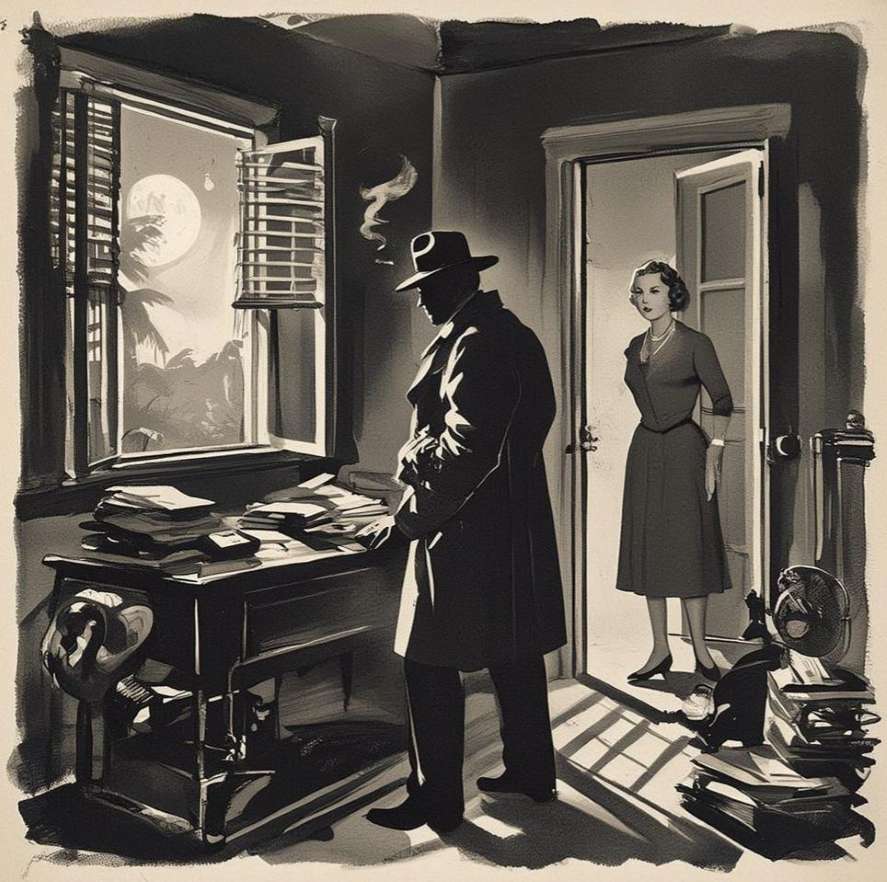
My name’s Eddie O’Brien. I’m a private investigator. My office is above a pawn shop on Hotel Street. I own a ceiling fan, two chairs, a desk, a filing cabinet and a coffee pot that hasn’t worked right since Pearl Harbor. Right now, though, I wasn’t in my office. I was in the Mai Tai Bar at the Royal Hawaiian Hotel. The pink stucco of the place rose like a mirage on Waikiki Beach, its corridors echoing with laughter and whispered secrets.
I never trusted mirages, I trusted them even less now.
It was hot and muggy. The trades had died and there was a storm coming. I was sweating through my sport coat and interviewing a mainland blonde with eyes that were one-part lapis lazuli and two-parts trouble baked in for good measure. Her name was Karen Atwater.
“My husband’s dead,” she said flatly, staring past me toward the ocean where the waves were rolling and the sky was turning the color of old bruises.
“They think I killed him.”
I pulled a cigarette from my breast pocket and lit up.
“Go on.”
She crossed her legs with an elegance that didn’t match the apparent panic in her voice.
“My husband, Rich, is a professor of Anthropology at Stanford. He brought me here to patch things up. He’d been having an affair, a series of affairs, actually, back home in San Francisco.”
Karen Atwater paused, took a sip of her drink and fought back a tear.
“I guess he thought a little sunshine and sugarcane might make me forget. We’re staying here at the Royal. Top floor. Ocean view. Lovely.”
“I take it you weren’t buying the ‘second honeymoon’ pitch.”
“Not once I saw her at the bar. Cindy Drake, that is. She’s Rich’s research assistant and his current ‘interest’.” She spat the last word out like it tasted foul.
“I confronted him about it. He told me it was just a coincidence that she was here. I walked out after the argument. The sky was turning weird—yellow-orange, like the sun was holding its breath. Everyone’s talking about the storm, Felicia. Figures. We come to Hawaii and there’s a hurricane.”
Felicia was currently a tropical depression, but I spared Mrs. Atwater the lesson in meteorology.
“Where’d you go? After the fight I mean.”
I stubbed out my cigarette. A waiter came by and I ordered another bourbon. On the stage behind us a combo was working its way through “My Yellow Ginger Lei.”
“I walked down Kalakaua until the beach emptied out. I ended up somewhere just past the Moana Hotel. There was this little night bazaar there. Just a couple of stalls tucked into shadows, smoky torches, soft Hawaiian music.”
Something wasn’t right. I hadn’t been to the Moana for a few weeks, but last time I was there I don’t remember anything like a night market or bazar around the place. I let it pass. I wanted to hear the rest of her story.
“You don’t strike me as someone who goes in for that sort of thing; too trite, too touristy.”
Karen Atwater managed a weak smile.
“I’m not, usually. But that night I was hot, tired … and angry. Maybe, deep down, I just wanted something nostalgic. I wanted to believe in the way things used to be and might be again. I’m sorry, I don’t really know what I wanted.”
She brushed the hair from her face, shifted in her chair, then continued.
“Anyway, it was just past that enormous banyan tree. You know the one?”
I nodded my head.
“There was an old Hawaiian woman. She called herself Aunty ‘Alina. She said she had things that could cure your pain, fulfill your dreams. Real fortune-teller hocus-pocus.”
Karen Atwater reached into her purse, pulled out a crumpled tissue, and dabbed her eyes.
“I asked her if she had anything that could make a husband stop cheating on his wife. She gave me a tiny bottle. She told me it would ‘reveal and tie the bond between our hearts’. Something like that. I had no idea what she meant. She said all I had to do was put a few drops in his drink.”
“And you did?”
Karen nodded.
“It’s crazy, I know it. Rich was in our room when I got back. He was smiling. Said he wanted to talk, to make things right. I poured the wine and added the drops when his back was turned. I just wanted him back, to be done with her. Mr. O’ Brien, you have to believe me.”
“What happened next?”
“He drank it. I told him the truth, showed him the bottle. I was laughing. He looked, I don’t know, scared maybe? Said he wondered why the wine tasted funny.”
Karen Atwater took out a cigarette, held it while I lit it for her.
“He told me that if I had studied the things he had studied, seen the things he had seen in primitive cultures, I wouldn’t be laughing. That made me laugh even more! A few minutes later, he clutched his chest and collapsed. I thought he was faking. You know, as a joke. He didn’t even get a last word out. Rich always had the last word. He just… died.”
I finished my drink and leaned back. The band had taken a break and some local comedian was up there telling jokes that weren’t all that funny even back when they were first written … when Hoover was president.
“O.K., Mrs. Atwater. Let’s just assume for a moment that I believe you. I’m not sure exactly what it is that you want me to do?”
Karen Atwater took an envelope out of her purse and pushed it across the table toward me.
“Twenty-five dollars a day plus expenses,” she said. “Is that right? I’m not really worried about the police; they couldn’t possibly believe that I’d be so stupid as to kill my husband that way and then make up such a silly story.”
I wasn’t so sure. It’s funny what cops will believe if something looks right and it gets a case off their desks. But I let her continue.
“What I’d like you to do is to find out where I stand with the police. Just to be sure. I don’t want something like this hanging over my head for the rest of my life. Of course, I’d also like to know what actually happened to my husband.”
The latter almost seemed like an afterthought.
“Give me a day or two. I’ll nose around. See what I can find out. But no promises.”
No promises. I should have that stenciled on my office door, on the frosted glass, right below my name.
I stood up to leave. “As far as my fee is concerned,” I said pointing to the envelope on the table, “We’ll worry about that later.”
I didn’t know what to make of Karen Atwater’s story. It had more holes than a colander. Still, I had a pretty good idea of where I should start.
Next morning, I was sitting in my office. The ceiling fan was clunking away like it was fighting a war with the heat and humidity. It was losing. I took a walk around the corner to the police station on Bethel and Merchant. I was looking for Detective Lieutenant Jake Kwan and his partner, Sergeant Ray Kanahele. Lucky for me, they were both in the office.
Kwan was thin as a bean pole and sharp as surgical steel. Kanahele was big and lumbering. Not too bright but loyal and a good man to have with you in a tight spot. Neither of them liked me much. Still, I had helped them clear a few cases not too long ago and I figured they owed me.
“Well, well,” Kwan said as I stood across from him at his desk. “If it isn’t the world’s greatest detective. To what do we owe the honor?”
Kanahele, standing behind me in the doorway, laughed. I let that pass and explained what I was looking for.
Kwan reached over to his ‘in’ tray and handed me a carbon-copied sheet. It was an autopsy report.
“No signs of known poisons,” he said from memory. “No strychnine, no cyanide, not even arsenic. Atwater apparently had a bum ticker and it just stopped. Clean as a whistle. Doc says it’s like he got scared to death. Lab boys don’t think anything was in that bottle other than plain old H-2-0. Thing’s locked up in evidence.”
“You ever hear of this Aunty ‘Alina Karen Atwater says she bought it from?”
Kwan shook his head.
“Asked around. Nobody’s heard of her. That night market behind the Moana? Not a trace when we had a look-see. But you know how it is in Waikiki. Always a few locals around trying to sell the sun, the moon and the stars to the tourists. Some of it is real old school kahuna stuff. You know the pitch.”
Kwan shrugged his shoulders. Kanahele, by the window now, was watching the clouds roll in from the east.
“You feel that?” he asked no one in particular. “The way the air tastes? There are stories, Eddie. About that banyan behind the Moana. There are spirits that live in trees … spirits that are older than the sea.”
The big man winked, made a sound like a supernatural presence then laughed again.
“Anything doing with the ‘other’ woman… that Cindy Drake?” I asked, ignoring Kanahele as I turned to leave.
Kwan shook his head. “Solid alibi. She was nowhere near the Atwater’s at the time the husband died. She’s already gone back to the mainland.” Kwan paused, picked up a pencil and started twirling it in his hand.
“If you see Karen Atwater. Tell her that she’s free to go too. We’ve got nothing on her either. I don’t like it but that’s the way the fortune cookie crumbles sometimes.” Now Kwan laughed too.
For some reason, my conversation with Kwan and Kanahele reminded me of something Karen Atwater had said. It gave me the glimmer of an idea. Maybe it wasn’t a very good idea, but it wouldn’t let go. It was like an itch you just had to scratch.
I left the police station and took a ride up into Manoa. I was heading for the University of Hawaii library in George Hall. On the way, the storm broke. The wind that had been absent for days howled like it was making up for lost time. The palms bent double. The normal, soft susurration of their fronds was now something fierce, something insectile. In minutes, the streets were awash with water.
I parked my heap. Lit a cigarette and waited for a break in the rain. After twenty minutes or so, I dashed into the library. I spent the next two-and-a-half hours reading. It was pretty heady stuff but, by the time I was done, that seed of an idea that brought me up here had had blossomed into an exotic but deadly flower.
The storm had passed by the time I left George Hall. There were puffy white clouds in the sky and, as usual in Manoa Valley, a profusion of rainbows. The trade winds, mercifully, had returned. That’s what it was like here in Hawaii Nei; if you don’t like the weather, wait thirty minutes or take a ride into the next valley.
Back at the office, I poured myself a drink. I practiced my foot-dangling in time to the ceiling fan for another hour or so. I walked over the Smitty’s for a mediocre burger, a warm beer and less than scintillating conversation. After sunset, I drove into Waikiki.
I walked under the Moana’s porte cochere and up the steps between the Ionic columns. I crossed the guests’ lounge and went out the back to the banyan veranda. The tree was there, of course, massive and silent. Its aerial roots reached down like arthritic fingers holding on for dear life. I didn’t sense any of Kanahele’s spirits. A broadcast of Hawaii Calls was in full swing. Webley Edwards was holding the microphone toward the beach so that the “folks at home” could hear the sounds of surf from famed Waikiki Beach.
I stepped out onto the sand and walked about ten minutes along the beach in each direction. No sign of any ‘night market’. Just a couple of aunties selling halfway decent plumeria and orchid leis at twice the price you’d pay at any flower stall in Chinatown. No one had heard of Aunty ‘Alina.
By the time I got back to my apartment and got ready for bed, I was pretty sure I knew what had happened to Richard Atwater. Problem was, there was nothing I could do about it. I had no real evidence and no one would believe me even if I did. I hardly believed it myself … but it was the only thing that made sense. That night I dreamt of banyan trees trying to capture me with their roots and force me to drink some noxious concoction from a glass bottle. An old kahuna watched from the shadows and cackled as I struggled to escape.
I called Karen Atwater the following morning. We agreed to meet at my office at 2:00 P.M. She had settled her husband’s affairs in town and was scheduled to take the clipper back to San Francisco the next day.
She arrived promptly. I pulled out a chair for her and, once she was seated, I went around and sat down on the other side of my desk.
I looked her over. She wore a black skirt, a tropical print blouse that was tastefully bright and breezy. She had a small jade pendant and matching jade earrings. She looked far more like a well-to-do Honolulu society type than she did a grieving widow. If the strain of her husband’s death and the subsequent police investigation had taken a toll on her, I sure wasn’t seeing it.
“So, what can you tell me, Mr. O’Brien?” she began. Once again, she took an envelope out of her purse. She placed it on my desk.
“For starters, your husband had a heart attack, plain and simple. But, then, you knew that.” I paused and lit a cigarette. The smoke rose slowly toward the ceiling, giving that old fan of mine something to push around for a moment or two.
“That, by the way, the fact that your husband had a heart condition was something you failed to tell me when we met at the ‘Royal.”
Karen Atwater crossed her legs and shifted in her seat.
“I didn’t think it was particularly relevant. Besides, I was quite upset and embarrassed when we spoke. It was all I could do to go over the story again.”
“Oh, it was ‘relevant’, alright,” I replied. “In fact, you were counting on it!”
Karen Atwater hesitated and looked down. I’ll give her credit. It was only for a second, but it was enough.
“I’d like to read something to you, Mrs. Atwater. I’m sure you won’t mind. I guarantee you’ll find it riveting.”
I opened a desk drawer and took out my battered notebook. I turned to the page where I had jotted own a few things I had read while I was up at the university library.
“Let’s see.” I made a show of finding my place. “Are you familiar with Sympathetic Magic, Mrs. Atwater? I asked. “How about the nocebo effect?”
I turned a few more pages, more for effect than anything else. Karen Atwater remained silent.
“Well, just in case you’re a little fuzzy, let me explain. Both of those things relate to the way curses are believed to have operated in the ancient world.”
“Mr. O’Brien,” Atwater interrupted. “What in the world has this got to do with anything?”
“I’m getting to that. There are two components, actually, but you already knew that, didn’t you? From a psychological standpoint, the nocebo effect asserts that ‘a negative expectation or belief about a treatment or intervention leads to a negative experience or outcome – even if the intervention itself is harmless’. Drops from a bottle full of nothing other than tap water placed in a glass of wine, for example.”
“Mr. O’Brien, I’m even more lost now than I was a few minutes ago.” Karen Atwater’s smile was as vacuous as a politician’s promise.
“From an anthropological angle, and here’s where things really get good,” I ignored her and continued …
“While it doesn’t directly cause harm, ‘the power of suggestion in the realm of Sympathetic Magic can have tangible effects on individuals. It can, in fact, induce significant distress, fear, anxiety and even catastrophic physical effects’.”
I closed my notebook with a flourish. I couldn’t help myself. I put it back in the drawer. My chair creaked like an old man’s knees when he bent to tie his shoes as I leaned back.
“Do you recognize those words, Mrs. Atwater? You should. They’re your husbands. From a book he wrote three years ago. He was an expert. Not only did he study the stuff, he more than half-believed it himself, didn’t he?”
I didn’t give her a chance to respond.
“You told me as much, remember? When you explained how upset your husband was when you concocted that story about Aunty ‘Alina and told him how you had spiked his drink. I have to hand it to you, it was ingenious. The perfect crime, even.”
Karen sat perfectly still, then gave a slow, practiced sigh. The kind that could mean anything.
“You really think I killed Rich with what … a ghost story, the power of suggestion? You’ve lost your mind.”
“I think you knew how to push just the right buttons,” I said. “And you knew your husband well enough to know what just might happen when you did. That’s not murder in the legal sense. But morally? I’d say you’re responsible for what happened to the guy.”
She stood, smoothed the front of her blouse, and looked around my office like it offended her.
“I didn’t come here for a sermon on morality, Mr. O’Brien. Or to listen to nonsense. Besides, I hired you to find out what happened to Rich. Why would I have done that if I were responsible for his death?”
I sat forward in my chair. Stubbed my cigarette out and lit another.
“Only you can answer that but I have a couple of theories. Interested in hearing them?”
“By all means, enlighten me. You missed your calling. You should have been a writer … of fiction.”
“In the first place, it would look good to the cops. A truly guilty person would have to be crazy to hire a private detective. To your way of thinking, hiring me would convince the police that you had nothing to fear, nothing to hide. On the off-chance they had anything on you, you were counting on me to fill you in.”
I got up from my desk and walked around to the other side. I sat on the edge, looked into her pretty eyes.
“But that wasn’t your primary reason. No. You wanted to demonstrate how smart you’d been. You were proud of yourself and wanted to show off. To show you could get away with it. When we first met, you told me that your husband always had the last word. You weren’t going to let that happen this time, were you? Tell you what, though, he did … in that book of his!”
Karen Atwater looked down at the envelope she’d placed between us earlier. It seemed fatter to me than it had before.
“Call that what you like,” she said pointing. “You took the job. You did the work. You earned it.”
I didn’t move. Neither did the envelope.
“You know what bothers me the most? Not that you played your husband. Or even that you played me. What bothers me is that it was clever. Cold, clean, and clever. And it’ll eat at you for the rest of your life – or maybe it won’t. That’s really why I wanted to meet you here today.”
Karen smiled. There was no warmth in it, but no gloating either.
“You wanted to see if I was a monster or just … what … desperate?”
“Yeah. I guess I did.”
She picked up her purse, paused, then turned back toward me.
“Which is it?”
“I don’t know,” I said. “But if you ever figure it out, send me a postcard.”
She lingered a second longer, then left without another word. I expected a dramatic slam, a final flourish. I should have known better. She wasn’t the type.
I sat there for a minute, staring at the envelope.
Eventually, I picked it up and locked it in the bottom drawer of my filing cabinet.
Let the money sit a while, I said to myself. Let it ferment like guilt and recrimination often do.
Outside, the sky was starting to change again. Storms always came and went in this town, fast and loud and full of sound and fury; then blue skies and unanswered questions.
I poured myself a drink and opened the window. Time to rid the place of the scent of mainland blonds, clever little murders that weren’t technically murders and two-bit shamuses who can be too smart for their own good.
The breeze rolled in like a whisper through the blinds. Soft, but with an edge. It smelled of ocean and iron and damp earth, like something old but freshly dug. And just for a second, less than a second, I thought I heard it. The sound of laughter, brittle and low, threading its way through the sounds of the traffic and the trollies.
I thought about Rich Atwater, a serial philanderer dead from a lie wrapped neatly in ritual and suggestion. I thought about how his wife had weaponized belief, turned ancient folklore into fear and paranoia. If I was right, Karen Atwater had used the old island magic like a scalpel. I don’t know whether or not she actually believed in it, but her husband did and she knew enough to make that work for her.
And maybe, just maybe, that was her one mistake.
In places like Hawaii, the old gods don’t care if you actually believe in them. They only require that you honor them. But when you use their names, their mana, for your own ends. That’s when they sit up and take notice.
I couldn’t help but think that one night somewhere down the line, the wind would suddenly stop and there’d be a hint of ozone and electricity in the air. Karen Atwater – wherever she might be – would wake up to find something standing at the end of her bed. It wouldn’t be a ghost. It wouldn’t even be guilt. My guess is it would be something far older, and far less forgiving.
I put my feet up on my desk and took a long pull from my drink. Outside, it sounded like the wind was really starting to pick up. The ceiling fan creaked once and then stopped on its own. This time, the breeze, the elements, would have the last word.
* * * * THE END * * * *
Copyright James C. Clar 2025
Image Source: Dey from Fictom.com
Moody mid-20th century period fiction resplendent with culltural elements of the Hawaiian Islands. I adore James’s work centered in Hawaii and this one didn’t fail to come through for me. Jaded, cynical O’Brien deals with a cunning black widow. Wonderful dialogue.