
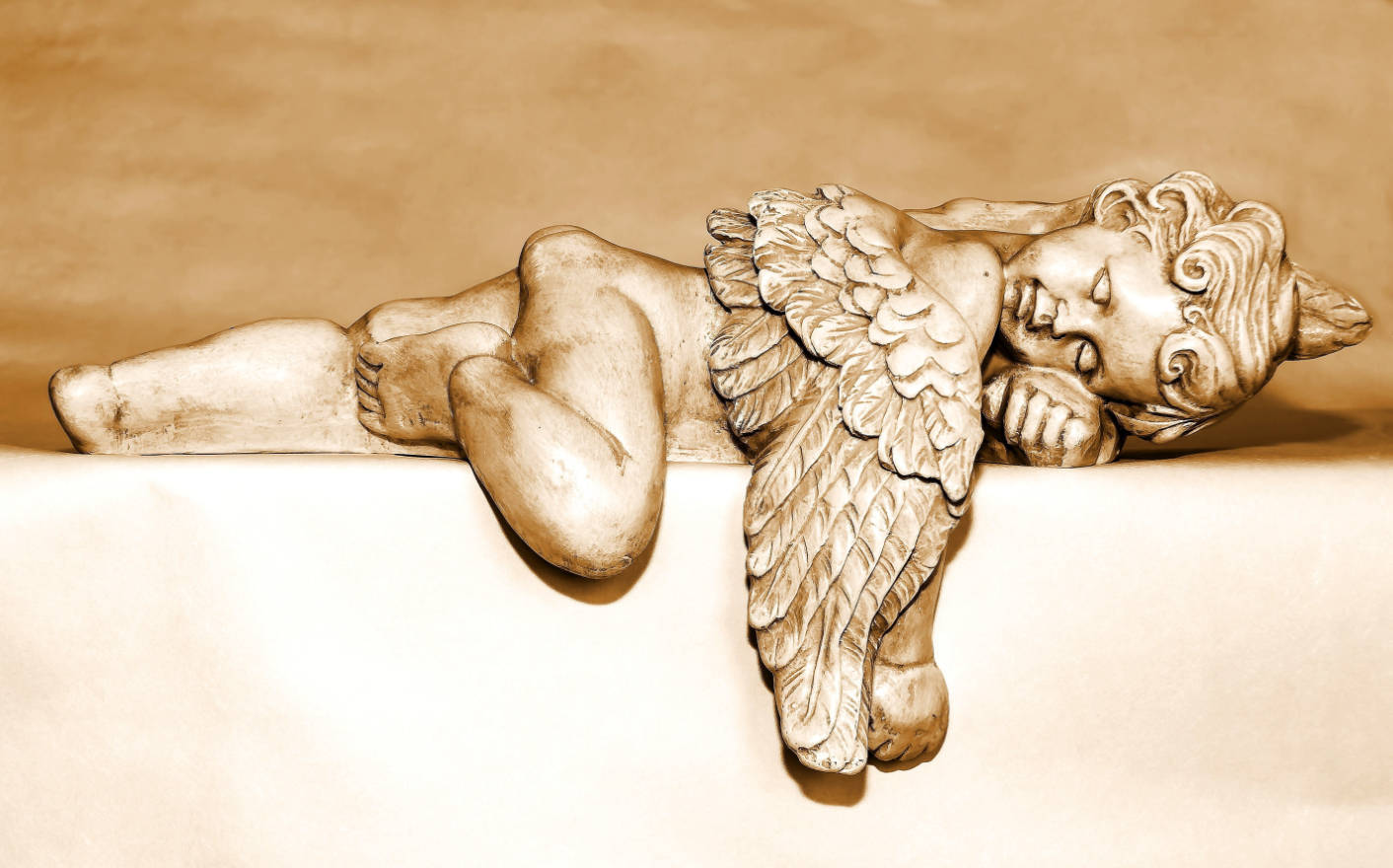
Better Angels by Holly Pfeiffer
What Leonard thought he saw, plummeting down to earth, was an asteroid.
The sun was setting, and it was one of those nights in early October that Iowa was known for. There was visibility for miles in every direction, but not much to see. When it happened, Leonard was in the garage, replacing the timing belt of his 1964 Mustang. He paused to watch the “asteroid” fall from the sky, then wiped his hands on the backs of his jeans and strode out into the field to look for it. It was smoking gently, a beacon for him to navigate by in the tall grass. He stopped just a few yards shy of, and realized two things:
The first was that it wasn’t a rock after all.
The second was that it was a man, and that the man was alive.
He was lying on his side, groaning, naked from the waist up, back soaked with a golden substance that came from a large wound. Blood, Leonard’s mind supplied, but that couldn’t be possible because blood was red. The man rolled over, and out popped a wing so white that it almost glowed blue. It was bigger than any natural wing Leonard had seen in his seventy-five years, but it was a wing all the same.
The man sat up, both stumpy legs stretched out before him. He began to whimper. Leonard felt he should announce himself, but before he could think of something to say, the present company burst into loud and unabashed sobs.
Leonard stared. He tried to speak again but couldn’t.
“Oh, please take me back, Lord,” the man begged in pitchy falsetto. “I’ll be good this time. I promise. You know I will.” And when he was finished with his appeal, the sobbing resumed.
“ZOTIEL, NO. YOU ARE EXILED FROM NOW UNTIL THE DAY IN WHICH YOU PROVE YOURSELF TO ME.”
Leonard staggered back. The Voice was like the force of the collective winds of the earth. In the aftermath of it, he could feel—and hear—his teeth buzzing.
“Well, that’s rather vague!” the fellow protested, throwing his arms wide. “At least once in this eternity I thought You’d tire of ambiguity. I was wrong!” Leonard was momentarily afraid that the man’s whining would bring the Voice back, but there was only silence. Not just silence, but the supreme silence of central Iowa.
“Um, hi,” Leonard managed at last. “It seems you… fell.” Zotiel looked over his shoulder and they stared at each other. Leonard was transfixed by the strange, radiant blue of his eyes. “So, are you one of the, uh, one of the extraterrestrials?” he asked.
“Extraterrestrial,” pronounced the fellow as if he’d never heard such a word before. “Not of the earth,” he translated. Then, with a brittle, sarcastic smile, he said, “Quite so.” He pushed himself off the ground and began to march away from Leonard, whispering “Ouch, ouch, ouch,” as he flexed his wounded shoulder. The wound already looked a bit better than when he’d first laid eyes on it.
“Wait!” Leonard called. He didn’t know what made him do so. This, after all, wasn’t his business, and he hadn’t wanted it to be in the first place. “So, was that the mothership?”
The fellow paused, looked back. “That, mortal, was your Creator.” He continued walking, and again, against his will, Leonard followed.
“What do you mean?” he asked.
“It was God,” Zotiel replied.
“God?” Leonard asked.
“God,” said Zotiel.
They walked several paces in silence.
“What does that make you, then?” Leonard asked, arching a quavering eyebrow.
“An angel,” Zotiel replied.
“An angel?” Leonard asked.
“An angel,” Zotiel said.
There was more silence. “I think I’m going senile,” confessed Leonard.
“Yes, it is a fallen world, and such diseases are common,” Zotiel said, feigning sympathy. “Now, if you wouldn’t mind, I’m rather busy. I have to find somewhere to live. Temporarily, at least.”
“Well, you aren’t going to find anything out that way,” Leonard said.
“How do you know that?” Zotiel asked.
“I live here,” Leonard said. “We have these things called roads. You follow them to get places.”
“Yes, I’ve heard about roads,” Zotiel said. “We have them up there, too. Ones made entirely of gold. You may have read about it,” he explained.
“Okay. No need for tests. I’m definitely going senile,” Leonard murmured.
“I don’t see how that’s relevant,” Zotiel said.
“Of course you don’t,” Leonard said with a sigh. “See, about these roads. They lead to cities,” he continued.
“Right. That’s where I’m going,” Zotiel said.
“So, you’re gonna wanna walk back the way you came,” Leonard informed him. They both stopped and regarded each other with intense curiosity.
“Yes. Yes. You seem to know the ropes,” Zotiel concluded. “Perhaps you can help me.”
Now that it was put into words, Leonard shied away from the prospect. “I don’t believe in Him, you know,” he said. “Whatever you are, I don’t believe in it, either.
“Not believing in Him doesn’t make Him any less real,” Zotiel said. They began to walk back towards Leonard’s house.
“Sure it wouldn’t if that were true,” Leonard said.
“Yes, of course, but it is true,” Zotiel said. “There is an almighty Someone. He lacks the proverbial flowing white beard and robes, but He is up there. And He can hear us!” Zotiel shouted, cupping his mouth with his hands.
Leonard sighed. “I didn’t know senility could set in so quickly. Or maybe I just don’t recall the other incidents.”
“You’re not special,” Zotiel told him. “You’re like every other man of your kind,” he added.
“Is that so?” Leonard asked.
“Yes, it is,” Zotiel said, unbothered. “You don’t have any good reason. You just don’t want to believe.”
Leonard said, “Because I’m not a sucker.”
The rest of the walk back to the house was jarringly quiet. When they reached it, Leonard paused. So did Zotiel, looking haughtily and inquiringly over his shoulder at Leonard.
“This is my house,” Leonard said. Zotiel looked it up and down.
“It’ll do,” he said.
“What does that mean?” Leonard asked, placing his hands on his hips.
“In the short term, these accommodations are suitable,” Zotiel elaborated.
“What, so now you’re staying here?” Leonard demanded. “I thought you were going to the city.”
“Why bother when you just offered to help me?” Zotiel asked.
“Hold on, now. I never offered,” Leonard countered.
“You did. And besides, you receive many blessings when you house an angel,” Zotiel replied.
“…Okay,” Leonard said.
“Don’t you want blessings?” Zotiel asked.
“Sure. But you’re not an angel,” Leonard retorted.
“I fell out of the sky. You heard His voice. And yet, I’m not an angel,” said Zotiel, incredulous.
“You have one wing. Not two,” Leonard pointed out.
“You’re saying that’s what it would take to convince you?” Zotiel asked. “Two wings?”
“Well, no, but it would help,” Leonard said. “Let’s go inside,” he suggested.
Leonard’s kitchen was small but well-kept, a relic of the 1970s with wooden cabinets, yellowed appliances and faded wallpaper. He gestured at the table by the door and grunted. Zotiel took a tentative seat.
“It’s a little too late for coffee,” Leonard said, glancing at the clock by the wall.
“It’s been at least three centuries since I’ve had coffee,” Zotiel said conversationally.
“I’ll put the pot on,” Leonard decided, not wanting to incite further discussion.
“I had it in the home of an Italian woman,” Zotiel went on anyway.
“This isn’t going to stack up to that,” Leonard confessed. “If you’re hungry, I’ve got TV dinners.”
“Teevee dinners?” Zotiel asked. “What is a teevee?”
Leonard gave him a long, hard stare as he turned on the coffee pot. “So, there’s salisbury steak, or there’s chicken pot pie,” he said.
Zotiel looked down at his plump stomach with much ire. “I do hunger,” he said. “You choose for me. I’m not exactly up to date on the local cuisine.”
“You’ll have the pot pie,” Leonard said, rooting around in the freezer for the two meals.
“Who’s the woman in the painting?” Zotiel asked. Leonard paused and looked back at him. He was holding the framed photo of Leonard’s late wife that he kept at the dinner table when he wasn’t expecting guests and there wasn’t anything good on the television.
“That’s Mabel. Isn’t she a sight?” Leonard asked, smiling.
“I’ve beheld the holy throne, so no, not comparatively,” Zotiel flatly replied.
“You can admit it. She’s prettier than all that,” Leonard said.
“Is she a daughter of yours?” Zotiel asked.
“No. That’s a photo of her when she was young. She was my wife,” Leonard said, popping the chicken pot pie in the microwave.
“Oh,” Zotiel said. “Where is she now?”
“It’s been forty-seven years since her passing,” Leonard said. “Time does fly.”
“I see. My condolences,” Zotiel murmured distractedly. “Are there any great wars going on right now?” he asked, a bracing non sequitur.
“I don’t know about great,” Leonard said, scratching the back of his head. “There’s one in the Middle East. Another in Eastern Europe.”
“‘Middle East.’ You’ll have to be more specific,” Zotiel said.
Leonard raised an eyebrow. “If you are who you say you are, you may recognize Jerusalem as being in the Middle East.”
“Jerusalem,” Zotiel said, nodding solemnly. “A holy war. It’s decided, then. I shall solve it.”
Leonard scoffed. “If they haven’t been able to in all this time, I doubt you will. And the same goes for the one in Ukraine,” he added.
“A modern atlas will be helpful,” Zotiel muttered to himself. “Do you live near these lands or reside near any ports?” he asked.
“I’m about as far away from a port as I can possibly be, and also on the other side of the world from where the wars are,” Leonard said.
“Where are we, then?” Zotiel asked.
“Iowa,” Leonard replied.
“Iowa?” Zotiel asked.
“America,” Leonard said.
“I’d heard whispers of such a place,” Zotiel said. “I didn’t know if it was real.”
“Well, it is,” Leonard replied. “It’s been real since 1776.” Leonard took the chicken pot pie out of the microwave, grabbed a spoon from the drawer, and set it before Zotiel. Then, he put the Salisbury steak in the microwave.
“What about disease? Any plagues? A plague might do as well,” Zotiel said.
“There was one a few years back called the coronavirus. Some people still get it but they aren’t dying anymore,” Leonard said.
“Confound it,” huffed Zotiel. “All right. Any famine?”
“I keep hearing about starving kids on the news. I don’t know where, exactly, they are, but I think they’re mostly across the ocean from here.”
“Which ocean?” Zotiel asked.
“The Atlantic ocean,” Leonard said. “Like Jerusalem. Like Ukraine.”
Zotiel sighed. “I don’t want to spend months crossing the sea,” he said.
“You could fly,” Leonard suggested.
“Sir, that is rude,” Zotiel hissed. “You are fully aware that I can’t fly with only one wing.”
Leonard was about to explain about airplanes, but then the microwave buzzed, and he was more enticed by the idea of his Salisbury steak. He took it out of the microwave, grabbed himself a fork and knife, and sat down across from Zotiel. Before he ate, he took the picture of Mabel and laid it down on its face.
After dinner, Leonard asked if Zotiel would like to watch TV. Zotiel, confused at the prospect, declined, so Leonard took him upstairs to show him where he’d be sleeping. Ava’s room was how she’d left it when she moved out. It wasn’t that way because he was nostalgic; it was because there was no other purpose for the room. It had been built for her, like the house was built for the family, and just because she wasn’t here didn’t mean it didn’t belong to her anymore. She could return whenever she wanted.
But only if she apologized, of course.
Zotiel sat down on the canopy bed with its pink, plaid coverlet and gazed around the room. “Under any other circumstance, I’d be pleased to see the cross hanging there on the wall,” he said. There was indeed a cross pinned to the wall over Ava’s dresser. “But given my current, difficult relationship with the higher ups, I’d prefer if you took it down. I’ll never be able to sleep with it staring at me, and now that I need sleep, it is a matter of utmost importance.”
“Fine by me,” Leonard said. He ambled across the room, took the cross off the wall, and slid it into the empty top drawer of the dresser. “I’ll leave you to it. The bathroom’s down the hall.”
Zotiel groaned. “I’d forgotten about that particular earthly need.” He covered his face with both hands. “Why, God, why?” he demanded, voice muffled.
As Leonard was falling asleep that night, he was given a chance to reflect on the day’s events, and on the fact that there was a one-winged visitor from the sky sleeping in his daughter’s bedroom. It was enough to raise the blood pressure, that was certain. But then he remembered that he was old, that he was likely going senile, and that, in the morning, the room would probably be empty. He closed his eyes and fell deeply and entirely asleep. It was the deepest sleep he’d had in years, a protest, almost, to the day’s absurdity.
He woke in the morning to a sharp rapping on his door. He blinked once, then closed his eyes. No, thank you. He didn’t want to get up right now, and he was long past the time in which he had to get up for anyone’s sake. The rapping persisted though, and with an almighty grumble, Leonard sat up, and rasped, “What do you want?”
“Leonard, you should have disclosed the fact that you keep demons in that glass box downstairs,” a voice scolded.
Leonard rubbed his eyes. “Coming,” he said.
The glass box with the demons in it was, in fact, the TV. Leonard tried to explain this as he heated up a cup of last night’s coffee in the microwave. Halfway through his first explanation, he had to add on an explanation about the microwave as well, which Zotiel apparently hadn’t noticed while sulking last night. But in the end, for all of Leonard’s effort, Zotiel’s understanding of modern science was deeply flawed.
“I see. You’re a warlock,” he decided.
“Warlock? What, are you serious?” Leonard asked.
Zotiel squinted. “Yes. You are a sorcerer, greatly in tune with the supernatural powers of the world. I have fallen into the hands of a serpent.”
“Well, am I a warlock, a sorcerer, or a serpent?” Leonard asked.
“You tell me,” Zotiel said, crossing his arms defiantly.
Leonard sighed. He went to the pantry, poured them two bowls of raisin bran, and heated up another mug of coffee for Zotiel. They ate in silence. After breakfast, Leonard took Zotiel to the basement and sat him down in front of the computer. They waited for it to boot up. As the screen lit up and the fans started to run, Zotiel went rigid and pressed himself as far back against the office chair as he could.
“This,” Leonard began. “Is a computer.”
“What sorcerer’s contraption is this?” demanded Zotiel.
“This,” Leonard repeated slowly. “Is a computer.” He opened the tab for a search engine. “You have mastery over the English language, correct?” he asked.
“I know all languages, mortal,” Zotiel replied.
“Good. So you know how to write?” he asked.
“Of course,” Zotiel said.
“If you tap one of these keys,” said Leonard, indicating the keyboard. “The letter will appear in this bar.” Leonard demonstrated, and Zotiel made a small, pained noise. “In this way you can type out entire words and sentences. Once you’re done typing what you want, you tap the ‘enter’ key and it will give it to the computer to think about. Ask the computer a question, and it will draw on the knowledge of all human beings to give you an answer.”
“What have I done that you should equip me with such immense power?” Zotiel asked.
“It’s better that you ask the computer these things instead of me,” Leonard grunted.
“This computer of yours,” Zotiel began. “Do you believe he can tell me how to restore myself to my former glory?”
“If you ask enough questions maybe,” Leonard replied. “Listen, I’m going to be in the garage replacing the timing belt on my Mustang. Can you promise not to bother me for at least four hours?” he asked.
Zotiel placed a hand over his heart. “I swear a solemn oath.”
“Excellent,” Leonard said.
The timing belt was a more difficult problem than Leonard thought. Though he’d taken it out and reinstalled it several times, the engine seemed intent on misfiring. He was frustrated beyond all measure when Zotiel found him.
“I’m busy,” he snapped. “This damned timing belt is faulty.” Leonard heard a dull thud, and turned to see that Zotiel had fallen to his knees, crestfallen.
“This world is beyond my help, Leonard,” he said faintly. “All the trivial problems have been solved. All the nontrivial ones are beyond my knowledge, and even if they weren’t, they are too immense.”
“I don’t see what that has to do with my timing belt,” Leonard grumbled.
“There is no way to restore myself to my former glory,” Zotiel said. “I’m trapped here. Trapped in this body. Exiled from my home. Forced to live out my days in the company of a warlock.”
“I thought I was a sorcerer,” Leonard said.
“All is lost,” Zotiel replied.
“I’m beginning to think you’re not listening to me,” Leonard said.
“I have nothing to hope for,” Zotiel lamented. Then, he collapsed onto the floor and curled up into a ball. Leonard scoffed and looked away. He needed a break.
Around seven in the evening, Zotiel slouched in from the garage, eyes red and puffy. Leonard was watching reruns of Gilligan’s Isle in his easy chair. Zotiel sat down beside him and they watched several episodes in silence. Once or twice, Zotiel chuckled—but when Leonard glanced over at him, he pretended that he had been clearing his throat.
They had microwave dinners again, and then they went to bed.
In the morning, after coffee, Leonard went to the garage to run diagnostics on the other parts of the Mustang’s engine to see if the timing belt wasn’t the only problem. He found Zotiel waiting for him. Well, he wasn’t exactly waiting. He was standing at the workbench, examining a project that had fallen at the wayside weeks ago. Leonard had been trying to craft his own wooden model of a Cessna 172. As a young man, he had designs of getting his commercial pilot’s license and buying his own 172. He’d become an engineer of aircraft instead, not a pilot.
“What is this?” Zotiel asked Leonard.
“That is a Cessna 172,” Leonard replied.
“A what?” Zotiel asked.
“An airplane. A model of one,” he explained.
“An airplane?” Zotiel asked.
Leonard joined Zotiel at the workbench and picked up the shell. “You see these? They help it fly,” he said. “And the pilot and the passengers are housed inside the cabin.”
“You mean these are wings?” Zotiel asked, unconvinced. “But they have no feathers.”
Leonard chuckled. “They don’t need feathers. It’s all about the shape. The lift effect,” he said/
Zotiel placed a hand on his chin, bewildered. “You’ve built it wings,” he repeated.
“Model wings,” Leonard corrected him.
In the afternoon, when Leonard had stopped fighting the natural inertia of post-lunch drowsiness, he awoke from his nap to find Zotiel peering down at him.
“Jesus,” Leonard huffed, and Zotiel scowled reprovingly. “You can’t just stand over a sleeping man,” he said. “Especially one used to living alone.”
“I believe I just did,” Zotiel replied. “And it was you who invited me to stay here.”
“No, I didn’t,” Leonard insisted, sitting upright. “You just stayed.”
“You haven’t made me leave,” Zotiel said.
Leonard pondered this. Then, he shrugged. “Yeah. What do you want now?” he asked.
“I need your help with something important,” Zotiel said. “I want you to build me a replacement wing for the one I lost.”
The wing—the appendage Leonard had been ignoring in the same way that physicists ignore matter-antimatter asymmetry—was now tucked neatly behind Zotiel, its outer feathers shining brilliantly.
“Why?” he asked.
“So I can get back to heaven to plead my case,” Zotiel said.
“What do you mean, plead your case?” Leonard demanded.
“I was booted out without a trial,” Zotiel said. “I didn’t have enough time to tell my side of the story to the Lord. If He’d only heard me out, I would still be up there instead of down here with you.”
“Zotiel, isn’t this Lord of yours supposed to be all-knowing?” Leonard asked.
“Yes, but—”
“Then, by your logic, his ruling is probably fair,” Leonard pointed out.
“It isn’t, though!” Zotiel exclaimed. “He threw me down to this wretched earth with the premise that my only way back is to prove myself when there is no opportunity to do so.” Zotiel sat down on the couch, pouting. “You build wings. Build me one.”
The truth was that Leonard had built wings—the wings of airplanes. He had drawn hundreds of blueprints of wings, their specific components, and their varied positional capabilities. Wings were his life’s work. But the thing was, Leonard was retired.
“No,” he said.
“What do you mean, no?” Zotiel asked.
“What I mean by ‘no’ is no.”
A day passed. Another day. It was dinner, and it was Friday. Leonard and Zotiel sat across from each other, enjoying the undisturbed silence of their feud. Leonard poked at the watery mashed potatoes from his TV dinner. Zotiel ate them rapidly and with a spoon. Leonard realized he’d forgotten to turn down his picture of Mabel, so he did.
“Why do you always do that?” Zotiel demanded.
“Because you’re here,” Leonard said.
“And why does my presence interfere with the strange attachment you have to that… photograph?” Zotiel asked.
“She’s private,” Leonard said.
“Why don’t you have one of your daughter? She’s even more private than your wife,” Zotiel said, and Leonard knew that he was being provoked. He gritted his teeth and continued to stew in silence. “You keep your wife’s portrait. You keep a room for your daughter, even though she no longer resides here. An odd practice for one so alone,” Zotiel pursued.
“I am not alone by choice,” Leonard snarled. “Ava can come back any time she pleases. All she damn well has to do is apologize.”
“For what?” Zotiel asked.
“For taking up with that—” Leonard grew red in the face as he prepared to say the word. “That pastor,” he spat. “It was the presumption of that boy when he came into my house and asked about my relationship with the Lord. He knew what happened to Mabel—there’s no chance Ava didn’t tell him—and yet he still tried to talk to me about God.” Leonard was breathing hard. “You’re the same, you know—trying to convince me of something I know is a lie. And if I were a more foolish man, I might believe you because of your wing and the fact that you act like you haven’t heard of anything in the last five centuries. But I’m not foolish. No God would hurt Mabel like that.”
Something that had been sleeping in Leonard was now awake. On trembling legs, he made himself stand and walk out of the room. If he didn’t, he would drag Zotiel out of his house by the collar.
The next morning, Leonard discovered what was causing the misfires—a faulty spark plug. He had no idea how he hadn’t noticed it before. It was a simple replacement. All he had to do was send away for a new one when he was in town on Monday.
“Am I right in thinking you’ve calmed down?” Zotiel asked, disturbing the silence of the garage.
Leonard flinched, and said, “You did it again.”
“Sorry,” Zotiel said.
“It’s—fine. I just can’t believe you’re still here,” Leonard admitted.
“I don’t have anywhere else to go,” Zotiel said.
Leonard scratched the back of his neck, refusing to turn and face Zotiel. “Yeah. I know. That’s why I’m letting you stay,” he explained.
“You’re a kind man. My apologies if I haven’t properly conveyed that,” Zotiel said.
“Look, even if you… even if you are who you say you are, I don’t want to know about it. You can stay as long as you need to get back on your feet, but as far as I’m concerned, you’re human and down on your luck in the traditional sense.”
“I can’t pretend to be something I’m not,” Zotiel said.
Leonard sighed. Something in him gave way.
“Fine then. Why’d you get thrown out?” he asked.
“Okay, you don’t know this, but up there, it’s a little bit like it is down here. I read about bureaucracy on your computer—the division of labor in your government—and that’s what we have. That’s what we were made for.”
Leonard crossed his arms. “What do you mean?” he asked.
“I am Zotiel, the angel of fertility,” Zotiel said.
“Sure,” Leonard said.
“I’m supposed to go around granting children to the deserving, but about a thousand or so years ago, I realized that most deserving people were having children with or without my intervention, and even some undeserving people, too. Not to offend, but you humans are quite fit for the task of procreation,” Zotiel said.
“Most humans would take that as a compliment,” Leonard replied.
“I do so despise coming to the earth. It is so flat, and when it’s not flat, it’s mountainous, and when it’s not either of those things, it’s the ocean.”
“Alright. Sure,” Leonard said.
“I avoid coming down here when I don’t have to. I mean, every hundred or so years, I’d hear from someone’s saintly grandmother about her equally saintly albeit infertile grandaughter, and I’d give her a son if only to keep up appearances, but such appeals became increasingly scanty and so did my will to even feign dedication to my role. You know how it is.”
“I don’t,” Leonard said. “I never used a vacation day. Not once.”
“Well, that’s you. You’re Leonard. And that’s fine because you’re human and humans always have something to prove. But I’m Zotiel. I’m an angel, as old as all creation,” Zotiel replied.
“It seems to me this attitude adjustment is necessary,” Leonard concluded.
“But can’t a guy get a warning before he’s kicked out of heaven?” Zotiel whined.
“You wouldn’t need a warning if you had been doing your job,” said Leonard.
“Oh, I’ll get nowhere with you,” Zotiel said.
“And you can count on it,” Leonard agreed.
Leonard replaced the faulty spark plug on Monday and got the Mustang’s engine running. He took a joyride through the countryside and tried not to think about how flat Iowa was. It had never bothered him until Zotiel had pointed it out. He’d always had other things to focus on. But he was retired, the Mustang was finished, Mabel was gone, and his daughter lived hours away with her rotten pastor of a husband.
Iowa was flat, and he had nothing to work on.
Leonard didn’t think the high from finishing the car would fade so quickly. He would at least have time to plan out his next project; that, or finally give in and book one of those Alaskan cruises. The emptiness was already setting in, though.
When Leonard returned to the house, he found Zotiel sprawled on the couch, blue eyes half-mast as he watched Wheel of Fortune on the TV.
“So you figured out how to use the remote,” he said.
“I found the ‘on’ button,” Zotiel agreed. “The other buttons are still unexplored territory.”
Leonard sat down beside Zotiel. He stared at the screen. He felt his brain cells actively withering away. He contemplated suicide. Then, he let out a great harumph.
“I’ll make you a wing,” he said.
Zotiel bolted upright. “You will?” he asked.
“I’ve got nothing better to do,” he said. “Also, I’m pretty sure you’ll stay here forever if I don’t.”
“I quite literally might,” Zotiel said. “Even though I’m required to eat and sleep and evacuate my bowels, I’m fairly certain I’m still immortal.”
Leonard drove his truck into town the next day, and then to the supply depot forty minutes out from there. He had all the tools necessary for the project, but he still needed to buy the materials. He was used to working with metal when it came to building wings, but metal wouldn’t function on such a small scale—Zotiel wouldn’t be propelled by the burning of jet fuel, after all. The material for his replacement wing had to be lightweight and flexible. At first, he considered fashioning it out of wood and nylon, but then he remembered carbon fiber composites, which had been hitting the industry as he was leaving it. They were light. They were flexible. They were durable, but could easily be patterned. The only problem was they weren’t readily available at the supply depot.
He had to drive home, and then drive all the way out to Cedar Rapids. The things he did when he was bored.
Once in Cedar Rapids, he confused several well-meaning employees at an industrial warehouse by requesting one, long sheet of carbon fiber composite—that, and several blocks of titanium alloy, which he would weld into a lightweight, skeletal harness for Zotiel.
“What are you making?” the young man helping him asked.
“A wing,” Leonard said.
“For a scale model?”
“No, for the fellow who landed in my backyard. He won’t leave until I make him a replacement for the one he lost,” Leonard explained, straightening up to full height. The young man smiled, opened his mouth, closed it, then smiled again.
At home, Leonard took Zotiel’s measurements in the garage. The wings needed to balance each other perfectly. It was nice, having a symmetrical model of his future creation. All he had to do was artificially mirror it.
“Aren’t you worried he’ll just throw you back down again once you get up there?” Leonard asked.
“He’s been quite forgiving in the past,” Zotiel said.
“But he’s fickle,” Leonard replied.
“Why do you think that about Him?” Zotiel asked.
“Remember my wife?” Leonard said. “She was his biggest supporter, I think, bar Mother Theresa.”
“Mother Theresa,” Zotiel said, nodding solemnly.
“She taught Sunday school at our local church,” Leonard remarked.
“That’s worth at least thirty points,” Zotiel said. Leonard stared at him.
“There are points?” he demanded.
Zotiel smiled over his shoulder at Leonard. “I do jest,” he said.
Leonard shook his head. “I’m trying to tell you something serious here.”
“Right. Continue.”
“If you make any more jokes—”
“I won’t.”
“Fine. Well, when Ava was five, Mabel got bone cancer.” Leonard jotted down a measurement in his notebook. “She died within the year, right when our life was beginning. Pretty fickle if you ask me.”
“Death is not a punishment, Leonard,” Zotiel said. “It’s a product of the fallen world, not, in most cases, inflicted by God.”
“Even if he didn’t give the cancer to her, he could have taken it away,” Leonard reasoned.
“It wasn’t His will,” Zotiel said.
“That’s what I’m saying. I don’t like nor do I agree with his will if it involves her dying young and leaving behind a husband and a daughter,” Leonard said.
“And what did Mabel say about her impending death?” Zotiel asked.
“Not much—she was brave,” Leonard replied. “She only said to take care of Ava when she was gone, which I did.”
Once Leonard had the measurements, he set about his work in earnest. He wasn’t the sort of person who could take breaks in the initial phases of a project. When he hit a roadblock, he was forced to, but there were no roadblocks at the moment, and so, he didn’t stop. Several times, Zotiel brought him microwaved meals. They were either too hot or too cold, and occasionally, they were burnt, but he appreciated the sentiment. What came to shape under his frantic hands was a clean, aerodynamic reflection of Zotiel’s right wing. He used the extra carbon fiber composite to mimic feathers, which he welded on in intricate patterns. The final effort was the harness, which would be worn over both shoulders so that when Zotiel flapped the real wing, the replacement wing would flap, too.
This was the most delicate part of the work. He retook Zotiel’s measurements. As he did, Zotiel stared at the work-in-progress wing, which lay poised on Leonard’s workbench.
“You really are quite marvelous at this,” he said at last.
Leonard chuckled. “That’s forty years in the business.”
“I honestly don’t know why you’re doing all of this for me. I haven’t exactly been kind to you. And I can’t offer you with any certainty a blessing from God,” Zotiel said, sheepishly looking at the ground. “I may have been a bit overconfident on that particular point.”
“I’m not doing it for a blessing,” Leonard said. “You’re giving me something to do, and for that, I’m grateful.”
“What will you do after I’m gone?” Zotiel asked.
“Well, I don’t know,” Leonard said. “Maybe I’ll find another car to fix up. I’ll sell the Mustang and use the proceeds.”
“You fix things. That’s your calling. But you neglect the important things that are broken,” Zotiel observed.
“What do you mean?” Leonard asked.
“I mean about your soul, Leonard,” Zotiel said. “And your daughter.”
“I may not be the sharpest tool in the shed, but I know when something is broken beyond repair,” Leonard said.
“In your eyes, you’re doing the impossible right now. You’re building a wing for an angel,” said Zotiel.
“I’ll concede that point,” Leonard replied, and then, he laughed. But he couldn’t muster up as much enthusiasm for the laugh as he’d anticipated.
Leonard hewed down the harness so that it fit Zotiel perfectly. He hoped that it would feel like a second skin, like how the original wing had felt. He had Zotiel try it on in the backyard. The angel slipped it on over both of his shoulders, wedging the remaining wing through the gap Leonard had allowed and securing it in the front with two leather belts. The carbon fiber wing could not be tucked in like the organic one, but it could be flapped. Tentatively, Zotiel extended his real wing. The little man cut a striking figure in the hazy afternoon light, half divine, half invention. He flapped the mismatched wings. Zotiel’s lips parted slightly in awe at the sensation, but then, his face hardened.
“No, it’s too heavy,” he said.
Leonard crossed his arms. Surely it wasn’t too heavy. Too light—he could understand that. The real wing, presumably, was made out of flesh, and carbon fiber composite was much lighter than that.
“It’s not,” he said. “Come on. Just try it. Take a running jump or something.”
Zotiel looked down. “Leonard, I can’t leave yet,” he said.
“Why not?” Leonard asked. “Cold feet?”
“No.” Zotiel kicked the dirt like a scolded child. “I’ve learned a lesson from you,” he admitted.
“What lesson is that?” Leonard asked.
“An incredibly basic one,” Zotiel said.
“Tell me.”
“I did good because I thought I would lose my status if I didn’t. It took the long, hard fall to realize that doing good helps me internally as much as it does externally,” Zotiel explained.
Leonard chuckled. “If you go up right now and tell your boss that, I’m pretty sure he’ll give you your job back.”
“But I haven’t helped you yet. And I know that I need to.” Zotiel flapped his wings gently. “You fixed me,” he said.
“Yeah, and I don’t need fixing,” Leonard replied.
“Don’t be stubborn,” Zotiel said. “That’s the very thing about you that needs fixing. Your stubbornness has separated you from your family.”
Leonard raised a finger. “She needs to—”
“Apologize,” Zotiel finished for him. “That’s all you’ve ever told me about her. But no, she doesn’t need to apologize—in the same way you don’t need to apologize for reacting to your wife’s death in the way that you did. Don’t abandon her just because she’s different from you. Of course she’s different. You aren’t her sole creator,” Zotiel said.
“No,” Leonard agreed. “She’s Mabel’s, too.”
“Mabel loved God,” Zotiel said. “Don’t begrudge the daughter for being like the mother.”
Leonard clenched his hands into fists. He could feel himself getting red in the face, red all over. He reached for words; there were none. Zotiel, instead of noticing this, became distracted by his new wing. He took a few steps back from Leonard, and the persistent fluttering of the wings became outright flapping. As Leonard grappled with the truth, Zotiel’s feet left the ground. Immediately, the angel veered in the direction of the flesh wing, but then, he balanced himself. With three, great flaps and a giddy shriek, he set off across the sky.
Leonard stopped thinking and put his hands in his pockets, enjoying the sight of the angel flying, the success of his invention. In the sunlight, the carbon fiber composite shone almost as brightly as the feathers.
In ten minutes, Zotiel touched down before him again, steadying himself by stretching his arms out before him. “Well done,” he told Leonard, breathless. “It isn’t quite like the original, but it’s a close mimic.”
Leonard said, “Credit my stubbornness.” Zotiel nodded, then sat down on the ground, crossing his legs. “You know what? You’re right. I need to call Ava,” Leonard admitted.
“Oh, I depend on it,” Zotiel said. “I’m not leaving until you do.”
That evening, Leonard made breakfast for dinner. Eggs. Those were the only food he’d perfected. The rest of it came out of a package. There were toaster waffles and oven hash browns and microwave sausage. It was a feast.
In the morning, they stood together at the landline in the kitchen as Leonard dialed his daughter’s number. His heart was pounding like it hadn’t in years.
She picked up on the third ring.
“Dad?”
“Yes, hello,” he said stiffly. “This is your father, Leonard.”
“Dad, I know. Are you okay? Did something happen?” she asked.
“No. Well, yes. Well, uh…” He trailed off, and Zotiel kicked him in the shin. “I would like to take you to lunch at some point.” Zotiel kicked him again. “So that I can apologize to you in person.”
Ava said that she didn’t want to wait to see him again. She’d drive in immediately.
Her beat-up, 2001 Honda Accord pulled up the drive three hours later, just as Zotiel was preparing for his flight back to heaven. Even from far off, Leonard could see at least three things about the vehicle he needed to check out before Ava left, not the mention the things he couldn’t see.
“Well, I suppose I’ll be off,” Zotiel said.
“Okay,” Leonard replied. “Bye now.”
“Oh, you can’t be that nonchalant!” Zotiel exclaimed. “Don’t pretend like you won’t miss me.”
“I don’t have to pretend,” Leonard parried.
“Then don’t make it so obvious that you are,” Zotiel advised. “Come on, young man. Shake my hand good-bye.”
“I am seventy-five years old, I’ll have you know,” Leonard said.
“And I am as old as time itself. You haven’t even cleared a century yet,” Zotiel pointed.
“With all the scares you gave me,” Leonard growled. “I doubt I will.” And then, to both of their surprise, he wrapped his arms awkwardly around Zotiel’s shoulders and squeezed. It couldn’t quite be called a hug, but there wasn’t any other name for it.
Once Leonard had released him, Zotiel smiled and started off towards the fields behind the house. As he did, his wings began to flap. He lifted off the ground, and when he had reached optimal speed, he shot straight up into the sky. Leonard shielded his eyes to watch Zotiel’s progress. Then, the sky did something the sky normally didn’t do: it opened inward on itself like a sinkhole, only the sinkhole emitted the most radiant light Leonard had ever seen. When Zotiel passed through it, it closed behind him, leaving not even a blemish with which to remember it by.
“Dad!” Ava shouted. “I’m here!”
Leonard turned and saw his daughter running towards him. Wordless, he pointed at the sky with his thumb. She didn’t care. Her embrace knocked the breath out of him. He stumbled, but managed to right himself.
“Did you see that?” he asked.
“See what?” she replied.
“Well, I don’t know.”
“I’ve missed you,” she said.
“Really? I thought you would hate me,” Leonard mumbled.
“Maybe at first. But no. I mostly just missed you.”
* * * * THE END * * * *
Copyright Holly Pfeiffer 2025
This is a really beautiful story, well-written, and a wonderful character study of both Leonard and Zotiel and how they found their way again. Leonard is a character, delightfully brought to life by Holly. I’ve seldom become so invested in the outcome of a story. Thanks you, Holly!