
*
The Anatomy of Frederick Foote’s Dark Fantasy: Social Commentary Through the Supernatural
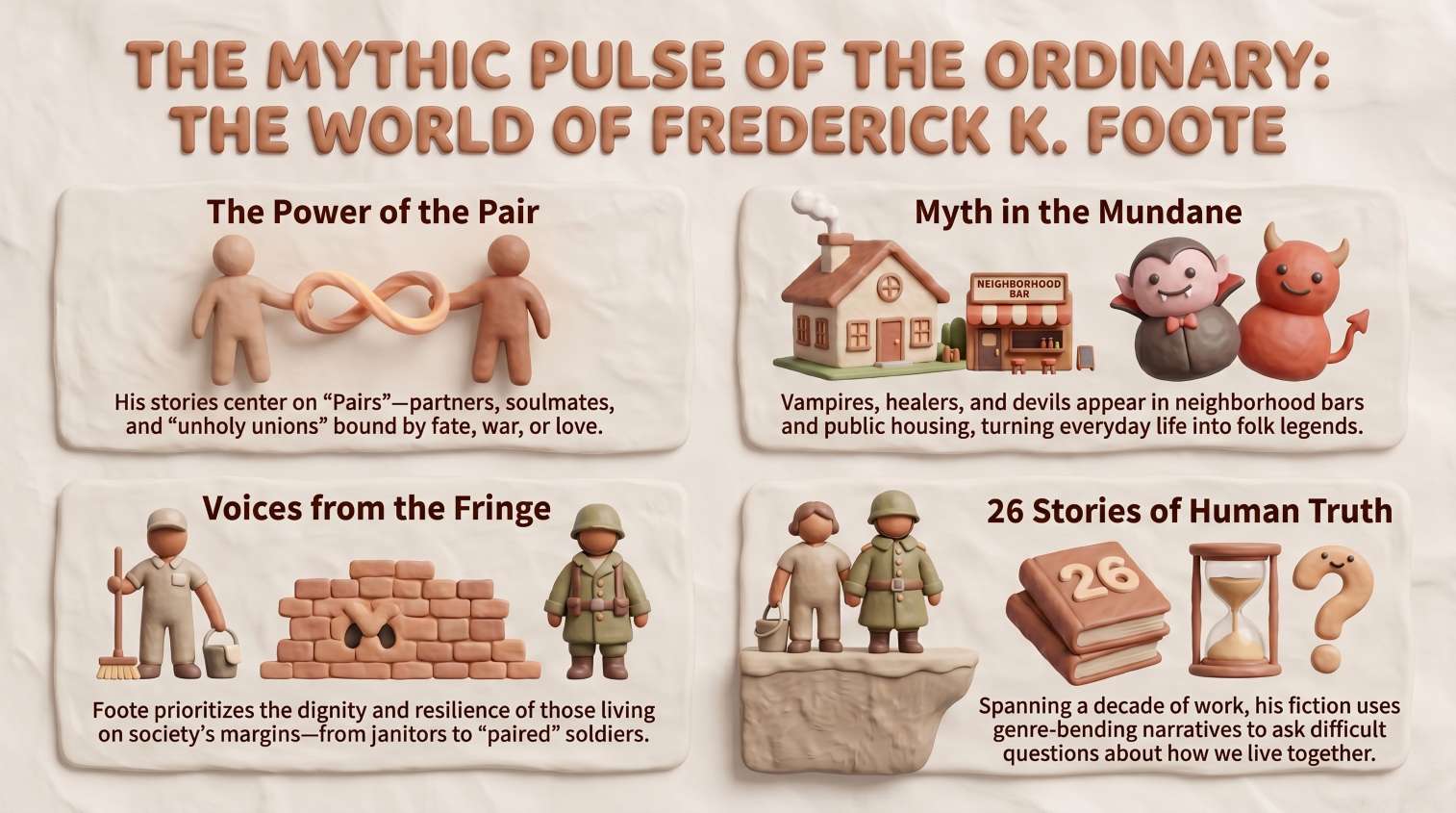
Frederick Foote’s extensive body of work effortlessly defies traditional genre boundaries, merging contemporary dark fantasy, horror, and magical realism with sharp social commentary. For readers new to his complex narratives, Foote’s stories can be understood as modern fables. He populates his fiction with ordinary people, the working class, and the marginalized, placing them in recognizable, often struggling communities. However, rather than simply documenting their hardships, Foote introduces sudden, startling paranormal events that physically manifest the psychological and societal traumas his characters endure.
The Shift from the Mundane to the Paranormal
Foote frequently employs a jarring narrative shift, pulling characters from mundane domestic or urban settings into sudden, life-altering paranormal events. A prime example is the story “Rain.” What begins as a typical, bickering domestic conversation between a long-married couple about vacuuming and loaning money to their son slowly escalates into a terrifying, apocalyptic 40-day flood that traps them in their home. Similarly, in “Munday Morning,” the protagonist is simply looking for a quiet morning of fishing to escape a grueling heatwave, only to be confronted by a terrifying, ancient woman who demands he find her sister, plunging him into a surreal, mythical conflict.
Systemic Failure and Supernatural Interventions
In Foote’s worlds, systemic failure creates the space for supernatural visitations. When human institutions and societal structures fail to protect the vulnerable, magical or demonic entities intervene—often mirroring real-life struggles and personal transformation.
In “A Perfect Match,” systemic violence and a lack of police protection allow gang leaders to terrorize a neighborhood and drive children out of a park. This societal failure leaves room for “Little Bit”—revealed to be the legendary, terrifying witch Nambi—to violently intervene, issuing an ultimatum and literally skinning the gang leader alive.
Similarly, “The Visitor” explores systemic neglect through the lens of healthcare and isolation. Esther, an elderly woman suffering from severe, untreated arthritis and failing vision, is magically healed and subsequently impregnated by a mysterious, supernatural stranger. The failure of the community is highlighted by the local sheriff’s incompetence and the sensationalized, exploitative media circus that turns the miraculously healed women into pariahs. The supernatural intervention becomes a catalyst for the women to band together and find strength in their shared adversity.
Everyday Trauma and the Transformation to Empowered Agents
Foote intricately connects everyday trauma with paranormal encounters, often tracing the transformation of characters from victims to empowered agents of change. In “I’m Back,” the protagonist returns to the Deep South, overwhelmed by the historical trauma of racism, poverty, and Jim Crow-era memories. His journey leads him to a hidden, magical “Maroon” community where he is confronted by “Seth”—a demonic entity responsible for the area’s misery. The protagonist is physically blinded but transformed into the new supernatural guardian of the Maroon, empowered to fight the ancient evil and build a sanctuary for his people.
Human Frailty Versus Supernatural Power
Foote’s portrayals of human frailty versus supernatural power emphasize how easily humans are manipulated or destroyed by ancient forces. In “A Dying View,” a disease-ridden, dying outcast seeks a place to die but is intercepted by a mythical serpent, an eagle, and a cruel Goddess. The Goddess grants him vitality, flight, and venomous fangs. Though he transforms from a frail victim into an overpowered agent of slaughter who easily massacres street gangs, his human hubris leads him to slay the eagle and serpent. In response, the Goddess revokes his vitality, leaving him immortal but trapped in unending agony, proving that human fragility cannot outwit divine power.
Critiquing Environmental Decay Through Horror Tropes
Foote’s commentary on environmental and social decay is uniquely channeled through modern horror elements. He frequently turns classic genre tropes upside down to critique environmental pollution, specifically the infiltration of man-made chemicals into the natural world.
In “You Know How We Are,” Foote reimagines vampires not as terrifying predators, but as an ancient species facing a mass extinction event. A vampire confronts an author to explain that the microplastics polluting human blood are short-circuiting vampire brains, leading to a genocide far worse than any violence their species ever committed.
He uses a similar eco-horror trope in “She.” The narrative follows a sentient, mosquito-like creature struggling to find viable human hosts because humanity has poisoned itself with chemical toxins. The toxic blood causes the creatures to falter and starve, illustrating how human pollution destroys entire ecosystems from the inside out.
Open-Ended Resolutions and Unconventional Structures
Finally, Foote uses open-ended resolutions to challenge traditional storytelling structures. Rather than providing neat conclusions where evil is vanquished and order is restored, his stories often end in ambiguity, reflecting the ongoing nature of real-world inequalities. “The Visitor” concludes not with an explanation of the supernatural stranger, but with riots breaking out across the state the moment his supernatural child is born. “She” ends with the desperate insect creature abandoning her destroyed colony to warn others of their impending starvation, offering no guarantee of survival. By leaving these narratives unresolved, Foote forces the reader to sit with the discomfort of the social, environmental, and systemic issues he so masterfully brings to light.
Frederick Foote’s writings published with FreedomFiction.com is defined by his seamless blending of genre fiction—such as dark fantasy and magical realism—with profound social commentary. His modern fables explore the lives and struggles of marginalized, working-class, and ordinary people. He is an exceptionally versatile author with and his social and environmental commentary, thrust common, marginalized characters into sudden supernatural encounters, allowing readers extraordinary insight into the ordinary life.
As I said earlier in an interview with him, Frederick is a writer of restless imagination and uncommon empathy.
Read Frederick Foote at FreedomFiction.com by visiting the below link