
Plutonian Shore by Nick Young

Plutonian Shore By Nick Young
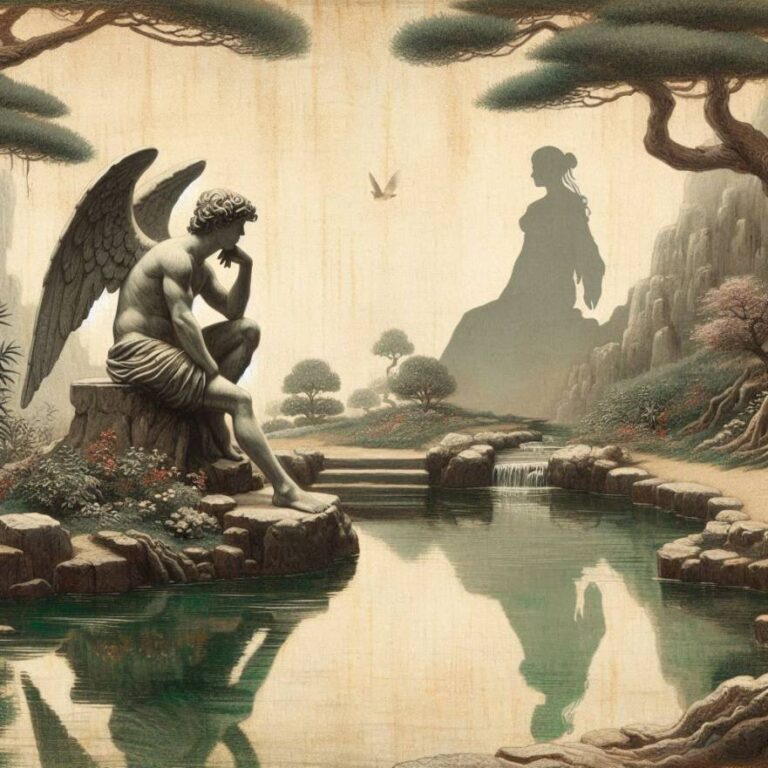
The maelstrom had abated. Outside, yes; but within his tortured soul there was no respite; it raged on. Another night of torment enveloped him as he slumped at his writing desk before the fire, flames barely sputtering amid the dying embers. He had quaffed the last of the brandy; yet while his senses reeled, the liquor had done nothing to soothe him. The volumes that littered his tiny room, filled with all the wisdom of the ancients, were barren of succor. A fortnight gone and still he grieved the passing of his cherished Eleanor—a wound that would not be healed.
In the throes of a weariness profound, as he laid his head upon the smooth wood and closed his eyes, the image of her face, yet reflecting the shadow of beauty despite consumption’s depredations, swam before him. Her once-bright green eyes, hollow and haunted, pleaded with him while her pale lips struggled to speak, yet no sound issued forth.
Ah, sweet love! Dearest angel!
The candle flame by his side quivered as his consciousness hovered between light and dark, day and night, life and death. And while thus suspended, shadows dimly flickering across the walls like a troupe of macabre dancers, the door to his lodging slowly opened, creaking and sighing with the night wind. He raised his head and beheld the blackness without; and, though he doubted in the moment the veracity of his senses, he perceived the distinct fluttering of wings accompanied by a voice that reverberateed within—low in timbre, yet compelling.
“Rise from thy stupor,” it ordered. “Clasp about thee thy cloak, and if thee would have surcease of sorrow, begone at once and hie thee to the west!”
Whence this utterance? A dream? Delirium?
He knew not the answer but heeded the commandment, staggering to his feet and grasping the desk lest his balance betray him. Thus steadied, he took up his cloak and, once enwrapped, stepped through the portal of his lodging and into the night.
Again, he had reason to question his senses, for what he beheld was not the surroundings familiar to him but a blasted landscape, barren and full of foreboding, stretching as an endless plain, flat and featureless, marked only at intervals by the scattered, withered remains of trees each with an agony of twisted branches. Overhead, neither moonlight nor veil of stars broke an oppressive dome of the deepest indigo, while far in the distance, where the plain met the horizon, lightning pulsed, providing an eerie illumination. Time seemed to halt its inexorable march as he drove himself forward. In what new land did he find himself? And what was his destination and the surcease of sorrow vouchsafed to him?
Presently, on the edge of exhaustion, he descried what appeared to be a human form. The character of the surroundings had changed. Gone were the flashes of lightning, supplanted by an opalescence that suffused sky and earth. The plain gave way to the gentle slope of a river embankment. The water was placid and smooth as glass. Resting upon it was a wooden boat, narrow abeam, with an upswept prow ending in a carved head fierce of mien. But more than the craft itself, what commanded his attention was the striking figure of an aged man, preternaturally tall, gaunt and ashen in appearance, with a long white beard to match his wild, free-flowing hair. He stood in the stern, the fingers of his left hand gripping a long pole that had been thrust into the water. With his right, he beckoned the nocturnal traveler to approach.
“Who art thou?” he asked, astonished at the arresting figure’s presence.
“Do ye seek passage?” came the response in a voice that reverberated through the night. Recoiling slightly, the traveler pressed his query.
“What place is this? And who beist thou?”
“I am the ferryman,” was his reply, staring with a stoniness that only deepened the traveler’s anxiety.
“Ferryman? To what far shore?”
“The world beyond,” he intoned.
“And will I find there the one I cherish above all others?” The question went unanswered.
“Are ye ready to embark?”
“I am,” the traveler answered, “but what is thy fare? I rushed from my lodging with no coin upon my person.”
“I seek no coin,” was his response, gesturing with a thin finger toward the boat’s thwart.
With trepidation yet a fluttering of hope within his breast, the traveler stepped into the boat. As soon as he had seated himself, the boatman employed his stout pole to push away from the embankment.
With long, smooth strokes he plied the dark water that slid past the prow with barely a ripple.
“Of what length is the journey?” the traveler asked, turning to the ferryman. He made no reply, sunken eyes staring directly ahead, his pole moving ceaselessly, shifting from one side of the boat to the other.
At length, the traveler saw ahead a billowing silvery mist arising from the surface of the water. At first, it brushed by the boat as mere wisps, but with each stroke of the ferryman’s pole, it rapidly thickened into an all-enveloping opacity. The traveler felt his heart beat faster, insistently hammering within his chest, his breath catching in short gasps as his anticipation grew.
My beloved Eleanor!
Now there came to his ears a susurration, a murmuring of a multitude of voices, a thousand upon a thousand, sighing, in what he perceived to be a plea of universal anguish. Again, he turned to the boatman.
“What is the meaning of this suffocating mist and the groaning that clutches at my soul?” he implored. “Speak, canst thou, for the love of God!?” The ferryman’s reply was not immediate, but following one more long stroke, he paused, raised his right arm and pointed directly ahead.
“Behold!” he cried.
The traveler turned in time to witness a parting of the mist, revealing beyond the approaching shore a looming escarpment—forbidding crags of dizzying height that fell away sharply to a boulder-strewn beach.
But as his heart sank in the face of such desolation, he detected the slightest movement upon the sand; and with each new stroke of the ferryman’s pole, he realized that what he perceived was a figure walking toward the river’s edge. And again, stroke upon stroke, the solitary figure sharpened in clarity until there was no mistaking that what he beheld was, lithe and beautiful, his Eleanor! She was clad in a robe of dazzling, diaphanous white. Gone were the ravages of the consumption that had stolen her from him. Lustrous auburn tresses caressed her lovely face—pure cream complexion tinged at each cheek by a blush to match the strawberry hue of her lips, moist and inviting.
As the ferryman brought his boat to a halt, nearly noiselessly in the pebbly wash where the river met land, Eleanor drew closer, green eyes flashing, her mouth wide in a welcoming smile. She called out the traveler’s name and opened her arms when he alit from the craft.
“Eleanor . . . is it? It is really you?”
“It is, my love; your senses do not deceive you,” she answered, her voice softly melodious. “Now, come away with me quickly. We don’t want to keep the others waiting.”
Others?
Her comment and the slight alteration of her tone caused him puzzlement, but it was swiftly banished by the sheer delight at his reunion. He allowed her arm to take his and pull him forward. He cast a final glance over his shoulder in time to see the ferryman thrust his pole into the water and draw away from shore.
As he walked across the sand with Eleanor, again to his ears there arose the chorus of sighs, of what he could only describe as lamentations. He turned to his companion, a questioning look upon his face.
“Dearest—those voices?” She greeted the query with a squeeze of his arm.
“Think nothing of them,” she answered lightly and said no more.
Presently, the two approached a yawning cleft in the towering rock face before them. They entered into a grotto enveloped by crepuscular gloom, the air thick and cloying. Seized with apprehension, he pulled up.
“Do not hesitate, my love,” Eleanor reassured him. “Continue straight on, for the others await us.”
Again, that reference!
Though he did not understand it, he refrained from raising the question anew, doing as he was encouraged to do, walking ahead of Eleanor with all the fortitude he could muster. Stepping carefully, he made his way down a lengthy incline until a vast chasm opened before him and within a scene of indescribable horror—a churning mass of what in the deep gloom he perceived to be human forms but ghastly to behold for they bore scant resemblance to the living. Their coloration overall was a sickly pallor with faces elongated in the extreme that seemed to have melted as wax from a candle until the features were nearly impossible to discern. From their gaping mouths, hollow and black, there emanated the moans of creatures in the throes of the utmost agony. And as they wailed, their elongated limbs thrashed and entangled in desperation.
The dread that had been building now took hold of him in full, gripping his heart, clutching at his throat, causing him to recoil.
“What forsaken place have ye brought me to?” he gasped, spinning ‘round. But instead of his beloved Eleanor, she of delicate and surpassing beauty, what he beheld was a grotesquerie like those in the pit. With no word this thing lunged and snared him in its grasp with talon-like fingers, drawing him with a force that, though he struggled, he was incapable of resisting. And as the hellish thing pulled him close to its face, with gray flesh oozing, it opened a dark gash of mouth and spoke with breath so fetid that he feared he would retch.
“You are mine now, my beloved,” the creature rasped.
“No!”he cried out. “It cannot be!!”
“Ah, but yes!” came the sharp reply as the thing tightened its hold. “Was not our reunion what you have yearned for with every beat of your heart since the moment I left you?”
“You, foul thing, are not—cannot be—my Eleanor!” The abomination tilted its head back and laughed.
“I am she, beloved, and we are as one again . . . forevermore! Now, come, for the others are waiting!”
* * * * THE END * * * *
Copyright Nick Young 2026
Image Source: Patrick Gillespie from Unsplash.com



Nick has conjured an infinitely effective and shocking horror story. There was the 19th century, Poe-esque vocabulary and manner of writing which was of no little significance. Words like portal and surcease and vouchsafed have a period feel but are well-suited to the narrative. And the metaphors are exceptionally well-selected. The story might well have been titled “Nightare.” Well-done, Nick.
Very kind, Bill. Thank you.
Oh, Nick, I loved this. It is very Poe like and your use of vocabulary is wonderful . You had me from the “quaffing” of the brandy. Rod Serling would approve, too.
Thank you, Jane.