
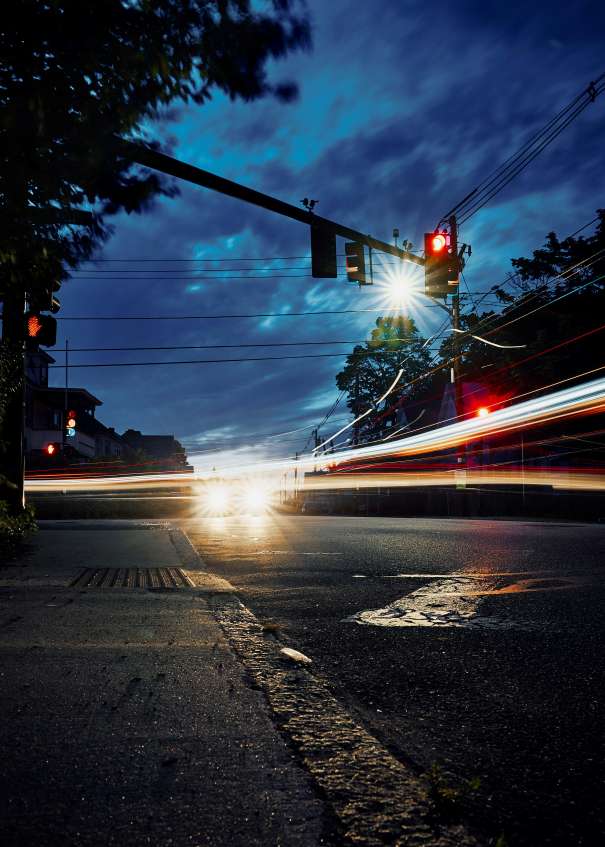
Summer Night, City Adjacent by Nathan Thompson
“Which one’s this now?” one old-timer asked another.
They sat on floral seat pads atop white wicker lounge chairs, each slurping a Tom Collins in a sweat-beaded glass. Their cigar cherries wandered the muggy night air, like fireflies bulbous and red-hot. They fancied themselves holdouts of that old guard—genteel barons on a veranda or sportsmen at a grand lodge. But they were just early models of the here and now, retirees of lives up and down, manning a wraparound porch in August. Good ol’ boys, aimless and accomplished, restless and beat-down. Taken to watching, remarking.
“He’s not the linebacker, is he?” the same asked. “No,” he answered himself, squinting at the lamp-lit avenue. “Can’t be. Heard he’ll captain the defense.”
“Must be the youngest,” said the other on an ice-rattled swig. “Oldest went off to college. Do his fighting with a bullhorn and pamphlets. Better for him than this Vietnam business. Fellas burning draft cards and what not …” He sucked his stogie. “Oldest is brains. Middle is brawn, the All-Met linebacker.”
“So, who’s this one then?” asked the other, jutting his chin off the porch.
“Half a damn retard by the looks of it.”
Their lubricated chuckles melted to the rhythm of the cricket and cicada and treefrog. The score for such sultry summertime night—along with shattering glass and hissed threats peppering the geezers’ soupy repose. They seemed unbothered.
“Yep. Only numbers this one’s sticking his nose in are those the damn Beatles play on Ed Sullivan.” They laughed. “Must’ve mistook him for the linebacker given his company. Seems the District Catholic league has got just about all the city’s blacks playing in it these days.”
The other shrugged. “Can’t deny talent.”
“Who’s denying anything? Time’s passing differently, is all. Few years back, Ernie Davis wins Heisman. Now, Willie Mays is the highest paid in the Bigs, Sidney Poitier is the Best Actor in Hollywood, and Doc King will likely win that Nobel Prize.”
“There you go again,” said the other, dabbing sweat below clean-parted, stark-white hair.
“Where?”
“On one of your tangents.” He stuck his handkerchief under his yellow spear-point collar.
“Tangents, you say?”
“I do. And I say the game of football has never been more exciting.”
“Hell, a firecracker tied to a mutt’s tail is exciting. Doesn’t make it sport.”
“What would you know of sport?”
As their quarrel flared up, one long-lit smoldered nearby. Tommy McDonnell hugged the brick of a Sunoco service station on Connecticut Avenue. Laird and Landmark ran behind him to either side, bowing into the quiet neighborhood. He peered around the wall’s edge at a throng of teenage boys up to nothing but no good, as Wednesday’s night crept toward Thursday’s morning. Bottles got passed ‘til empty, then smashed with requisite indifference, as pull-tab beer cans met the wrath of pile-driven adidas and penny loafers.
Tommy studied his foes with snarls of his peach-fuzzy lip, eyes menacing under a helmet of chlorine-stiff hair. He wore his navy and yellow striped rugby shirt, lifeguard-red swim trunks and tan rubber flip-flops. Rubbing a nickel in his fingers, he withdrew behind that service station, peering down sedan-studded Landmark Court. Behind the Sunoco’s rear lot, it cut between swell homes and a tree-hidden fence along train tracks, dead-ending at the country club’s enclosed golf course.
Tommy leaned upon gum-caked, motor-oil brick. He’d gained his position so near enemy territory after hours retreating, rallying, retreating, while hurling and ducking projectiles in a cat-and-mouse standoff that had the other guys boozing in a defunct streetcar station. Despite a brave showing, conditions prevailed. They had him cornered. And not him alone.
Tommy saw Lincoln Davis behind a Buick’s taillight, knee on the pavement, his other leg bent, toes toward space. Ready to book it. Link furrowed a bloody brow. Wiry biceps swept flaps once sleeves as he shrugged at Tommy, his blue tee hanging asunder. He wore swim trunks—his first ever—muted silver, navy stripes down the sides. He chose them for Cowboys colors, despite being a generational Washingtonian, and paid with cash from painting rowhouses on Florida and Rhode Island. His mother wouldn’t shell out for trunks. But he and his older brother Douglas had Ocean City plans—Colored Excursion Days a thing of the recent past. They saved enough for the bus and two nights at the Henry Hotel, bidding their time to pitch their mother.
That time never came. Douglas got locked up that July 4th, nabbed by a stormtrooper near the Museum of Natural History for smoking grass on the Mall while watching the fireworks. Not so much that as where he opted to light up—mainstream city—or with whom—a white girl with flowers in her hair, who held his hand while reaching for the doobie in his other. Douglas knew it was dumb, but her smile was just too damn much. And patriotism perfumed the air.
They cracked his skull and knocked out eight of his teeth, amid other trauma that had him urinating blood for a week before creative charges of resisting arrest and assaulting an officer got him taken to jail, where he still sat. Recalling his battered brother chained to a bed at Freedman’s Hospital as MPD restrained their hysterical mother, Link studied blood on his trunks. He realized his mother—in the dark about Douglas’s Independence Day outing and Link’s today—was right. He had no use for swim trunks. All they did was trick him into thinking so. Swim trunks … And fuckin’ Tommy McDonnell.
Link met him two weeks back in summer session at their Jesuit high school in the city—a requirement for Link to transfer sophomore year, for which his achievements at tailback played a part. His mother seized upon the opportunity, even if financial aid stemmed from boosters’ desire to dominate the gridiron. It was a good school—one of the few, she’d say. And she’d make damn sure Link achieved on his report card same as on the field.
Tommy’s reason for summer school after his freshman year varied—truancy, bio teacher with an ax to grind, excuse for bus fare from his mother. Tommy’s oldest brother was at college, his next older, a freak linebacker Link had seen in action and planned to avoid at camp. Tommy, well, he was a character. Either had Link in stitches or ready to cause the need for some. He was pure entertainment. And the first white boy Link ever befriended.
Well, Mister Entertainment indeed gave Link a reason to sport his trunks, even providing a swell day at the Chevy Chase Lake Swimming Pool—massive, pristine, and serving close-knit suburbanites since the 20s. It sat just beyond that hooligan depot, on the west side of Connecticut Avenue where Link currently hid. Its opening by Mr. Lou Heon in ‘27 came of an itch the Chevy Chase Lake Amusement Park—once across the avenue around that since-filled-in lake—couldn’t quite scratch.
That lake—rather industrial reservoir formed from damming Rock Creek’s Coquelin Run tributary—cooled powerhouses supplying electricity for the streetcar until its closure in ’35. And this neighborhood, or lack thereof at century’s turn, hosted the trolley’s northern terminus, where it met B&O’s Georgetown Branch line, which still ran across the avenue. The Chevy Chase Land Company sought community from industry, branding the swampy basin a lake and surrounding it with an amusement park in the 1890s, complete with a bandshell and dance pavilion, rowboats, a shooting gallery, carousel, pony rides, fun galore. It became a year-round jaunt for city folk as its languid waters proved an ideal skating rink once frozen. Local newspapers updated the public on ice conditions and advertised a wintry wonderland with hot cocoa and cider—even electric lights eventually—open until that last streetcar back into the city, and only for the cost of a Rock Creek Railway trolley ride.
For the developers wanted to sell land to builders and buyers, not admission to games and travelling acts. It worked. And the park even outlasted the streetcar, free to the public—the white Christian public. Most others, whether speaking poor English, holding a different day as sabbath, or one of the city’s tens-of-thousands of blacks, would be barred by safety officers for any phony reason or none. Most others knew not to go.
While a great ice rink formed from its briar banks and reptilian waters, the lake ultimately failed summertime expectations. Hence the pool across the avenue, where Link knew he was just as unwelcome these decades later. He wondered if a grandparent or great uncle ever tempted fate at that lake, as had Link at this pool. He took scowls and snickers from pasty and tan alike on the chin, head held high. He’d expected it. But once the sun sank and word grew a colored kid hit the pool with one of those batshit McDonnell boys, another breed of objector appeared, time to spare and hate to burn that dog-day night.
“They gonna bounce me like brother Malcom from the Nation of Islam,” Link had joked, masking his fear at menacing gestures from the pool fence.
“Mellow out,” Tommy had said. “Hotdogs on me when the bike-cart comes.”
Truth was, up ‘til thereabouts, it hadn’t gone so bad, just as Tommy had said. Once shock and awe dissipated and folks contented themselves on the murmurs Link was one of the catholic-school ballplayers, he’d even settled into a goodtime. He ignored indirect comments and Tommy dared any to come directly, pit-bull glare fronting for his Pomeranian bite. Bigoted dust settled to folks young and old enjoying a summer day. At the time, Link had to hand it to Tommy. He even managed to get some choice girls their age to take abutting lounge chairs and tease hints at which field they’d be sneaking spritzers that night.
But the dreamlike day shattered along with the first empty fifth of Old Grand Dad to land at Link’s feet. And nightfall sunk his hopes of having visited this place unscathed. Tommy tried slipping them from the pool, off the busy avenue, to eat in peace as he’d put it. In hindsight, they couldn’t have chosen worse, leaving the public eye—willfully blind as it was—to get stranded at the railroad fence. Wolves limited to howls spotted them and licked their chops.
The confrontation turned from threats and posturing to a quick melee, tempered by a still-too-sober reticence on the part of the pack and Link’s and Tommy’s ability to avoid being pinned down. A neighbor’s hollow shout of ringing the police scattered the fledgling posse. As Link saw it, cops would be worse—a beatdown with authority. He saw Douglas handcuffed to that bed and refused to put his mother through it again, pondering the level of assault for his offense. The next two hours, darkness settled, any public eye shut for the night, and more goons joined. Link had a knotted head, cut brow, torn shirt, no shoes. Missing that last bus into DC, thus a transfer back to Bloomingdale, he dreaded how this night might end.
Tommy caught Link’s motion by the Buick, blue tatters flapping. He felt awful. He knew they’d get shit for it. But he couldn’t stand anyone in the neighborhood. He meant to thumb their eyes, while maybe gaining a pal it’d pay to have come the schoolyear. Hell, Link had never been to a swimming pool. Tommy found that egregious, a matter he was called to rectify. But Tommy could be a selfish, misguided bastard. Things ballooned on him. As they often did. Some of these blitzed sweat hogs he didn’t even make as from around here.
Just then, he heard gravely scuffs and a shushed guffaw from around the south side of the building, beside the train crossing. By the odor, a click had splintered off to smoke grass and idle about, interfering—peace-and-love drug, his fuckin’ ass. There went his last resort, a dead sprint up Connecticut to Dunlop, then home to involve his mother and perhaps get that same beating he would here, only on his own front lawn, where a couple neighbors he knew might even join in on discovering his company.
But that was a half mile. Uphill. And Tommy sucked at running. While Link would leave him and them in the dust, he wouldn’t with no shoes and glass in his feet. In fact, Tommy’s shin ached something awful where bottle shrapnel had lodged.
Laird and cross-street Loughborough in the near distance, where Tommy swore he heard geriatric chuckles not long ago, met another residential block or two—a small suburban impasse, penned by the golf course, the old Georgian-brick Hayes Manor, and the avenue. Landmark died at the links, where Dobermans had the run overnight and security would likely go worse on Link than the cops he feared. The course, damp and brilliant under summer’s moon, through which the B&O cut in a feat of landscaping disguise, bore a grand white clubhouse with a mission-tile roof, along with swimming pools, tennis courts, and a white-male membership since its 1911 founding and Woodrow-Wilson-frequenting days. They tolerated no trespassers.
Link had nixed Tommy’s idea to cut out as Tommy made a diversion, for reasons beyond infeasibility. Tommy didn’t realize just how deep Link’s apprehension ran. Unknowable hazards of wandering a nice white neighborhood alone in such a state spooked Link more than the certain beating he’d get from this drunk teenage throng, bad as it may be.
He had two miles to reach DC, three after that of well-to-do whiteness—whether in Rock Creek woods or on busy Connecticut Avenue, both daunting given the hour and circumstances—then three more home. More than once under siege Link referenced the three civil rights activists killed that summer, bodies found just the day prior. He reminded Tommy two of the young men were white, albeit Jewish—extent to which Tommy wondered factored into their murders. When Tommy reminded Link that had happened in Mississippi, not the nation’s capital, where LBJ just signed a Civil Rights Act into law, enabling his Great Society, Link scoffed and spit on the glass-strewn ground.
Watching Link behind that Buick beneath moonlight, Tommy then spotted his own blood drippings across the pavement below. Fuck the waiting game. This had run its course. He huffed from his nose then flipped his nickel, catching and slamming it on his scraped hand. Eyes finding Link’s, he nodded, forgoing the toss result.
He crept along the service-station wall, south, peering around the corner. That grass circle hadn’t seemed to lighten any moods. Tommy took his chances with this contingent. He raced for a multicolored block of newspaper boxes, arriving unseen. He covertly snagged the Bell Atlantic receiver above, his black-eye shiny in the lamplight. He rose subtly, put in the coin, then dropped back behind the metal boxes.
Thrown off by Tommy’s sudden move and not yet trusting him all the way, Link crept up alongside parked cars.
“Tommy!” Link hissed. “Don’t you fuckin’ do it! No cops!” He went unheard or ignored. “Told you, I’d rather get it from the prep-school Klan.”
Just then, a head belonging to such snapped around. Link dove from sight.
At her home on Cypress, Beverly McDonnell flicked a switch on a wood-paneled wall. A stained-glass billiards light hanging over a breakfast table revealed a tidy, quite lived-in kitchen. Bev wore a punch-pink robe atop her satin dressing gown, with tightly bound teal curlers in her auburn hair and a pasty, honey-and-cornflower overnight mask on her face. She got a glass from the coffee-colored, Tudor-style cabinets then opened the icebox below her avocado Frigidaire. A ceiling fan whipped overhead.
Bev didn’t know for just what but had a midnight-snack hankering. She figured she could use another glass of orange juice while at it, so might as well splash in a little more Smirnoff and call it a night. She’d snuck past Joey and that odd Rutkiewicz boy she didn’t care for in her home at such hour.
They played some dweeby, soldier-man board game in the den and listened to that awful California-sound stuff on a Westinghouse transistor. She couldn’t see why her son palled around with that lab-rat doofus—a damned football star, after all. She always figured that’d make things automatic for him. And she had to shoo off the girls since fifth grade just to get her cart down the supermarket aisle.
Of course, Joey had always been a little off-kilter. All three were, in their own ways. And he had his demons, most of which he freed out on the field, thank heaven. The Rutkiewicz stooge was well-mannered and kept out of trouble, apparently nifty with that guitar he always toted too, which Bev figured may help him at college. Hell, at least they weren’t in there jerking each other off—far as she knew.
Might not be perfect, she told herself, gray pork-jelly aspic jiggling on its tray, as she slid it aside for the OJ. But she’d done her best. She’d done okay. All on her own the last … Bev laid her glass on the harvest-gold countertop, fanning her eyes with another reminder it’d be ten years next month. She huffed and snorted herself back to composure. This face mask was too goddamn expensive. She unscrewed the red cap she’d just returned to the bottle—contents of her glass still a little too bright. Shutting the icebox, Bev flinched as a salmon-colored telephone clanged on its wall receiver.
She snatched it up, slurping liquid off her hand. “Hello?”
“Mom. What’s my fucking blood type?”
Beverly sighed, icy glass to her head, slouching on the wall. “Jesus, Tommy. I should’ve suspected. Where are you? What’s it this time?”
“Oh, I’m not far. And this time, it’s for all the marbles. I need to be prepared.”
His voice came heavy and hushed through the line, like she could feel his breath.
“What the hell does that mean?” She squinted for a gimmicky plastic cuckoo clock on the wall. “Thought you were just going to the pool. Maybe catch a flick?”
Tommy’s caustic chuckle rustled the receiver. “Went to the pool. Couldn’t catch anything after that expect horseshit vibes and pussycat haymakers.”
Bev sighed again. “Tommy, son. You really need to make friends.”
“I’m with a friend, Mom. That’s what this is all about.”
Bev couldn’t imagine what that meant. He couldn’t mean a girl.
“Tommy, you worry me. One day you’ll get yourself in a bind you can’t escape.”
“Well, this one I ain’t trying to escape.”
“Listen. You’re going to get hurt, killed even.”
“Then press my suit and play me out to The Parting Glass.”
“Tommy—”
“And, Mom. That’s only if these candy-asses don’t get themselves killed first.”
“Tommy, are you still down—”
“Mom.”
“What!”
“What’s the only thing necessary for evil to triumph?”
“Oh, Tommy.” Bev pinched her sinuses, taking back caky fingers on forgetting her mask.
“What is the only thing necessary for evil to triumph?” he rasped.
Bev sipped her drink. “For good folks to do nothing.”
“Fucking-a right.”
She heard the phone separate from her son.
“Tommy!” She could hear his breath again through the line. “You’re O-negative. Not that you’d be in much position to relay it if the situation truly called.”
Silence. “I love you, Mom.”
The line went dead. “I love you too, Tommy.” Bev hung up the phone and swigged again, eyeing wheat-laurel wallpaper a foot from her face. “Joey!” she cried. Abandoning her glass, she marched for the den.
“…no, it’s a gas, man,” came Rutkiewicz’s deep voice. “I’m telling you.”
“I can dig it,” she heard Joey reply.
“Joey!” barked Bev, rushing into a side-room lit by a metal hobby lamp over a game on a coffee table. The boys flinched atop burnt-sienna shag carpet. The Rutkiewicz kid spasmed to his feet, as drilled into him.
Bev flinched a little herself at the inverted mop with matchstick legs and angel-hair arms. She scarcely kept down her screwdriver at the sight of his bones poking through powder skin and mauve, paisley-print satin. His long hair appeared too much for his shoulders to bear, the way he slouched and swayed beneath it.
Her son remained reposed on the shag, in a dress shirt too—unnecessarily so in her mind. Goddamn polkadots at that—lime-green discs atop a grass-green base, some sizes too small, with buttons toiling. He looked like a jockey out of work due to gigantism. The Polish boy’s dark eyes filled his glasses, as he gulped in complete exhibit of his working esophageal parts. Recalling her own appearance, Bev hugged her robe, clearing her throat.
“Joey, your brother needs help.” She took cigarettes from her robe.
“With what?” asked Joey, minding the Stratego board.
“What the hell do you think?” mouthed Bev around her Pall Mall, striking a match.
“Mom,” groaned Joey, “he needs to bail his own self out once and awhile.”
“Joey!” she yelled after her drag, giving Rutkiewicz cause to check his drawers.
“But I’ve almost got him surrounded,” Joey mewled at the board.
Bev flipped the game off the table, waif beside her convulsing on the wall, half expecting a whack. Flagged tiles flew in echo of her temper. She stood over Joey. “If you want to report to camp next week or play one single snap this season, get your ass down to that pool and save your goddamn brother’s life!”
Joey relented, as if to take out the trash. “Sheesh, I was gonna anyway.” He laced up new baby-blue Puma Suedes. “What now?”
“Who knows with that little disgruntled menace?” Bev snatched a ceramic ashtray off the end table. “Be careful. Try talking some sense into him.”
Joey scoffed, upright and limbering, as Bev took her leave. He eyed his buddy, still glued to the wall. “Take it you’ll be sitting this one out.” A skeletal jaw fell in reply, as the kid fumbled for an excuse. “Yeah, yeah, just try putting everything like it was.” Joey motioned at the upended boardgame. “I’ll be right back.” He spun in the threshold. “No cheating!”
Joey marched into his bedroom. Approaching a sideboard serving as a dresser, he opened his outnumbered drawer to enough melee weapons to supply a WWI trench. He got sweat-tinged brass knuckles and a duct-taped roll of quarters he kept at the ready unless in need of coins. He’d come to find a set of knucks on both hands hampered him when push came to shove—hard to get off sometimes, grab or maneuver bodies. Brawls were never boxing matches.
Joey didn’t employ blades. Not that he hadn’t met those who did, sporting some scars for proof. But blades changed the game in his eyes. Anyone could stick a pin in a cushion or slice an apple. A rumble, well, that boiled down to something sacred.
Joey left his front stoop for a skip on Cypress and left on Dunlop. At Glendale, he inhaled the living summer air and eyed a clouded moon, only sounds that of night bugs and fast steps. He passed his mother’s white-brick Woman’s Club, which offered lectures, craft fairs, health clinics, bridge—and most importantly, iced-tea in summer and hot cider in winter. Plus, the treats at their holiday party were unreal.
At the quiet avenue, Joey studied the country club’s high range net against a slate sky. It looked like a cosmic butterfly net for someone after stars. He cut the corner over the fire station’s front lawn, passing its two-garage bay under an American Flag. It moped in the thick air from its 45-degree affixture to the brick. Nothing occupied the avenue from him to the hill-bottom where the Georgetown Branch train crossed but a lake-fill of gnarly undergrowth and vine-choked trees on one side and the club’s course on the other.
Joey could hear that train’s air horn screaming beyond the golf course, just as it once had when hauling lumber, coal and bricks to offload at TW Perry hardware—still open down there in front of the supermarket and Packett’s Pharmacy, even if no longer as a railhead. And Joey fixed his eyes down at that hill-bottom.
Seemed a squadron of itchy and well-oiled nighthawks had all but laid out roadblocks by the old streetcar waiting-station and closed Sunoco—pool behind them, tracks between them and Joey. They clustered in pockets and hugged the shadows when headlights came zipping along the avenue.
Joey inspected them for recognizable faces or telltale identifiers, assessing challenges and cake pieces. Although the dark distance made it difficult, he thought he knew a fellow or two—a couple hard-cases from the Kensington side of that beltway soon to open any day; rich brats from the old-money side streets closer to that traffic circle bordering DC; wrestlers from the sprawling prep school a ways out. Some strangers too. But Joey knew the bottles and bricks. He recognized Perry’s repurposed lumber.
They basked in a quiet weeknight reign—bad-ass fish in a low-stakes pond of safe streets and wealthy parents … most anyhow. Joey didn’t see Tommy, but he’d found him. This had him written all over it.
Joey kept to his jog. His palms would sweat when shaking hands with new acquaintances. Sometimes long lectures or assemblies had him sure he’d piss himself, so he’d hit the John every few minutes in case. Being in an elevator or an airplane made it damn near impossible to breathe. And he couldn’t be around girls without his heartbeat short-circuiting and faucets going off in his armpits, although he let rumors to the otherwise abound. But here he felt at ease. Here and on the field.
Joey didn’t politic. He didn’t boast or taunt. He favored action and revered silence. Not as general conditions of existence but currency and narcotic—trading on his action, doping off their silence, brief eternals amid constant wisps of consideration and noise.
Joey dismissed what ifs and why nots, will he or won’t he, did she or didn’t she, pursuing action free of as much. He ignored the noise—pound of knuckles on flesh, clap of jaws in skulls, pop of helmet on pads, thump of bodies against grass—for the fleeting silence thereafter. And at that pinpoint juncture of action and silence, Joey soaked in respect; pure, primal, that head-to-toe warmth like none other. It left him stoned as hell. And despite his other debts in life, he amassed a small fortune from it and kept on earning.
Given as much, probably a good thing Joey’s dad taught him how to fight. How to take a fucking hit. He’d taught him well.
Setting his topped-off Tom Collins on the wet-ringed glass of a wicker table, one golden-year onlooker whistled through his teeth. It snapped alert that other in the sweaty goldenrod shirt, whose two inches of smoldering cigar ash fell onto his naked knee, singeing him wide awake. He sat upright.
“Think that’s one of those Mustangs Ford just rolled out.”
The groggy one caught taillights zipping up the avenue.
“Mustang’s right with that horsepower,” added the spotter.
The other grunted, brushing ash from his leg, checking for a burn. Glancing up again, his attention found the back of that Sunoco, where Tommy had winded himself shadow boxing. The kid sprang around, pummeling the nighttime, like a fighter who kicked off the bout without even making the ring walk. Tommy stopped, rolling his neck, pounding his chest, as if keeping beat to a chant.
“Goddamn,” croaked the tipsy cat-napper. “That kook’s still hanging tough? Where’s his interloping pal?” He watched Tommy searching the gravel lot amidst scrap metal, pallets and oil drums. He grabbed up a rusted tire iron, which he admired in moonlight and wielded in darkness. “What’s that dunce planning on doing?” asked the old-timer, finally awake enough to retrieve his own drink.
The other one whistled again. “Who knows?” He nodded up the avenue. “But here comes the linebacker.”
His associate glimpsed up the hill, beyond the tracks, which had begun rattling slightly at that freight engine’s approach. “I’ll be goddamned. Might just need to hold off on my refill.” He screwed up his face. “Say, what the hell is he wearing? Looks like the strongman ran off with the clown’s shirt.”
Link could hardly hear the rumbling train over his thumping pulse … But he had detected footsteps of two whispering goons. They advanced toward where he’d retreated down Landmark. He’d lost sight of Tommy and the main posse. Hugging the gritty street behind a chrome-rimmed tire of an old Bel Air, he peered beneath its undercarriage. He felt beat and ached badly, wishing he could sink through the pavement, slapping away that nagging notion of walking out to request amnesty.
Some 200-pound meathead lumbered forth in a navy and white letterman jacket—a must for any 82-degree night. His flushed cheeks appeared permanent though, just like that mean scar meandering down from his high and tight crew cut. A teeth-bearing snarl seemed like his natural expression. He spat brown and juicy from his dip-fattened bottom lip. And yanked up his khakis every few steps, leather belt repurposed around his fist, wrapped tight, the buckle tucked over his knuckles.
His contradictory crony looked lean and graceful, like a dancer. Although his forest-green trousers fit, he nevertheless fiddled with their side-adjusters—no belt to weaponize and wielding nothing else. His blonde hair swayed at his chin, overtop gold shoulder buttons of his thin-striped sailor shirt.
“… At the handball courts,” said the bulldozer, their voices reaching Link.
“Oh. That’s boss,” replied the beanpole.
“No, that’s what I’m saying,” huffed the ogre. “Not boss at all. All show, no go.” He spat tobacco juice. “Wasted half my week’s dough on her.”
“Oh … damn.”
“Where the fuck is he? You’re seeing things on that grass. Stoned as a damn quarry.”
That bred one-sided chuckles. “Yeah, fuck it. He flew the coop. Bummer.”
“He’s got nowhere to go,” snapped Bigfoot. “Just hang tight …”
Slim sighed. “Rather hang loose with another doobie. What the hell are we even doing?”
At that, they whipped around to their whole gang racing up the avenue toward the tracks, train’s headlamp casting them in brightness. Fireplug whacked fire-hook. They rushed to join the ranks, one more eagerly than the other.
Link stood at seeing the same. He crept out, thinking of Tommy with pangs of guilt. Then he spotted him behind the Sunoco, pep-talk pacing with that tire iron.
“Go boy,” seethed Tommy, wearing a track into the gravel. “Go forth and beat their faces until you pound nothing but the ground beneath their heads!”
His words becoming a roar, Tommy exploded into flames then bolted around the Sunoco. Having been so absorbed as his own corner man, he’d failed to notice that oncoming train, which he’d been accustomed to hearing day and night.
Charging past the fuel pumps onto the wide avenue, he saw those dirty dozen or so of his sworn enemies race across the tracks, bathed in mega-lumen glow, angry engine blaring its horn. Then Tommy saw him—alone against the dark road, bearing down upon the poor bastards with a stride of imminence that iced even Tommy’s coal-furnace veins. The goons scampered across the tracks to meet him.
Tommy’s mouth opened to curse but it all got caught in his throat. Joey ducked a wild bat swing then downed that first fool with ease. Even had Tommy turned the air blue, it’d have been stifled by the ferocious train which blew across the avenue not three seconds after that last jackal cleared the tracks.
Stopped in his own, Tommy watched the flashes and shadows rumble past, chest heaving, tire iron clanking onto the street. Link shuffled up gingerly. They observed with thunderous calm as, car-after-car, the beast chugged along until suddenly vanishing—buried much quicker by that same silence which bore it.
A lone figure cut toward them, gait less steady than typical. Stepping into the light of the crossing, Joey eyed them with the one that hadn’t already swelled shut. His lip had split good. He favored his left ankle.
He wasn’t the only one standing, but all who remained. The few on their feet behind him only managed as much in a half-concussed stupor, bewildered self-examination or some stage of that same surrender or retreat which spared them—only a few. The rest decorated glass-sheened sidewalks and blood-dyed grass, a sporadic writhe all to speak for them and that olio of weapons, their company.
Link gaped at the scene.
“Fuckin’ unreal,” he whispered.
Joey drew up before them. Eyes on Tommy then Link, then heavy back on Tommy.
“Let’s blow before the cops come,” he said.
“Fuck … You,” said Tommy. “This was me!”
Link reared, eying Tommy askance.
Joey kept that same weary accomplished stare of his and kept to holding his ribs. He gave Link a once-over then met his eye. “Better get them feet healed before camp. No fuckin’ excuses when I chase your ass down.”
A chuckle escaped Link. “Might wanna take a look in the mirror.”
Joey snorted. “Bumps and scratches.”
But he winced on his left ankle, and Tommy never knew mere pain to bother his brother.
“Don’t think I owe you anything,” Link told Joey. “Ain’t even close to that.”
Joey nodded. “As I see it, you owe me what I owe you … all you’ve got to give on every fuckin’ play. That’s if you make varsity, champ.”
Link scoffed, guilty of liking what he heard.
“Do yourself a favor,” said Joey. “Steer clear of this one.” He motioned at Tommy. “He’s got balls the size of party balloons, filled with laughing gas just the same.”
Link stifled another chuckle. “Yeah, well rumbling ain’t my bag. If I can help it.”
“Okay,” said Joey, after a moment’s reflection. “Come on, let’s get back to the pad. Mom can make you two a bottle of warm moo juice and put you to bed.”
He led them past the eroding gang, laboring to hide his painful limp.
“But don’t fuck with my Stratego game,” spat Joey.
Tommy crowed. “Ha! You would be home doing that!”
“And you’d be out doing this,” replied Joey.
“We didn’t do shit! I stand on that. To the death!”
“I’m sure you do, Tommy.”
“Isn’t that right, Link?”
Link kept quiet a moment. “What the fuck is Stratego?”
“Contraception, that’s what!” cried Tommy.
The boys each took of laughter as they wanted, turning at that fire station, off the avenue.
With the wrap-around porch silent once more—save for the swampy accordion of August night—one geezer put a drink in the other’s waiting hand then groaned back into his chair. Sirens seeped into the sky around the avenue, from which the defeated attempted escape—those upright yanking at those who weren’t.
“Know what hit me in there?” one asked. “I think that might be the public-school star, the transfer. Post had a write-up on him. Speed and vision, they say.”
“Hmm,” replied the other after a sip. “Why you figure he’s palling around with the whelp then? Kid barely made JV last season. And only because he toted the water.”
They chuckled.
“Wonder if he’ll go out this year.” He shook his head. “Somebody needs to stop him.”
Silence crept between them.
“Bet he will. Not sure who can. Boy’s nothing if not a fighter.”
The other scoffed through his gulp. “He didn’t throw a punch!”
His pal sipped too, shrugging. “Not always where the fight is.”
The other shifted uneasily. “You sound like one of them damn flower children.”
They laughed, red and blue lights flashing on the avenue with all the noise.
* * * * THE END * * * *
Copyright Nathan Thompson 2026
Image Source: Mark Boss from Unsplash.com