
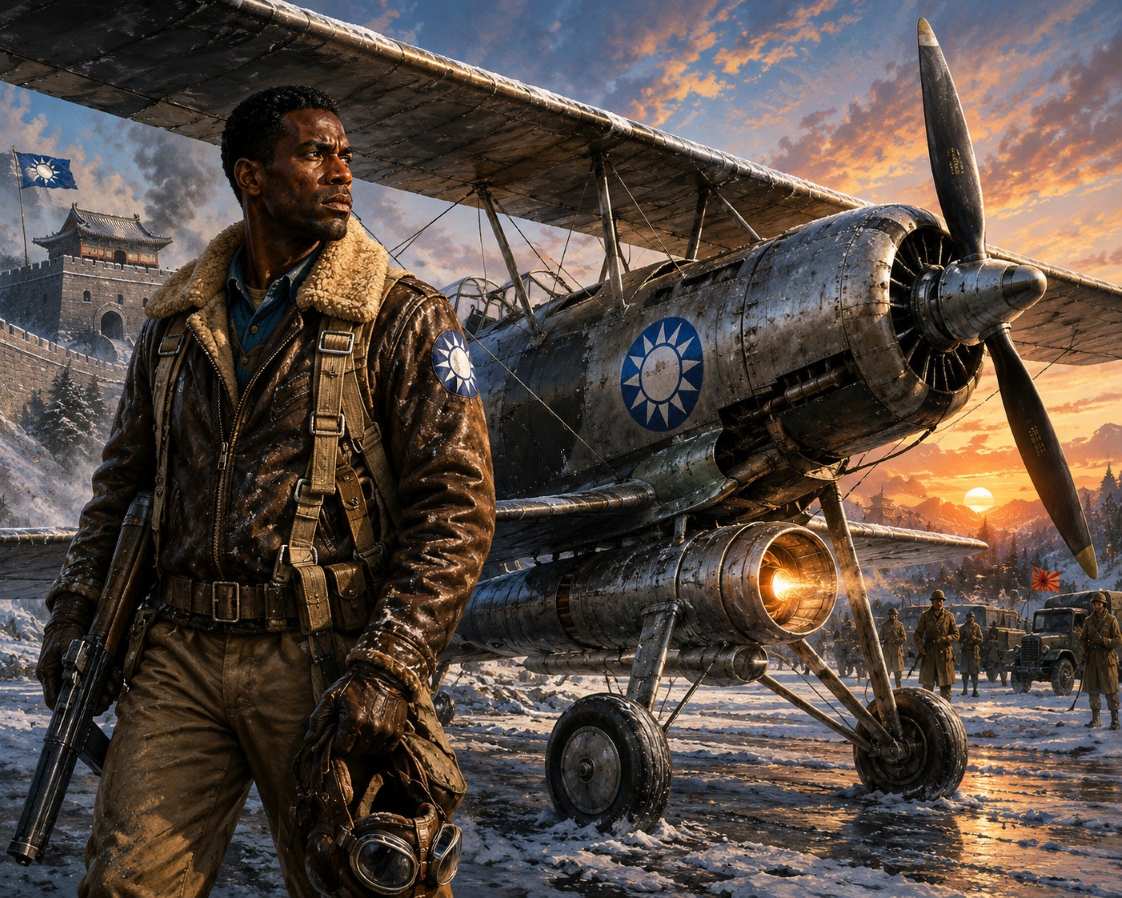
EDITOR’S NOTE: You can read four other Adventure stories by R.K. Olson on FreedomFiction.com ,
This story features the character Jackie Boyd and his continued adventures through war and valor. This is the fifth Boyd fiction appearing on FreedomFiction.com — the previous four in reverse chronological order of publication are:
Manchurian Gambit by R. K. Olson
https://www.freedomfiction.com/2026/01/manchurian-gambit-by-r-k-olson/
Trotsky’s Train by R. K. Olson (February 2025)
https://www.freedomfiction.com/2025/02/trotskys-train-by-r-k-olson/
The Tsarina’s Jewels by R. K. Olson (August-2024)
https://www.freedomfiction.com/2024/08/tsarinas-jewels-by-r-k-olson/
The Vladivostok Express by R. K. Olson (April-2024)
https://www.freedomfiction.com/2024/04/the-vladivostok-express-olson/
Other Adventure story sans Jackie Boyd from R. K. Olson involves ancient lore of kingdoms and kins
Two Kings For Toltan by R. K. Olson (January-2024)
https://www.freedomfiction.com/2024/01/two-kings-for-toltan-by-r-k-olson/
* * *
C. O. D. – Cash On Delivery by R. K. Olson
He balled his gloveless hands into fists and shoved them deep into the pockets of his National Revolutionary Army (NRA)-issued khaki pants. His legs moved through the evening chill in a staccato-like fashion. He spat a cigarette butt from his mouth. It glowed for an instant in the darkness until it touched the thin layer of fresh snow, and the snow extinguished it. He exhaled, making him appear demonic as steam shot from his mouth and nose.
The NRA lieutenant observed the few other soldiers out at this dark, early morning hour scurrying like beetles to get back inside and away from the winter cold that had settled on the ancient town of Shanhaiguan. The town was located where the Great Wall meets the sea, descending into the Bohai Gulf. Constructed as a Ming-era army garrison in 1381, it still served as a frontier bastion against invaders over five hundred years later. Instead of the Mongols in the Fourteenth Century, the troops at Shanhaiguan were part of the forces attempting to prevent the Japanese Army’s complete takeover of Manchuria in 1932.
Wind probed and poked him with icy, ghost-like fingers through the rag wool sweater he wore over his Lieutenant’s uniform. The peaked cap, adorned with the blue and white symbols of the Kuomintang (Chiang Kai-shek’s political party), stretched to cover the tops of his ears.
He turned into a gloomy side street awash in dark shadows and heavy with silence. The lieutenant loosened his holstered pistol attached to the Sam Browne belt he wore under the sweater and dashed up the steps of the second building on the right to the second floor, taking two steps at a time. He crossed the second-floor landing and fished a match out of his pocket. He scratched it on a doorpost, and it sparked to life, giving off a sulfurous smell. He held the small flame up to the door. His dark eyes scanned the Chinese characters on the door. The lieutenant blew out the match and rapped his knuckles on the door and waited. He knocked again. Again, no answer.
The lieutenant tried the door, and it was open. He stood behind the right jamb and nudged the door open, the creak loud in the silent building.
A coal-oil lamp, turned low, cast an uncertain light in the room. The lieutenant peeked and pulled his head back. A man was lying in bed with a woman. The woman’s hair spilled across her pillow like a halo.
“Jackie Boyd,” whispered the lieutenant standing in the doorway. He inhaled the sweet, floral, musky scent of jasmine in the room.
“Liu, what the hell do you want?” Jackie Boyd rested on his back, propped up on his elbows. He was bare-chested.
“Jackie, they sent me to get you and bring you back.”
“Come on,” Boyd looked at his watch. “It’s one in the morning!”
“We must go. Now. He Yingqin ordered me to find you.”
“Chiang Kai-shek’s right-hand man? What’s going on?” The dark-haired Chinese woman in the bed blinked open her eyes and nestled her head on Boyd’s chest.
“I don’t know. I don’t give the orders. I follow them,” said Lieutenant. Liu, sneaking a peek at an uncovered female leg.
Boyd turned up the flame on the coal oil lantern and hopped out of bed. His brown skin looked like burnished leather in the flickering, shadowy light.
“Best not to irritate the guy that pays me.” He pulled on army-issue khaki pants and shrugged into a blue shirt, then into his leather, sheepskin-lined aviator jacket. He wore the same work boots used by the Italian plane mechanics from Italy hired, like Boyd, to serve as aviation advisors and trainers for the NRA in their battle against the invading Japanese and the Communist Armies.
The Chinese woman kicked the covers off and stood up naked next to Boyd. Her skin looked translucent beside his ebony skin. Her breasts were firm and perky. She smiled up at Boyd. Liu looked away and blushed.
“Let’s go! Hurry!” whispered Liu.
Boyd wrapped his sinewy arms around the slim, young Chinese woman and mashed her lips with a long kiss. While he cradled her backside in his large hands, she slipped a hairpin made to look like a stylized peacock into his pants pocket.
“Luck,” she said, giggling.
The two men set a brisk pace. The cold predawn hour found the narrow, winding streets of the Ming-era walled fortress town deserted. Wooden storefronts and short, squat gray brick buildings lined the streets. Thick, fourteen-meter-high walls with four gates surrounded the city.
“How did you find me?” asked Boyd. He gave the twenty-one-year-old lieutenant a sideways glance. The Lieutenant winked.
The two men followed a narrow alley that passed a small temple and a residential area with shrines tucked between the homes. The number of soldiers in the streets increased as they walked toward the North Gate, past military barracks and administrative compounds. The Japanese were threatening from the north to overrun and add to their growing Manchukuo empire as they continued to spread across Manchuria.
A company of one hundred serious-faced soldiers marched in a column down the narrow streets, keeping gear grinding and brakes squealing, armored cars and supply trucks from moving faster than a walking pace. The sound of their tramping feet echoed off the buildings crowding the street.
Liu zig-zagged a path through the soldiers before cutting in front of a line of Shanghai Arsenal Armored Cars. The armored cars featured an oversized, boxy design, a steel plate covering, and heavy machine guns mounted at the front and rear. The armored car driver was waving his hands to get the marching soldiers out of his way. A rider on a motorcycle cut through the crowd and weaved a path to freedom on the other side of the marching soldiers.
Boyd glanced at the sliver of moon and the stars winking in the clear, cold, dark sky. Flashlights sliced the thick darkness with random beams of light, illuminating a face or a war machine for an instant before clicking off and vanishing into the cold blackness of shadow.
Liu came to a stop and pointed up the stairs of a gray stone government building serving as army headquarters. He ran up the steps and into a man standing at the top, smoking. The smoking man switched on a flashlight, showing his face, and Liu snapped to attention. He whispered to Liu, and Liu saluted and raced back down the stairs. He nodded to Boyd as he blended into the mass of men and equipment in the crowded street.
& & &
Boyd watched Liu disappear in the crowded streets and then turned his attention to the man on the stairs. Shadows hid the man’s face at the top of the steps. He motioned for Boyd to follow him into the building.
The brightness of the interior lights blinded Boyd for an instant. When his dark eyes adjusted, he saluted the NRA officer who flicked away his cigarette. The officer was thirty years old, younger than Boyd, and already a full colonel.
Another of Chiang Kai-shek’s Whampoa Military Academy graduates.
He motioned for Boyd to continue following him down the main hallway, where side doors led to rooms filled with people doing paperwork, holding meetings, or drafting reports. All lit by bare bulbs in electrical sockets. The hum of a hundred voices floated and surged through the air. After the cold walk to get here, Boyd was sweating in the overheated building. Drops of sweat rolled down his sides.
“Colonel, what is this all about?”
The colonel ignored Boyd’s question.
They came to a door around the corner, and the colonel knocked and then stepped aside to let Boyd go inside.
The room reminded Boyd of the one-room schoolhouse he attended as a child in Alabama until he turned twelve and started working full-time in the fields with his father. While working in the fields, he witnessed an airplane overhead and was struck by a fierce desire to become a pilot himself. His father urged him to focus on tilling the soil and take his head out of the clouds. “Flyin’ in those airo-planes is for white folks.”
He learned to fly in France during the Great War because his own country wouldn’t train him. He fought dogfights for the French over the trenches and now sold his piloting skills to the highest bidder.
Boyd would sometimes think back to his family’s sharecropper farm and wonder whether his father was still alive, still digging in the ground.
No matter.
He’d severed any connections with his country, the United States of America. He was a man without a country; a country unto himself.
An older Chinese officer, wearing four stars of a full general on his collar, was sitting at a desk at the front of the room. Next to him was another young officer and a European-looking man with wild red hair, disheveled clothes, and a white lab coat thrown over his shoulders.
A Chinese officer and Marco Bianchi, a pilot with the Regia Aeronautica (Italian Air Force), were sitting in the front row of chairs. Boyd slid into a seat two rows from the front by himself.
“What did you mess up this time, Bianchi?” said Boyd, leaning forward in his chair. The fat on Bianchi’s neck squeezed against the collar of his Regia Aeronautica uniform.
“The only thing I will mess up will be your face,” said Bianchi.
Bianchi was short and pudgy with a paunch straining against his Regia Aeronautica uniform. His eyes narrowed to slits, and his lips curled into a sneer, “Mercenary.”
“Enough,” spat out the younger officer sitting at the front table. “General He Yingqin is ready to speak. I will translate.”
The General appeared slight of build, with eyes as flat as coins behind his gold wire-rimmed frames. He opened his mouth and spoke in a deep, rich voice that sounded like it would carry on the battlefield.
“The General welcomes you. He has assigned you both to a secret mission to secure a new plane the Japanese have developed and fly it back here.”
Jackie Boyd sat up straight. The broom-handled Mauser poked out of a shoulder holster under his black leather flight jacket.
“I didn’t sign up for a secret, suicide mission in Manchuria, behind Japanese lines. I’m paid to train pilots,” said Boyd. His skin stretched taut over cheekbones and jaw, but his voice was low and calm.
The younger officer translated Boyd’s comment for General He Yingqin. The balding general looked up at Boyd, smiled, and leaned forward over the table before addressing him in Chinese. The general’s statement was short. The young officer translated it for Boyd, saying, “The General says, ‘How much.’”
Bianchi rolled his eyes. The Chinese officer next to Bianchi sat gun barrel straight, not cracking a smile.
“I can fly anything. Triple my monthly pay C. O. D.”
Bianchi rolled his eyes again. “Cash on Delivery, eh?”
General He Yingqin looked up with one raised eyebrow. “C. O. D.?” he repeated.
“Cash On Delivery. When I get back here with the plane, I want my money right after I land it.”
“What a pig you are, eh?” said Bianchi out of the corner of his mouth.
The general grinned after the younger officer translated Boyd’s comment. He chuckled, a dry sound like dead leaves skating across pavement. The General stood up, pulled the bottom of his khaki tunic down to straighten it, and adjusted his Sam Browne belt. Every other man in the room stood at attention.
The General spoke in Chinese to Bianchi and Boyd. He glanced at Boyd one more time and laughed, “C. O. D.” The General walked out the door and shut it behind himself, still chuckling.
Bianchi looked over his shoulder at Boyd. “You are an imbecille (imbecile).”
“The General likes the idea of C. O. D. He has decided that whoever – Boyd or Bianchi -gets a Japanese ramjet-equipped plane back here first gets paid. The other pilot gets nothing. It will be a spirited competition,” said the officer at the front of the room. “We will discuss compensation after the briefing,” He nodded towards the thin, fidgeting, red-haired man in a white lab coat. “You may begin, Professor Peeters.”
& & &
Boyd crossed his legs and tapped his foot on the floor as the Professor started describing a “ramjet”. He spoke in a rapid amalgamation of French and English that was difficult to follow.
“Lorin had patented the basic ramjet concept in 1913, but he couldn’t test it because aircraft weren’t fast enough to make it work. It was theoretical,” said the professor, warming to the topic. “Or so we thought.”
“So is it real or not?” said Bianchi. “Do the Japs have one?”
Boyd slouched in his chair, staring up at the cracks in the ceiling and listening.
According to the Professor, a ramjet was like a large tube on the front of an aircraft. It uses the aircraft’s own high speed to suck in air, compress it, mix it with fuel, burn it, and shoot it out the back to make thrust.
“There are no moving parts. No compressor, no turbine—it works because the engine is already moving fast enough for the air to ram itself inside. Speeds of Mach One are possible using air and fire!.”
Boyd sat bolt upright. “Whose has flown Mach One in a ramjet?”
“Not you, Boyd,” said Bianchi.
The Chinese officer at the front of the room cleared his throat and added, “If viable, ramjets could alter the balance of power in Asia. Ramjet-enabled planes would be the fastest planes in the sky.”
Boyd spoke up. “Mach One would tear up the skies, but a ramjet cannot start from zero. With no moving parts, doesn’t the plane have to be moving fast enough to suck in enough air for the pressure to build?”
“Merveilleux!” (Wonderful! ) exclaimed the professor, hopping from one foot to another.
“What engine can go fast enough to achieve the needed inlet speed?” asked Boyd.
Bianchi added, “The high temperatures generated for ramjets to function would destroy the engine. I don’t trust ramjets. Too many ways this can go wrong.”
“So, it’s not only the ramjet that is the prize. It’s the engine that can generate enough speed to activate the ramjet, too,” said Boyd. “If it worked, Japan would own the skies.”
“Merveilleax!” said the Professor, his body shaking. “You are an outstanding student!”
“And a better pilot,” replied Boyd. “I don’t believe it will work. It is all theory. Ramjets need a kick-start of over 500 kilometers per hour to get going. What do we do with this information anyway?”
“You fly a ramjet – if you have the guts,” snorted Bianchi.
Boyd stood up. “Talk doesn’t pay the rent. For triple the pay in silver, I’ll fly a whiskey barrel if it has wings. I’m ready to discuss my fee.”
& & &
Boyd scowled, and his stomach grumbled.
The three-member team received warm outerwear, and someone issued them each a Chinese copy of the German MP18 submachine gun and two box magazines of 7.63×25mm Mauser cartridges. The Chinese officer from the briefing was leading the mission. He introduced himself to Boyd as ‘Captain Chen’. He was the same size as Boyd, with a flat face and closely cropped black hair. His English was good.
In the murky, watery light of a winter’s dawn, soldiers hustled them into a truck and delivered them to a nearby airfield that was little more than a plowed field. Ground crews warmed three Curtiss Falcons, ready to launch them into the dawn sky. Pilots in the cockpits blew on their gloved hands for more warmth.
“What about breakfast?” asked Bianchi, rubbing his stomach with one hand while holding the day’s weather report in the other.
“Not today, it seems,” said Boyd. “You don’t look like you miss many meals anyway.”
The Chinese officer, Captain Chen, was carrying a parachute, heading for a Curtiss Falcon. Chen volunteered for this assignment; Boyd learned.
The young Chinese colonel from the briefing room handed Boyd a parachute and a two-page briefing document written in Chinese.
“Hold on, you’re not having us parachute out of these planes!”
“It is risky,” said the young colonel. “That’s why we have two pilots. In case one doesn’t make it.”
Boyd wanted to smash a fist into the colonel’s smug face.
“Our agent on the ground will meet you and lead you to the Japanese ramjet. Good luck, Heisen Pilot,” continued the colonel.
“Heisen Pilot” was Boyd’s nickname. It translated to “Dark Pilot” because of his brown skin.
Boyd looked at the parachute in his hands and scowled again.
The only good thing to happen this morning was that General He Yingqin agreed to pay upon delivery of the Japanese ramjet aircraft silver bars through the National Bank of China. Boyd could then wire it to Credit Suisse Bank in Switzerland. He was accumulating a sizable bank account to make his dream of retiring in a few years to a French Riviera villa a reality. Boyd wanted enough money so he didn’t have to deal with people. Now, all he had to do was beat the dumb Italian.
He belted on the harness holding his parachute and pulled himself into one of the Curtis Falcons. Bianchi and Chen got into the other two. They all had open cockpits for the pilot and navigator. For this flight, the navigator’s seat would be occupied by a team member.
The Falcons were military biplanes built by the Curtiss Aeroplane and Motor Company in the United States of America. They had wooden wings and a metal‑tube fuselage braced with steel tie rods. Two fixed forward guns and sometimes a rear gun as well. The biplane’s top speed was 240 kilometers per hour.
The plane carrying Boyd was the second one to rattle down the runway before separating itself from the earth. Boyd lived for that feeling of momentary weightlessness, of overcoming gravity and heading into the sky. It felt like he shucked all the world’s cares off his back – a moment of pure joy.
Boyd smiled.
Fly, Jackie Boyd, fly!
It wouldn’t be a long flight, which was good because the gloves, wool sweater, socks, and stocking cap issued before the flight provided little warmth in the open cockpit.
Boyd sat hunched in the navigator’s seat and tried to stay out of the icy wind racing over and under the plane’s wings, lifting it into the brightening morning sky.
He rubbed his hands together. They needed to be warm to pull the ripcord on his parachute when the time came.
The sharp, crisp air and growing light reminded him of another time, years ago. The people from his small farming town had laughed at him when he said he wanted to fly. They called him “Bird Boy”. He wished he could fly this plane across the ocean and land it in the middle of the hick town he grew up in. They wouldn’t be laughing.
His feet were numb. The pilot banged his hand on the metal fuselage to get Boyd’s attention and jerked his thumb over his shoulder in the universal signal to “get out”. He slowed the plane and banked right.
Boyd looked down at the snow on the ground and spied a parachute open for a moment below before he lost sight of it.
He cursed and threw one leg over the side of the cockpit and flexed his right hand – the ripcord pulling hand.
The plane banked right again, and the pilot waved at Boyd to hurry him along. He shoved his stocking cap and gloves into the inside pockets of his leather jacket. His eyes were watering, and the blood in his chest turned to the consistency of pudding in the extreme cold.
Jumping out of airplanes is stupid. We need more altitude for this jump.
Boyd grasped the edge of the cockpit he was sitting in and let the rushing wind pull his legs back until his body was parallel to the ground.
He let go of the plane.
In an instant, the plane was a dot in the sky above as Boyd was falling in the spread-eagle position at ninety miles per hour. The wind noise in his ears was deafening.
He yanked the ripcord.
The chute opened.
He thanked the Lord.
The round silk parachute jerked and tugged at him as it filled with air. The straps squeezed his arms and under his legs as the parachute slowed his descent. He looked down at the Earth rising to meet him. He drifted beyond a stand of trees, looking like dark sentinels, toward an open, snow-covered field as the sun poked over the horizon.
He hit the ground with both feet and rolled to dissipate momentum. The chute dragged him for a few seconds until, all out of air, it collapsed. He sat up and brushed off the ankle-deep snow.
Boyd got to his feet, wincing. He’d sprained his left ankle on landing. Cursing, he untangled himself from the chute. He put on his hat and gloves and inserted a 30-round metal box magazine into the MP18. It made a satisfying metallic click that echoed in the woods he’d landed next to. He slung his MP18 submachine gun over his shoulder and scanned his surroundings. Then he covered the chute with snow.
He looked to the horizon, but scudding clouds obscured the distant mountains that surrounded this enormous flat area on three sides, creating a natural bowl. From the map Captain Chen shared earlier, Boyd reckoned he was standing on the lip of the bowl where the plains climb into the Manchurian forests of Korean pine, Mongolian oak, Manchurian elm, and ash.
Then a dog barked.
Boyd limped through the snow, which tugged at his ankles and filled his boot tops. He plunged into the forest, where less snow made moving easier, and Boyd would be harder to see.
More dogs were coming. From the barking, the dogs were circling him. Flashlight beams sliced across the tree trunks, and the sounds of pursuit came closer. Boyd was breathing hard from limping through the snow. He tripped and fell. The dogs were close now. He struggled to his feet and waited, hands on his knees, lungs heaving.
A flashlight beam blinded him for a moment. He dropped his machine gun and raised his hands as three medium-sized dogs spread out around him with low growls. They looked like wolves with pointed, upright ears, curled tails, and long muzzles with sharp, almond eyes.
The dogs darted off at the sound of a sharp voice from the forest, leaving Boyd alone.
“Boyd!”
“Chen!”
A young Chinese woman, surrounded by the three dogs, was next to Captain Chen, walking toward Boyd with the flashlights off.
Chen pointed to the girl and said, “Friend.”
“She’s our contact?”
“Yes,” he pointed to the young woman and said, “She is called Dog Girl.”
Boyd nodded hello and said, “I guess you could say she’s a real bitch.”
No one laughed.
Dog Girl’s eyes stretched wide with one hand over her mouth as she stared at Boyd’s black face.
“Come,” said Chen. They trudged a short way into the forest and met Bianchi, who was sitting on a motorized sled. At a word from Dog Girl, the dogs jumped onto the front of the sled, eyes bright and tongues hanging out.
Dog Girl’s name was Jing. She cranked the motorcycle engine bolted to the sled frame until, with a loud clattering, it caught. Conversation on the sled was impossible when the engine was running. It made Boyd’s teeth rattle, but it was better than walking.
The sled was on runners in the back and skis in the front. The handlebars on the skis allowed the driver to steer the sled. A single-speed, belt-driven chain powered a spiked track.
The modified sleds were used to move men and supplies over the snow. It still wasn’t full winter yet, but the snow was drifting in places.
An hour later, Boyd was feeling the effects of the cold. His nose wouldn’t stop running, and his fingers were stiff. At daybreak, sunshine poured down and revealed snow fields interspersed with stands of trees as the sled rattled past at fifteen miles per hour. Boyd squinted in the reflected sunlight off the snow.
He caught a whiff of wood smoke, and in the next forest clearing, Dog Girl slowed to a stop and shut off the engine in front of a small, one-story cabin with a thin ribbon of smoke wavering up from the chimney.
Boyd’s ears were ringing from the ride.
Bianchi stepped down from the sled and stretched. He groaned and looked at Boyd, raised his eyebrows, and headed toward the cabin.
The cold ride helped Boyd’s ankle. It gave an occasional twinge when he stepped the wrong way, but was otherwise in good shape.
Stepping over the cabin threshold, the intense heat and the smell of dried perspiration and wood smoke overwhelmed Boyd. A stew pot hung over the fire in the fireplace, adding its odor to the air.
Dog Girl was already spooning soup into bowls. Boyd grabbed one and swallowed a mouthful of the warm liquid. The soup was tasteless gruel, but hot. Dog Girl went around the room, dropping a hunk of fat into each bowl and mimicking eating it.
Bianchi pulled a face.
“Eat it and like it, Bianchi,” said Boyd. “The fat will help with the cold.”
Captain Chen finished his bowl and pointed at Bianchi and Boyd.
“We will wait here until dark and then retrieve the planes. The airfield is two hours from here.”
“Where is here?” asked Boyd. He was sweating, and his shirt was plastered to his back.
Chen pulled out a map and tacked it to the log wall. He pointed to two spots on the map. One for where they were and the other for where the plane was located.
“We are on the edge of Japanese-controlled Manchuria. In the middle of nowhere, being led by a young woman called ‘Dog Girl,’” said Boyd.
“Leave then,” mumbled Bianchi. “You’re not needed here.”
“You forget, Bianchi. I’ve seen you fly. You handle a plane like it’s a washtub. I’m bringing that Jap plane in and collecting bounty.”
“Merda! You talk too much!”
“I didn’t hear you turn down the money for this mission. Does that make you a mercenary too?”
“Shut up and sleep. You’ll need it,” said Chen.
Dog Girl curled up on the bed in the one-room cabin with a dog and was soon fast asleep. Chen found a corner near the fire and closed his eyes.
Grumbling, Bianchi leaned into the other corner next to the fire.
“Can’t believe she lives here by herself,” whispered Bianchi.
“She doesn’t,” said Chen without opening his eyes. “Groups of Chinese peasants displaced by the Japanese have formed encampments in the forest here. The Japanese don’t bother with them, as each group is small and stays clear of the Japanese Army. There are hidden camps all around here with Chinese.”
“Why is Jing helping us?” asked Boyd.
“Money, I imagine. A hint of patriotism? I doubt it. I’d have to go with my first guess. She is like you in that way.”
Boyd took the first guard duty, moving a curtain aside to look outside and letting a spear of noon-time light into the cabin.
& & &
Two hours later, Chen relieved Boyd, and Boyd found a spot to stretch out on the floor and let his weary body fall into sleep.
He woke up stiff, cold, and hungry. The cold was keeping the swelling down on his ankle. He didn’t plan on taking off his boot until he was back at headquarters.
Bianchi was poking at the fire and had added another log. He nodded to Boyd and then motioned to the empty bed. Both Chen and Dog Girl were gone. The dogs still rested, curled up together on the bed, but their eyes were open, and their ears were alert. They stared at Boyd with flat, emotionless eyes.
Seconds later, Chen came through the door. “Up,” he said. Boyd was about to ask what the hell was going on when the dogs started barking and then the sound of a distant gasoline engine sliced the brittle, frigid air.
“Japs,” said Chen.
“Dog Girl gave our position away to the Japs!” growled Bianchi.
Outside, the belching, rattling engines of three Japanese sleds trailed blue smoke. Nine Arisaka rifle-armed Japanese soldiers clung to the sleds. They wore snow gear, including stocking caps, gloves, and thick, heavy jackets.
The motorized sleds’ engines whined as they increased speed heading toward the cabin. Three Japanese soldiers hunkered down on each sled.
Outnumbered and outgunned in the middle of nowhere.
The first two slugs fired by the Japanese thudded into the wall of the cabin with a heavy, wet sound, followed an instant later by the rifle cracks echoing in the forest. Bright sunlight reflected off the motorized sleds as they plowed forward, hoping to overwhelm the small cabin with speed and superior firepower.
As Boyd crouched behind the thick log walls, the grinding sound of another motorized sled ripped the frosty air at the tree line.
More Japanese sleds? How did they know we were here? We’re cooked.
The sounds of the sleds were close enough to blend into a general, painful roar, like a primeval scream.
Suddenly, a sled burst out of the forest with a screech, with a man driving it, sitting in the back next to the exposed engine. Dog Girl was at the front of the sled, firing a Hotchkiss machine gun fitted to a pintle mount at the Japanese sleds.
The heavy machine gun’s distinctive chugging produced a rhythmic “thump, thump, thump”. Hot, empty brass cartridges sprinkled and clattered across the sled’s floor.
Dog Girl raked the Japanese sleds, forcing them to make wide sweeping turns, missing trees by inches. The Japanese soldiers hung onto the twisting, turning sleds with one hand, their rifles in the other.
Another burst from the Hotchkiss Machine Gun took out a Japanese sled pilot and sent the sled up a slight rise before pirouetting onto its side, casting soldiers like rag dolls and gas cans across the snow. The Japanese sled’s engine failed, and the sled rolled, crushing soldiers under its weight. Machine gun fire raked the other two Japanese sleds, and they smashed into trees as they tried to find cover in the woods.
Before the echo died, small groups of men appeared in the woods. They ran in the forest like shadows, with butcher knives flashing in the sunlight. The knife-wielding men cut the throats of the screaming, wounded Japanese soldiers and then ripped off the soldiers’ clothes and rifled their pockets. There was no cheering or prisoners in this war. Only scavengers and the dead.
“The rest of the encampments,” said Chen in a whisper.
The men from the encampments retrieved the scattered gas cans and rifles. They dragged the bodies and sleds into the surrounding forest, and the woods soon swallowed everything from sight.
Jing pulled up in what Boyd learned was her father’s sled, grinning. She said something to Chen, and he shook his head. The engine on this sled was from a Ford Model T. The operator sat in a wooden kitchen chair tied to the sled with a rope.
Bianchi was pale and shaky,
Dog Girl’s father looked at Chen and spit out what sounded like an order.
“Eat something. Prepare to move in an hour,” said Chen to Boyd and Bianchi. Chen told them Dog Girl’s father’s name was Yu.
Yu shut off the sled’s Ford Model T engine and started working on it, adding more gasoline and oil. Bianchi came over and helped. Boyd and Chen went inside the cabin and stood by the fire, trying to stay warm.
“Do you think those soldiers were coming for us?” said Boyd.
“How would they know we were here?” said Chen as he extended his hands toward the fire. His face was half in shadow. “We’ll move out tonight after we eat and Yu’s finished working on his sled. We walk the last mile and reconnoiter. You and Bianchi can fly the ramjets out of here. I return the way we came.”
“You make it sound easy,” said Boyd, flexing his sore ankle.
“Get ready to go.”
& & &
A cold, clear night settled around Boyd and the others. Chen said they would move out in the early morning hours and time it so they could fly at first light.
Yu had finished tinkering with the engine, and Jing handed him a bowl of stew. Steam rose from the bowl in the winter air as Yu shoveled it into his mouth with oil-stained hands.
He handed the empty bowl back to his daughter and started the sled. He primed the carburetor and set the choke for a rich mixture before flipping a toggle switch.
Yu grabbed a leather-wrapped starting rope wound around a pulley on a flywheel. He planted a snow-covered boot and yanked. Nothing happens. He yanked again, and the engine coughed. A puff of thin white and then bluish smoke poured out of the engine, followed by the sharp smell of gasoline. The engine caught, emitting an uneven “brap-brap-brap” sound. He gave it more gas, and the Ford Model T engine roared like a steel and wood beast.
Boyd watched Yu feather the throttle and ease the idle. The engine went from ragged and stuttering to a steadier, higher‑pitched “brrrrrrp”.
Yu engaged the drive, sending a spray of snow skyward from the rear treads. He dropped into the wooden kitchen chair, which served as the operator’s seat. Dog Girl carried more strips of bullets for the Hotchkiss gun onto the sled.
“Time to go,” said Chen. He pointed at a small engineless sled towed by the larger sled. Boyd and Bianchi go into the smaller sled.
The sled lurched forward, and Yu shouted to Chen. Chen moved to the center of the sled to redistribute his weight and balance the sled.
The sled speed increased from eight to 10 kilometers an hour with a screeching roar. Every bump translated into a kick that vibrated through the frame and into the riders. Boyd grasped the sides of the sled and clenched his teeth.
Yu opened the throttle.
At 15 kilometers an hour, the sled skimmed across snow fields rather than plowing them; the machine buzzed like a giant, angry insect.
He tightened his grip on the sled with frozen fingers, his numb hands absorbing the sled’s vibration. The wind lashed his face; he kept his elbows and knees bent, ready to counter any sudden dip or pull to one side. The stench of exhaust and gasoline, mixed with the sharp winter air, left a metallic taste in the mouth.
& & &
A mile from the airfield, the motorized sled eased to a stop. The sled idled, spitting hot oil on frozen snow. Clouds raced across a half-moon. Boyd’s watch read 4:23 a.m.
Chen and Dog Girl’s father whispered to each other, pointing at the sled. The conversation got louder, and Yu became angry. Chen’s forehead erupted in a web of lines. He pulled up his machine gun and pointed it at Yu. Jing exclaimed in rapid Chinese and stepped between Chen and her father.
“Change in plans. I want to use Yu’s sled to smash through the airfield gates and steal a plane before the Japanese can react. Yu doesn’t want to chance losing his sled,” said Chen over his shoulder to Boyd.
Boyd was getting colder standing at the edge of a forest. “Of course he doesn’t!”
Chen lowered his MP18 and started a rapid conversation with Yu and Dog Girl. He walked over to Boyd and Bianchi after the conversation had finished. “Our briefing document stated there was a company of infantry with no heavy weapons to guard the ongoing flight testing. Yu confirmed this information. We must act fast and catch them by surprise. The Hotchkiss gives us firepower.“
“So, you’re changing plans again?”
Bianchi cursed.
“Too late, Bianchi. What did you expect?” Looking Chen in the eyes, Boyd waited.
Chen swallowed. “The situation dictates a change in plans. We’ll use Yu’s sled as a diversion on the east side of the airfield. We’ll slip in on the west side. I’ll make sure you pilots get to the planes. Yu has agreed, for a fee, to provide a diversion, but he will not engage.”
“Assume we get the planes started in this cold weather, what are the runway conditions? If it’s icy, we can’t take off. Same for drifting snow.”
“Does it matter? We have no choice but to fly if we want to get out of here,” said Bianchi. “And I’m going to beat you, Boyd!”
Boyd ignored the comment.
Chen gave Yu his wristwatch and told him to give the three of them twenty minutes to get in position along the edge of the airfield, ready to run for the ramjet airplanes as Yu and Dog Girl created a diversion.
Boyd synchronized his watch with Yu’s. The plan was weak at best, but he’d seen other sloppy plans thrown together work in the past.
I’m taking a plane and getting the Hell out of here.
The three men made their way around the airfield, staying close to the trees by the light of the half-moon. Once in position, they didn’t have to wait long before the Hotchkiss Machine Gun started spitting fire on the opposite side of the airfield.
They sprinted across the open airfield as a Japanese soldier behind a defensive berm in front of them fumbled his rifle before firing a round. A slug snapped through the leather of Boyd’s aviator jacket, inches from scorching his ribs. Chen fired a burst from his machine gun, silencing the Japanese soldier with a hail of bullets.
The Hotchkiss Machine Gun blazed away to Boyd’s right, shredding the early morning murky daylight. Boyd figured Yu couldn’t last much longer and that the airfield commander would recognize the diversion and pull his troops back.
Groggy, half-dressed soldiers stumbled out of their barracks toward the sound of machine gun fire. Others ran toward the hangar. Chen heaved a stick grenade toward a swarm of men. The explosion catapulted snow, ice and men into the air.
Boyd jogged on his gimpy ankle across the aerodrome toward the hangar with its door wide open. The sound of an engine coughing to life came from the hangar.
Bianchi!
Chen ran by Boyd and pushed him to the ground. His MP18 tumbled from his hands into the snow. Boyd cursed and pulled himself up. He snatched up his machine gun and followed Chen into the dark hangar.
In the hangar’s gloom, he made out the silhouettes of six parked airplanes. The plane closest to the door was in rough idle. Two soldiers ran into the hangar, and Chen stepped out of the shadow of the door and fired a machine-gun burst that cut the soldiers down. He replaced the empty magazine of his submachine gun.
In the feeble light, Boyd recognized the planes as six Kawasaki Type 92 fighters (KDA‑5). The fastest planes in China have a top speed of 335 kilometers per hour.
The planes had a three-meter torpedo‑shaped tube slung under the belly with a wide, flared intake at the front and a narrow exhaust at the rear. The ramjet resembled a WWI‑style biplane with a rocket strapped underneath. Heavy steel mounting struts kept the ramjet in place, and the landing gear looked reinforced to prevent the ramjet from scraping the ground on liftoff and landing.
“Boyd!” said Bianchi, coming around to the front of the plane. “You lose! I’m flying out of here.”
Boyd stood in the darkened hangar between Bianchi and Chen. Shadow covered Chen’s face.
“No, you are not,” said Chen.
Boyd watched Chen point his MP18 submachine gun at Bianchi’s belly and pull the trigger. Bianchi’s sneer vanished, and his eyes got large and round. The slugs knocked the Italian to his knees. His Regia Aeronautica uniform erupted in bloody smears before Bianchi crumpled and lay dead, unseeing eyes staring at the hangar ceiling. Steam rose from his warm blood as it formed a small pool on the hangar floor for a moment before beginning to congeal in the frigid weather.
Chen swung his submachine gun toward Boyd, but Boyd had vanished. Chen ducked down and squatted behind wooden boxes of airplane parts.
“Boyd, you were supposed to die at the cabin. Yu’s arrival was unexpected.”
“You’re a traitor, Chen!”
“Said the man without a country, who owes allegiance to gold and nothing else. Japan will rule Asia. The ramjets will provide air superiority. I’m going with the winners. The Japanese.”
The sounds of rifle fire and the Hotchkiss Machine Gun were dying out as the sky continued to lighten. The plane was still warming up.
“Hear that, Boyd? It’s over. Soon, this hangar will be overrun by soldiers. Give up now, and we’ll go easier on you. You could end up flying for Japan? Boyd?”
Boyd answered with the distinctive sound of two 7.7 mm Type 89 machine guns being racked back, locked, and loaded. Boyd had crawled into a parked plane opposite where Chen was hiding. He squeezed the stick trigger, splintering boxes and ripping into Chen.
Chen’s mouth opened to say something more, and nothing came out. He dropped his MP18 and toppled over face down.
Boyd hopped out of the plane and reached into the cockpit of the KDA-5 biplane Bianchi had started up. He yanked out the pilot’s harness and parachute. He tucked his MP18 submachine gun behind the seat.
He donned the pilot’s harness with two pairs of straps running up the back, over the shoulders, and down the chest. Straps ran down both legs. He made sure the straps weren’t twisted and slipped on the harness like a vest, fastening the leg, chest, and shoulder straps.
He secured the parachute into the pilot’s harness with a loud click of the locking mechanism. The procedures were the same as the Chinese preflight checklist Boyd was using to instruct future NRA pilots.
The engine was warm, which was good, because the Type 92, with its BMW VI engine, was temperamental in the cold Manchurian weather, according to what he was told during the briefing in Shanhaiguan.
He was about to give the propeller a big spin when he saw a thick, heavy, steel-linked chain attached to the landing gear, locking the half-dozen ramjet-enabled planes together in the hangar. He removed the peacock hairpin from his pocket and probed the padlock holding the chains together. The cold made his fingers feel like wooden pegs. He fumbled twice before he tripped the tumblers, and the lock snapped open.
Easier than opening the lock on Daddy’s liquor cupboard.
Boyd pulled the chain away from the warmed up plane and hopped into the cockpit.
He checked the steps Bianchi took to warm the plane: opened the main fuel cock, hand‑pumped fuel to build pressure, then primed the intake manifold. Boyd was doing this all by habit, having done it a hundred times. He flipped the Magnetos and cracked the throttle. The oil pressure stabilized, and the coolant temperature reached the operating range.
A rifle bullet pinged off the fuselage.
The engine coughed as the Japanese soldiers rushed across the aerodrome toward Boyd. Boyd jumped out of the cockpit and, with his back muscles bunching, he gave the propeller a big swing, then another pull, and it caught. He kicked the chocks out from under the wheels and vaulted into the cockpit.
Boyd spun the plane around in the large hangar, fired a burst from his Vickers machine guns, scattering the advancing soldiers. He drove the plane onto the shoveled runway only to find another motorized sled with half a dozen soldiers blocking the takeoff path. He pushed the stick forward to get the maximum speed from the engine. He raked the sled with his machine guns and then cranked back on the stick, arm muscles bulging with effort, and the wings groaned, bending low to the ground before the KDA-5 fighter left earth.
The instant feeling of weightlessness cascaded over him.
Freedom.
For a moment, nothing mattered but the sky. He was up and over the treetops in the forest surrounding the airfield.
Fly, Jackie Boyd, fly!
The moment was interrupted by anti-aircraft fire that tore into the plane from a mounted 7.7 mm heavy machine gun on a universal tripod on the ground. It pounded Boyd’s plane, forcing him to go vertical and absorb the G forces until his vision grayed at the edges to get out of anti-aircraft range.
The plane was sputtering. Boyd goosed the throttle and nudged the stick to level out the plane and open it up for the ride home.
I am good. The best damn pilot in Asia!
The front instrument cluster of this KDA-5 fighter included brass-rimmed airspeed, altimeter, oil pressure, and fuel gauges, and a compass alongside black‑face dials with white numerals and square‑faced experimental dials. The left-side cluster of gauges monitored fuel flow, temperature, and pressure, but the other gauges and a red toggle switch were unfamiliar to Boyd.
Red toggle? Ramjet ignition?
A handwritten placard hung, taped, next to one of the unusual dials, but Boyd didn’t read Japanese. Stenciled Japanese characters were etched across the top of the central control panel.
Boyd wanted to get the plane landed and in the hands of General He Yingqin so he’d get paid.
“C.O.D. – Cash On Delivery. General He Yingqin,” hissed Boyd.
Boyd craned his head around and spied three Japanese pursuit planes. He looked back again, and they had gained on him. They knew this aircraft better than he did, so they could squeeze more speed out of it. Boyd made a rough mental calculation and figured they would catch him before he got back to his own lines. He kept his hand steady on the joystick, keeping the plane level to wring out every bit of speed.
Soon, the pursuit planes were on either side of his plane within machine gun range. Boyd slowed down and slammed the right rudder pedal to the floor. Instead of turning the aircraft, the plane slid sideways and crossed its own slipstream in a violent, gut-wrenching skid, firing its machine guns in a quick burst on the closest Japanese pilot. The burst crippled the Japanese plane and sent it careening out of the sky, crashing back to earth in a funeral pyre of black smoke.
The other Japanese pilots each fired bursts, chewing up Boyd’s plane. Boyd slowed down and pumped the rudder pedals at low speed, making the plane wobble like it’s about to spin out of control. The attackers hesitated, and Boyd recovered, cutting inside the closet plane, raking it with machine gun fire and sending it spinning away like a lopsided top.
He flipped the red toggle switch to engage the ramjet and rocket out of the area.
Nothing happened.
He increased his speed until the airspeed gauge was fluttering against the pin at 335 k/hr. The plane vibrated and lurched, stalling before the engine kicked in and its acceleration pushed Boyd back into his seat. The G forces increased, squeezing Boyd’s lungs like he had a great weight on his chest.
How do I turn it off?
Boyd smelled the burning oil first, and then the engine burst into flames. He’d pushed the plane too hard, and the engine overheated. The Japanese didn’t have a ramjet perfected yet, or ever.
All theory. No guts.
The third attacker caught up to Boyd, swooped in, and sprayed lead across the wings and into the fuselage of Boyd’s crippled plane with an extended burst. Then he banked left. Boyd knew he was making a wide turn to reverse direction and come in for the kill. The fighter’s coated fabric on its wooden wings caught fire. The flames were on the verge of engulfing the plane, creating a fireball in the sky.
Boyd slung the machine gun across his body and slowed his airspeed until the plane fluttered. He stood up in the cockpit as the wind tried to tear him away from his perch. He put a foot on the burning wing and then the other as he held on to the strut with one hand. His eyes watered from the smoke racing out of the engine. The struts vibrated like guitar strings.
He dropped clear of the plane before pulling the metal ripcord handle, praying the parachute worked. Frigid, icy air whipped his face.
The spring-loaded pilot chute popped out, followed by the main canopy. The chute’s round silk canopy caught air and snapped Boyd’s harness tight, nearly dislocating his shoulders. He watched his plane twist and nosedive, flames pouring from the engine, and both wings in the early morning sky. The plane crashed into the forest below in billows of black, oily smoke.
Boyd hung in the empty sky, an easy target as he floated to earth.
The Japanese pilot fired a burst of bullets, making a whipping sound as they ripped the air above Boyd’s head. The chute lurched to one side, and Boyd dropped his chin to his chest and hung motionless in the harness.
The pilot circled Boyd to get a closer look. He made another, tighter circle to see if there were any signs of life. Boyd waited for the plane to get closer and present its side. Then he jerked up his MP18. Boyd saw the Japanese pilot’s eyes widen an instant before he unloaded his submachine gun into the cockpit. The pilot slumped, and the plane dropped like a screaming shard of metal and smashed into the snow-covered earth.
That’s how you play possum!
Boyd drifted towards the National Revolutionary Army lines as the ground was rising at ten miles an hour to meet him.
My sprained ankle ain’t going to like this.
He went through the landing procedure in his mind: feet together, knees bent, and roll on impact.
Then he was on the ground, being dragged by the chute until it collapsed over him. He lay in the snow, feeling his ankle throb. He sat up, moving like an old man. He removed the pilot’s harness and brushed the snow off his leather jacket. He got on his hands and knees and stood up using his good leg.
He gazed south toward white snowfields and black stands of trees emerging as the rising sun lit them. He turned and looked back at where his plane had crashed.
C.O.D. – Crash on Delivery.
Boyd turned and limped south.
* * * * THE END * * * *
Copyright R. K. Olson 2026
Image Source: Dey from Fictom.com
This has to be the most eventuful and exciting Boyd story yet! The airplane chase was particularly wild. Well done!
Thanks Bill. It hadn’t occurred to me but your comment on this story – the fifth in a series – is right on. It does keep you on the edge of your seat from start to finish. Jackie Boyd will fly again!